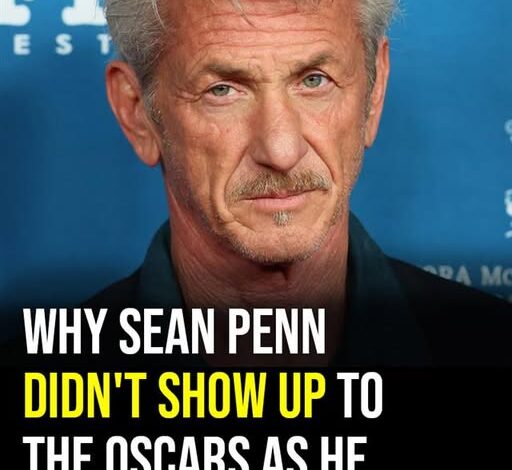
In the glittering ecosystem of Hollywood, the Academy Awards are traditionally viewed as the ultimate summit, the pinnacle of recognition where careers are codified and legacies enshrined. For most actors, the pursuit of the golden statuette is a lifelong quest, marked by meticulous campaigning, red-carpet choreography, and rehearsed speeches designed to charm the industry’s gatekeepers. Yet for Sean Penn, a man whose career has been as defined by raw talent as by an uncompromising, restless spirit, the Oscars have increasingly symbolized something far more hollow. When his name was announced for a historic third Best Actor win, the seat that should have been occupied by one of Hollywood’s most respected veterans remained conspicuously empty. Penn’s absence was no accident; it was a deliberate, silent manifesto against an institution he has long critiqued.
The tension between Penn and the Academy is decades in the making. While he has earned accolades for performances in films like Mystic River and Milk, his relationship with the Oscars has always been fraught with skepticism. Penn has publicly dismissed the ceremony as a televised spectacle, privileging spectacle over the often uncomfortable truths of cinematic artistry. He has criticized the Academy’s leadership as “cowardly” in the face of global crises and repeatedly questioned the value of an industry that spends millions celebrating itself while the world outside faces real suffering. To him, the Oscars have become a stage of appearances rather than substance, a place where fashion and commerce overshadow the gravity of human storytelling.
Choosing to skip the ceremony on the night of his third Best Actor win was therefore not merely an act of rebellion—it was the culmination of a long-held philosophy. In doing so, Penn turned a personal triumph into a public statement. While Hollywood clamored to celebrate him, he transformed the spotlight into a mirror reflecting the wider world: conflicts, humanitarian crises, and social upheaval that no red-carpet gown or scripted toast could meaningfully address.
This philosophy was most vividly illustrated by Penn’s handling of his past Oscars. Unlike most actors who enshrine their awards behind glass, he has treated them as instruments of purpose. During the height of the war in Ukraine, he threatened to melt down his statuettes if the Academy refused to give President Volodymyr Zelenskyy a platform during the broadcast. When the Academy declined, Penn took a bolder step: he traveled to Kyiv and handed one of his Best Actor trophies directly to Zelenskyy, framing the award as a symbol of solidarity and hope, with the possibility of its return after victory. In doing so, he stripped the Oscar of its traditional power, emphasizing that its true value lies not in personal glory but in service to causes greater than oneself.
Penn’s absence at the 98th Oscars extended this philosophy. By refusing to attend, he resisted allowing his performance to be swallowed by the machinery of publicity and spectacle. Instead, he let the work itself—his portrayal, his artistry, his message—speak unencumbered. The empty seat where he might have accepted the statuette became a visual argument, a quiet critique of an event that prioritizes ceremony over substance. In a room filled with carefully scripted interactions and the polished cadence of the industry elite, Penn’s deliberate absence resonated louder than any speech could have.
Critics have debated whether Penn’s stance is principled or contrarian, but the consistency of his actions suggests a man committed to integrity over accolade. The vacated chair was a powerful reminder of the real-world struggles he engages with daily: humanitarian missions, disaster relief, and documentary work that chronicles the human cost of political conflict. In a way, he reframed what it means to wield influence: not through applause or trophies, but through deliberate choices that amplify what truly matters.
The cultural impact of Penn’s decision cannot be overstated. It forces the entertainment industry—and audiences alike—to reconsider the meaning of recognition. Do we value stars for their participation in self-congratulatory rituals, or for the courage to challenge the very systems that elevate them? Penn has chosen the latter, embracing the paradox of being an Oscar-winning actor who rejects the spectacle of the ceremony. That duality, a combination of achievement and conscientious detachment, positions him as a singular figure in modern cinema.
As the night concluded and media coverage spread across global networks, the conversation focused not on the designer gowns or rehearsed speeches, but on the man who was absent. Penn had commandeered the narrative without uttering a word on stage, delivering his sharpest performance yet by simply walking away from the ceremony’s pretense.
Ultimately, Sean Penn’s third Oscar win will be remembered not for applause or accolades, but for the silence it left behind. It served as a reminder that true success lies not in the accumulation of trophies but in the freedom to reject them when they no longer align with one’s values. Penn has demonstrated that an actor can be at the pinnacle of Hollywood while refusing to participate in its rituals, proving that influence and artistry need not be measured by presence alone. The award may be metal, but the statement was unmistakably human: authenticity, conscience, and conviction matter far more than ceremony.