Why the Small Circular Dent on Everyday Milk Jugs Reveals Ingenious Engineering Hidden in Plain Sight Through Pressure Control Structural Strength Cost Efficiency Safety Environmental Benefits and Subtle Design Choices That Transform a Simple Container into a Carefully Engineered Object We Rarely Stop to Appreciate

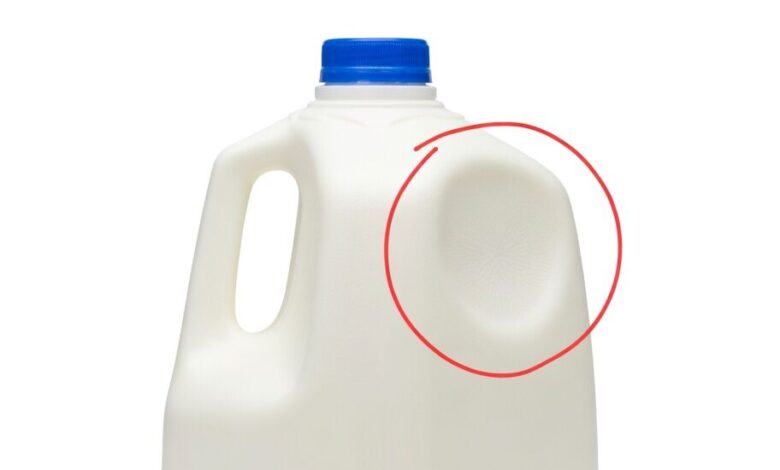
At first glance, the humble milk jug seems almost banal—a routine object picked up, poured from, and returned to the fridge without a second thought. Yet there is a small feature on its side—a circular dent—that quietly demonstrates a surprising level of engineering thoughtfulness. While easily overlooked, this indentation is far from accidental. It addresses multiple challenges simultaneously: pressure fluctuations, structural strength, cost efficiency, safety, and environmental considerations.
One of its main purposes is to manage internal pressure. Milk and other liquids expand and contract slightly as temperatures change, and without a flexible area to absorb these shifts, the jug could deform or even rupture. The dent acts as a small, adaptable zone that responds to pressure changes, protecting the integrity of the container during transportation, storage, and everyday handling.
The dent also enhances structural strength. Though it may seem counterintuitive, an inward curve distributes stress more evenly than a flat surface. This geometry helps the jug resist stacking pressures and accidental bumps, reducing the likelihood of collapse without requiring additional material. By relying on shape rather than thickness, manufacturers achieve durability efficiently, maximizing performance while minimizing cost and resource use.
Cost efficiency is another key factor. Even a slight reduction in material per jug leads to significant savings when scaled across millions of units. The dent allows the jug to remain strong while using less plastic, which not only reduces production expenses but also lessens environmental impact.
Safety is improved as well. Frequent handling—and the occasional drop—is inevitable in kitchens, and the dent allows the jug to deform under stress rather than crack, reducing spills and hazards. Its subtle curvature can even aid grip, giving users a more secure hold.
From an environmental perspective, the dent makes recycling and disposal easier. It allows the jug to be compressed more efficiently, taking up less space in recycling operations and making transport more effective. Combined with reduced plastic use in manufacturing, the design reflects a small but meaningful step toward sustainability.
In essence, the circular dent transforms the milk jug from a simple container into a multifunctional, thoughtfully engineered object. It manages pressure, enhances strength, lowers costs, increases safety, and supports environmental goals—all without drawing attention to itself. This unassuming feature exemplifies the hidden ingenuity behind everyday items: the smartest design solutions often work quietly, seamlessly integrated into objects that people rely on daily without ever noticing.