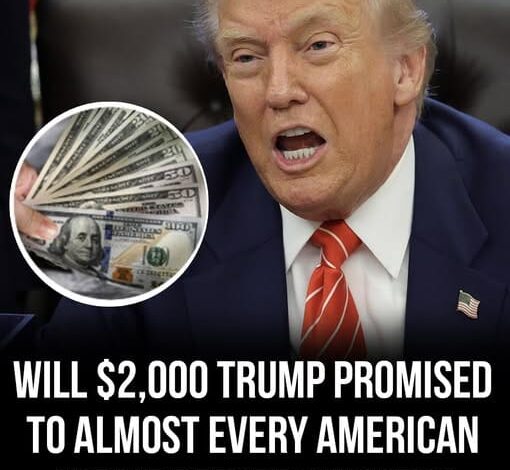
Talk about a possible $2,000 payment to Americans in 2026 is circulating again after comments from former President Donald Trump. The idea has sparked curiosity across social media and news outlets, with many people wondering whether it could become a real payout or if it’s simply political messaging ahead of upcoming elections.
Here’s what is actually known so far.
The idea of a $2,000 “tariff dividend”
The discussion began after Trump posted on Truth Social last year, arguing that tariffs imposed on foreign imports are generating huge amounts of revenue for the United States. According to his post, those funds could potentially be shared with American citizens.
In his message, Trump defended tariffs strongly and suggested that they are bringing in enormous sums of money for the government while encouraging domestic investment.
He also floated a proposal that quickly caught public attention: a “dividend” of at least $2,000 per person, excluding higher-income individuals, that would be distributed to Americans.
The concept resembles stimulus payments issued during the COVID-19 pandemic, but the proposed funding source would be tariff revenue rather than emergency economic relief.
Is there actually a stimulus check planned?
At this stage, no $2,000 payment has been approved.
Several key pieces that would be required for such a program are currently missing:
- Congress has not passed any legislation authorizing a payment.
- The IRS has not announced any program related to a tariff-based dividend.
- No official schedule or payment timeline exists.
Trump has suggested he would like to see payments distributed in 2026, potentially before the midterm elections. However, the proposal remains an idea rather than an implemented policy.
For comparison, the federal government issued three stimulus checks during the COVID-19 pandemic. The final opportunity to claim the third payment expired on April 15, 2025.
Because of that history, rumors about a fourth stimulus payment have spread widely online. Financial experts warn that websites claiming guaranteed checks may be inaccurate or attempting to lure people into scams.
Who might qualify if it ever happens?
Trump has indicated that the payments would be targeted toward moderate-income Americans, though no precise definition has been given.
Some analysts point to income ranges used by organizations like the Pew Research Center. In 2024, Pew estimated that middle-class households typically earn between about $55,820 and $167,460 per year, depending on national median income.
Meanwhile, U.S. Treasury Secretary Scott Bessent suggested during a November interview on Fox & Friends that the administration had discussed the idea of limiting the payments to families earning less than $100,000 annually.
Even that figure is not finalized. Eligibility rules—if the proposal ever becomes legislation—would still need to be determined.
If lawmakers modeled the program after previous stimulus checks, full payments could potentially apply to individuals earning up to $75,000 and couples earning up to $150,000, with benefits gradually reduced for higher incomes. But this remains speculation.
The potential role of the Supreme Court
Another major factor could be an upcoming decision from the U.S. Supreme Court.
The Court is expected to review issues related to the legality and structure of certain tariffs, including whether importers might qualify for refunds tied to them.
That ruling could influence whether a “tariff dividend” is even financially or legally possible. In other words, the feasibility of any payout may depend more on legal decisions and economic policy than on political promises.
Meanwhile, many Americans are waiting on tax refunds
While speculation about 2026 payments continues, many taxpayers are currently focused on their 2025 federal tax refunds.
For those who filed electronically and chose direct deposit, refunds generally arrive within about 21 days after the IRS accepts the return. Paper filings or mailed checks can take six to eight weeks.
It’s important to remember that filing a tax return doesn’t mean the IRS has accepted it yet. Once it is accepted, taxpayers can track their refund using the IRS tool “Where’s My Refund?”
The system typically updates once per day and requires three pieces of information:
- Social Security number
- Filing status
- Exact refund amount
Status updates will appear as one of the following:
- Return Received – the IRS is processing the return
- Refund Approved – payment is being prepared
- Refund Sent – the refund has been issued
Taxpayers can also check their status by calling the IRS at 800-829-1954.
So, will Americans receive $2,000 in 2026?
At the moment, the answer remains straightforward.
- No $2,000 tariff dividend has been approved.
- No fourth stimulus check has been authorized.
- No payment date has been announced.
Trump has expressed support for the idea, but Congress has not enacted it, the Supreme Court has not yet weighed in on key tariff questions, and the IRS has not issued any official guidance.
Until those steps occur, claims that Americans will automatically receive $2,000 should be viewed cautiously.
That said, with a Supreme Court decision pending and the 2026 midterm elections approaching, the debate over tariff-funded payments could continue to attract attention in the months ahead.