Woman, 26, with excessive itching diagnosed herself with cancer after being dismissed by doctors

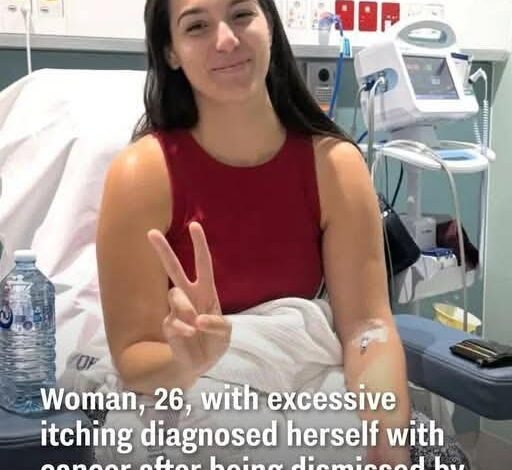
…her from the inside out.
As the months passed, what had once been mild discomfort turned into something far more alarming. The itching didn’t fade—it intensified, spreading across her body in relentless waves that no cream, medication, or advice could soothe. Then came the exhaustion, not the kind that sleep could fix, but a heavy, persistent fatigue that settled deep into her bones. Her body temperature became unpredictable, shifting between chills and night sweats that left her drenched and disoriented. Soon after, a deep, rattling cough emerged, lingering long past what any minor illness should have allowed.
Each new symptom layered itself onto the last, creating a pattern that felt impossible to ignore—yet somehow, it continued to be dismissed.
Doctors offered reassurance instead of answers. Stress, allergies, minor infections—explanations came easily, but none of them matched what she was experiencing. With every appointment that ended without clarity, Sumbul felt her frustration grow into something sharper: a sense of being unheard, of being reduced to a checklist rather than seen as a person in distress.
Eventually, exhausted and running out of options, she turned to the one place that always listens—the internet.
Night after night, she searched.
She read medical articles, scrolled through forums, and pieced together fragments of other people’s experiences. Strangers described symptoms that mirrored her own: the unbearable itching, the unexplained fatigue, the night sweats that disrupted sleep. Slowly, a pattern began to form. And with it came a realization that was both clarifying and terrifying.
This wasn’t something minor.
This could be serious.
The thought lingered in the back of her mind, growing louder with each passing day. She wasn’t just uncomfortable—she might be fighting something far more dangerous.
The moment everything changed came unexpectedly.
One day, she noticed a lump in her neck.
Unlike the other symptoms, this was undeniable—something visible, something tangible. It was no longer something that could be explained away or minimized. This physical sign forced a shift in how her concerns were treated. For the first time, the urgency she had been feeling was reflected back at her.
Tests followed.
Scans, blood work, examinations—finally, the process she had been asking for all along began to unfold. The results confirmed what her body had been trying to communicate for months.
Her lymph nodes were enlarged and abnormal.
In March 2026, she received the diagnosis: Stage 2–3 Hodgkin lymphoma.
The word itself carried weight—fear, uncertainty, and the undeniable reality of a serious illness. And yet, for Sumbul, it also brought something unexpected.
Relief.
After months of confusion, doubt, and dismissal, she finally had an answer. Her suffering had a name. It wasn’t imagined. It wasn’t exaggerated. It was real—and now, it could be treated.
“I didn’t care if it was cancer,” she later said. “I just wanted the itching to stop. I just wanted one full night of sleep.”
But that relief didn’t exist on its own.
It was accompanied by anger—deep, justified anger at the system that had failed her. She had trusted her instincts from the beginning, sensed that something was wrong, and still, she had been made to wait. Made to doubt herself. Made to endure months of worsening symptoms while being told everything was fine.
The diagnosis confirmed what she already knew: her body had been telling the truth all along.
Hodgkin lymphoma, while serious, is one of the more treatable forms of cancer, especially when identified and managed properly. Once treatment began, the change was almost immediate.
Chemotherapy brought its own challenges, but it also brought relief.
The relentless itching—the symptom that had dominated her life—began to disappear. The night sweats eased. The crushing fatigue slowly lifted. And perhaps most meaningful of all, she was able to sleep again.
“I can’t believe I’m saying this,” she shared, “but I sleep every night like a baby.”
Something so simple—something most people take for granted—had become a source of deep gratitude.
Each morning she woke up rested, it felt like reclaiming a piece of herself that had been lost for far too long.
Her journey is more than a story about illness. It is a powerful reminder about listening—to your body, to your instincts, and to that quiet voice that tells you when something isn’t right.
Sumbul now speaks openly about her experience, urging others not to ignore their own signals. She emphasizes that medical expertise is important—but so is personal awareness. No one lives in your body the way you do.
If something feels wrong, persist.
Ask questions.
Seek second opinions.
Refuse to be dismissed.
Because sometimes, the difference between uncertainty and answers lies in the willingness to keep pushing forward.
Her story carries a message that is both urgent and empowering: your voice matters, especially when it comes to your own health. And sometimes, the most important step toward healing is believing yourself—even when others don’t.
In the end, Sumbul wasn’t just fighting a disease.
She was fighting to be heard.
And that fight made all the difference.