It starts with a quiet realization, one that changes the entire way you look at cleaning: you’re no longer dealing with simple dirt or everyday mess. What you’re really up against is history—the slow accumulation of everything that’s ever been used on the surface. Every bottle that promised shine, every “protective layer,” every deep-clean solution that claimed to restore has, in its own way, left something behind. Not enough to notice in a single use, but over time those invisible traces settle in, layer upon layer, until the floor is no longer just itself. It’s covered in memory—of products, of attempts, of effort.
That’s why the surface can start to feel dull even when it looks clean. There’s a quiet heaviness to it, a kind of resistance. Light doesn’t quite sit right on it anymore. The texture isn’t what it used to be. It’s not dirt that’s causing that—it’s buildup. A thin film that softens edges, blurs clarity, and slowly separates the material from what it was meant to feel like.
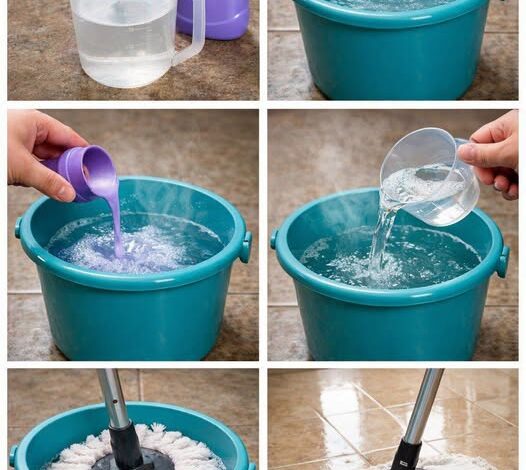
So when you switch to something as simple as hot water and plain white vinegar, you’re not just changing products—you’re changing direction. You’re no longer adding, enhancing, or covering. You’re removing. The warmth of the water helps open everything up, and the mild acidity of the vinegar begins to work through what’s been left behind. It gently breaks apart detergent residue, loosens the grip of waxy coatings, and dissolves the faint haze that hard water leaves over time.
It doesn’t happen all at once. There’s no instant transformation, no dramatic before-and-after moment. Instead, it’s gradual—almost unnoticeable at first. But with each pass of the mop, something shifts. The surface starts letting go. What once felt slightly tacky begins to feel lighter. What once looked a bit cloudy starts to clear. It’s as if the floor is exhaling after holding onto too much for too long.
There’s something grounding about that process. It’s not about forcing a result or chasing a certain look. It’s about undoing—about giving the surface space to return to its natural state. And in that simplicity, there’s a kind of precision that heavy products never quite achieve.
Then comes the smallest addition, almost counterintuitive after all that stripping back: a single capful of fabric softener in the bucket. Not enough to coat, not enough to build anything new—just enough to change the experience. It doesn’t sit on the surface in any obvious way. Instead, it works in motion.
The moment the mop touches the floor again, you can feel it. The drag disappears. The slight resistance you didn’t even realize was there is gone. The mop glides smoothly, evenly, almost effortlessly, following the grain and flow of the surface instead of pushing against it. It turns the act of cleaning into something fluid, controlled, and surprisingly quiet.
As the floor dries, the effect settles in more clearly. There’s no stickiness left behind, no overly slick finish that feels artificial or unsafe. Instead, the surface becomes balanced—soft underfoot, smooth without being slippery, clean without feeling stripped bare. It’s a subtle kind of comfort, one that doesn’t call attention to itself but is immediately noticeable the moment you walk across it.
Visually, the change is just as restrained. There’s no exaggerated gloss, no harsh reflection that looks manufactured. The floor doesn’t try to shine—it simply reflects light in a natural, understated way. Soft highlights appear where they should, and the true tone of the material comes through without distortion.
The room itself begins to feel different because of it. Not brighter in a forced, artificial sense, but clearer. More open. There’s a calmness that settles in when surfaces aren’t fighting to look polished. Nothing feels overdone. Nothing feels coated or masked.
It’s the difference between something that’s been treated and something that’s been cared for. Between a surface that’s been layered with intention and one that’s been allowed to return to its original state. There’s an honesty to it—a quiet authenticity that doesn’t need to impress.
In the end, the goal isn’t to create a perfect shine or a dramatic finish. It’s to remove everything unnecessary until what’s left is real. Clean not as an appearance, but as a condition. A surface that feels like itself again—unburdened, balanced, and quietly restored.