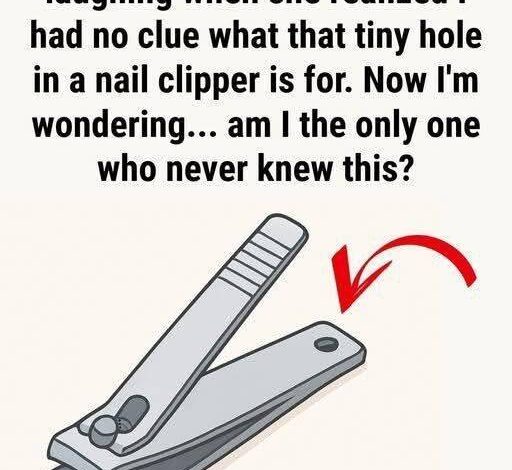
The evolution of the ordinary nail clipper is a striking example of enduring functional design, yet its most important feature is often overlooked entirely. Pick up a standard pair today, and your thumb will likely graze a small, circular hole at the end of the lever or along the frame. In our era of disposable convenience, that hole seems almost ornamental—a relic of a time when every detail had a purpose. Yet, for those who lived before mass consumerism and ever-present storage, that tiny aperture was far more than decoration: it was a practical lifeline, ensuring that an essential tool stayed within reach in a world where belongings could easily vanish.
To grasp the significance of that hole, we must step back to a time when personal grooming tools were not disposable items to be tossed in a drawer. In the late 19th and early 20th centuries, hygiene and grooming were matters of portability and necessity. Indoor plumbing was a luxury for the urban elite, and most people performed their daily routines at communal washstands, shared boarding-house facilities, or even outdoors. In such circumstances, the real threat to daily grooming wasn’t tool wear—it was misplacement.
Small, metallic objects were notoriously easy to lose. Clippers could slip from a coat pocket, be left on a crowded basin, or fall into the dark corners of a travel trunk. For someone of that era, losing a sturdy pair of steel clippers was no minor inconvenience; it meant losing a piece of personal independence. Designers recognized a simple truth: a tool that can be anchored is a tool that will stay with you.
The addition of that small hole transformed the nail clipper from a loose, easily misplaced item into a dependable companion. It allowed users to tether the device to a variety of supports. Men often looped clippers onto watch chains, dangling them alongside pocket watches or signet rings. Travelers threaded leather cords or twine through the hole, securing the clippers to vanity kits or doctor’s bags. In homes, the hole made it possible to hang clippers from a designated hook near a mirror or washbasin, keeping them safe from accidental loss.
This design was an early instance of what we might call “functional permanence.” By offering a way to secure the clipper, designers encouraged its integration into daily ritual. It was no longer a trinket; it became essential equipment. This subtle transformation is a key reason the nail clipper has remained almost unchanged for more than a century. The hole worked quietly yet effectively, surviving eras of Art Deco, Mid-Century Modernism, and the digital age, and removing it would have compromised both utility and tradition.
As households modernized and dedicated bathrooms became common, the role of the hole shifted but its usefulness persisted. It became a convenient way to attach clippers to keychains, allowing people to carry them alongside the keys to cars, homes, or offices—a precursor to today’s “Every Day Carry” culture.
There’s also an understated technical brilliance in the hole’s placement. Often located at the fulcrum or lever end, it avoids interfering with the blades or spring tension. By removing a small circle of metal, manufacturers added a practical safeguard. It was a promise that this modest tool was meant to stay with its owner through travel, moves, and the passing fashions of the world.
In today’s age of planned obsolescence, where many products are designed to fail within years, the nail clipper is a remarkable outlier. It excels at one simple task with precision and reliability. That tiny hole is a quiet relic of an era when we valued the longevity of possessions over constant upgrading.
Looking at that single, almost invisible circle, we see the foresight of 19th-century engineers who understood that personal dignity is tied to the ability to maintain oneself, and that self-maintenance requires tools that are present and dependable. The hole ensured that the clipper survived the transition from washstand to modern bathroom, outlasting countless other grooming devices that were too fragile or cumbersome to endure.
Ultimately, the hole is a testament to the power of simplicity. No battery, software update, or complex mechanism was required—only a bit of practical thinking and an understanding of human habits. It kept a small, sharp piece of steel from being lost, and in doing so, it preserved the tool’s relevance across generations. That tiny circle didn’t just prevent the clipper from disappearing—it kept it from becoming obsolete, securing its place as a quiet constant in lives spanning more than a century.