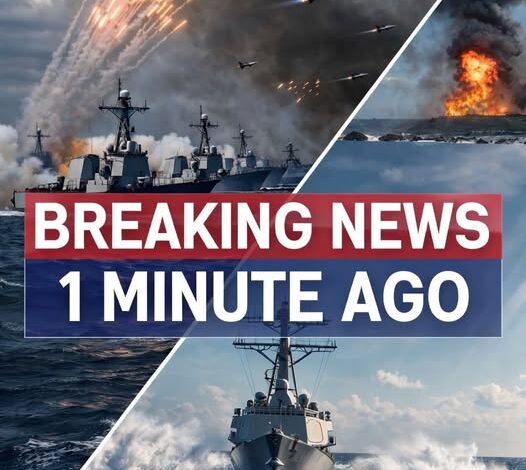
The Red Sea has long served as one of the world’s most critical maritime corridors, a narrow but indispensable route through which vast amounts of global trade and energy resources flow each year. Recently, however, this strategic waterway has become the stage for a new and dangerous phase of modern naval confrontation. A striking clash between United States naval forces and Yemen’s Houthi movement has drawn global attention, highlighting the rising intensity of security tensions in the Middle East. At the center of this escalation was a remarkable tactical episode: the launch of 36 missiles at a single U.S. destroyer within just 22 minutes. More than a routine exchange of fire, the incident reflects a direct challenge to established maritime security and demonstrates how asymmetric warfare is reshaping naval conflict.
Military analysts identify this type of operation as a saturation attack. In naval combat doctrine, the objective of such an attack is not simply to destroy a target outright but to overwhelm its defensive capacity. Even the most advanced warships possess limits—radar systems can track only a certain number of threats simultaneously, and missile interceptors can only engage so many targets at once. By launching dozens of projectiles in rapid succession, attackers attempt to push those systems beyond their operational limits. The strategy behind the 36-missile barrage was to create a momentary gap in the destroyer’s defensive shield, allowing at least one missile to penetrate. During those 22 minutes, the crew of the American destroyer faced an intense and sustained wave of incoming threats that pushed their layered defense network to its operational edge.
The defenses protecting modern U.S. warships represent some of the most sophisticated technology ever deployed at sea. Systems such as the Aegis Combat System integrate advanced radar arrays, automated command software, and interceptor missiles like the SM-2 and SM-6. When confronted with a saturation attack, Aegis must instantly evaluate every incoming projectile, ranking threats based on their trajectory, speed, and proximity. At the same time, sailors aboard the vessel operate under extreme pressure as multiple targets appear on radar screens within seconds of each other. According to reports, the destroyer activated both missile interceptors and electronic countermeasures almost immediately, forming a layered defensive barrier over the Red Sea. That the ship managed to survive the coordinated assault without catastrophic damage demonstrates the strength of modern U.S. naval systems, yet it also reveals the growing sophistication and confidence of Houthi forces.
The significance of those 22 minutes goes well beyond the immediate tactical outcome. The speed at which events unfolded—from missile launch detection to defensive engagement and eventual retaliatory strikes—illustrates a broader transformation in modern conflict. In today’s environment, escalation can occur within minutes rather than hours or days. As defensive intercepts took place, U.S. and allied forces reportedly moved quickly to strike the launch sites and command centers responsible for the attack. This rapid “detect-to-engage” cycle is characteristic of modern military operations, but it also introduces serious risks. In a volatile region like the Middle East, such compressed timelines leave almost no opportunity for diplomatic intervention once hostilities begin.
The importance of the Red Sea to the global economy further amplifies the stakes of these confrontations. Approximately 12 percent of global trade moves through the Bab el-Mandeb Strait, making it one of the world’s most vital shipping chokepoints. When instability threatens this passage, commercial shipping companies must choose between navigating dangerous waters or rerouting vessels thousands of miles around Africa’s Cape of Good Hope. Such diversions dramatically increase travel time and fuel costs, ultimately raising prices for goods around the world. By targeting a U.S. naval vessel in this region, the Houthis are not only confronting a military adversary—they are also exerting pressure on the global supply chain itself. In effect, attacks in the Red Sea can function as a form of maritime leverage, extending influence far beyond Yemen’s immediate borders.
The episode also sheds light on evolving regional dynamics. Coordinating a missile strike of this scale requires logistical organization, targeting intelligence, and technical capability that often extends beyond the resources of a single non-state actor. Many analysts believe that such operations may reflect broader geopolitical involvement from regional supporters who provide technology, intelligence, or training. In this sense, the Red Sea increasingly resembles a proxy battleground where wider strategic rivalries are played out through local forces. For the United States and its partners, maintaining naval presence in the area serves multiple purposes: protecting shipping routes, supporting regional allies, and upholding the long-standing principle of freedom of navigation that underpins global maritime law.
The 22-minute confrontation also highlights how fragile the margin for error can be in modern warfare. When dozens of missiles are in flight simultaneously, even a minor technical malfunction or a delayed defensive response could lead to a successful strike on a U.S. vessel. Such an outcome would likely trigger a major military retaliation across the region. This dynamic creates what strategists call a “tripwire” scenario, where a single incident could rapidly escalate into a much broader conflict. The Red Sea encounter demonstrates that regional stability now depends heavily on instantaneous decision-making by military operators and commanders.
Looking ahead, the Red Sea may remain a contested maritime space for years to come. Traditional naval deterrence—once based on the overwhelming presence of large fleets—is increasingly challenged by the emergence of inexpensive drones and missile systems capable of mass attacks. The economic imbalance is striking: it is often far cheaper to produce and launch drones or missiles than it is to intercept them with sophisticated defensive weapons. This asymmetry presents a growing challenge for Western navies, prompting accelerated development of new defensive technologies such as directed-energy weapons, laser systems, and lower-cost point-defense interceptors.
Ultimately, the confrontation in the Red Sea illustrates a broader truth about the modern world. Despite advances in technology and diplomacy, the oceans remain both the backbone of global commerce and one of its most vulnerable points. The volley of 36 missiles fired within 22 minutes did more than threaten a single warship—it exposed the delicate balance that sustains international trade and regional security. As long as tensions continue in this strategically vital region, global stability will remain closely tied to the rapid decisions made by sailors, commanders, and political leaders navigating the uncertain waters of modern conflict.