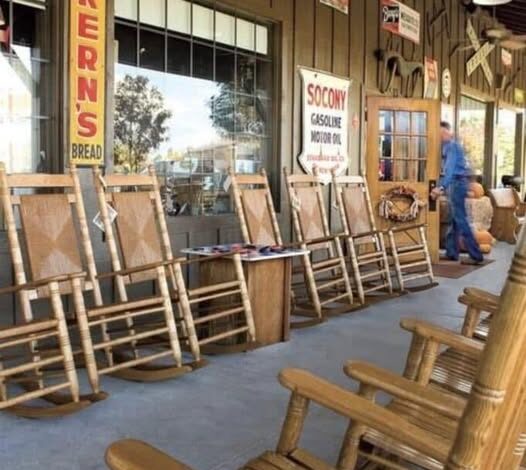
You don’t simply walk into that dining room—you step into something designed to feel older than it is, softer than it ever was, and somehow familiar even if you’ve never been there before. The space doesn’t announce itself as artificial; it invites you to fill in the gaps. The worn wood, the gentle creak under your feet, the glass jars lined neatly by the counter—they all suggest a past without ever fully defining it.
That’s where the illusion does its work.
Nothing feels overtly staged, yet everything has been deliberately chosen. The faded signs, the mismatched chairs, the carefully aged textures—they create the impression of something “discovered” rather than assembled. It asks very little of you, only that you bring your own memories along. A grandparent’s kitchen. A roadside stop from childhood. A version of small-town life that may never have existed exactly as you remember it—but feels true anyway.
What gives it power isn’t historical accuracy—it’s emotional plausibility.
It offers a version of the past that is clean, warm, and accessible. A kind of portable nostalgia that follows you wherever you are, promising comfort and familiarity in the middle of motion. You don’t have to question it. You just step in, sit down, and let it wrap around you.
But that simplicity comes with quiet selectivity.
Because while the setting feels universal, it isn’t neutral. It reflects a curated memory—one that smooths over complexity in favor of ease. The harder edges of history, the parts that don’t fit neatly into a comforting narrative, are absent. What remains is a distilled version of the past, shaped to be inviting, uncomplicated, and widely recognizable.
And that’s the subtle trade-off.
You leave feeling full—not just from the meal, but from the experience. There’s a sense of having touched something real, something rooted. But what you’ve actually stepped into is a story—one carefully constructed to feel like it belongs to everyone who walks through the door.
It doesn’t recreate the past.
It recreates the feeling of remembering it.