When my son sl:apped me for interrupting his video game, I just lowered my head and walked to the kitchen. I spent three hours baking his favorite triple-chocolate cake

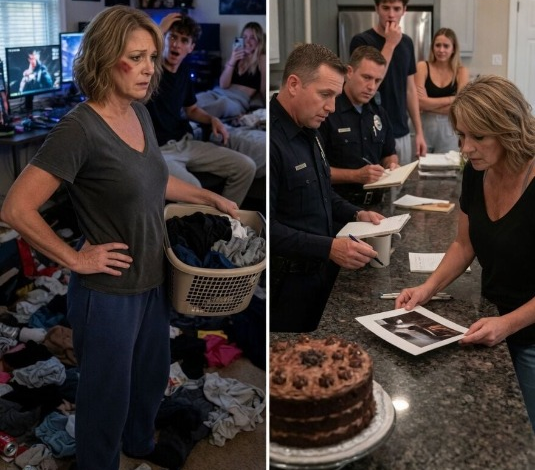
I did not cry while the officers watched the footage.
By then, I had already cried enough in places where no one could see me.
I had cried in the laundry room with the dryer running so he would not hear. I had cried in the bathroom with my hand pressed over my mouth. I had cried in my car after grocery trips, gripping the steering wheel and wondering how the child I had carried, raised, protected, defended, and forgiven had learned to look at me with such contempt.
So when the officers stood in my living room and watched the recording, I simply sat still.
On the screen, my son was screaming that I was “ruining his life.”
His face was red.
His voice was sharp.
His hands moved wildly through the air like the whole house belonged to him and I was only standing in the way.
Listening to him felt like watching a stranger unravel inside the body of someone I loved.
That may have been the worst part.
Not the volume.
Not the insult.
Not even the slap.
It was the recognition that the boy I remembered — the child who once reached for my hand crossing the street, who climbed into my bed after nightmares, who called me Mommy in a sleepy voice — had become someone who believed love meant unlimited access to forgiveness.
Someone who mistook my patience for weakness.
Someone who mistook my sacrifices for obligation.
Someone who had learned to treat my heart like something he could damage and still expect to find waiting for him.
The slap was only the final, visible sin.
There had been a long ledger before it.
Invisible offenses.
Small humiliations.
Cruel comments disguised as frustration.
Doors slammed hard enough to shake picture frames.
Money taken without permission.
Apologies given only when consequences appeared.
Promises broken so often they became background noise.
For years, I kept explaining him away.
He was stressed.
He was young.
He was struggling.
He needed guidance.
He needed time.
He needed his mother.
And maybe some of that was true.
But truth can become a trap when it is used to excuse harm forever.
At some point, pain stops being a phase and becomes a pattern.
I had protected him from that word for too long.
Pattern.
The officers watched quietly. One of them paused the footage after the slap. The room went still in a way that felt almost sacred. No one rushed to fill the silence. No one asked me why I had not stopped it sooner. No one told me that mothers should endure anything.
One officer looked at me gently and asked, “Do you want to press charges?”
For years, I think I had been waiting for someone to ask me a question that placed my safety inside the answer.
Not his future.
Not his feelings.
Not what people would think.
Not whether I was being too harsh.
My safety.
I looked down at my hands.
They were steady.
“Yes,” I said.
That one word felt heavier than any speech I could have given.
When they led him outside, he shouted again. Not apologies. Not fear. Not even confusion. Anger. Accusation. Betrayal, as though I had committed the crime by refusing to hide his.
“You’re really doing this?” he yelled.
I did not answer.
Some doors close more cleanly without final words.
When the patrol car pulled away, the silence that settled over the house felt unfamiliar.
It was not peaceful exactly.
Not yet.
It was too new for that. Too sharp around the edges. It sounded like shock at first, like the house itself was waiting for the next impact. No footsteps pounding down the hallway. No controller thrown against the wall. No voice demanding dinner, money, attention, absolution.
Just quiet.
The kind of quiet that does not ask permission.
I stood in the living room for a long time after they left. The lamp was still on. A glass of water sat on the coffee table. His gaming chair faced the television like a throne abandoned by someone who had mistaken comfort for ownership.
The next morning, I donated it.
I did not make an announcement. I did not post anything online. I did not call relatives and explain myself in trembling detail. I simply dragged that chair to the front porch and let someone else take it away.
Then I boxed his clothes.
Folded shirts.
Old hoodies.
Sneakers by the door.
A jacket I bought him last winter after he complained the old one embarrassed him.
Each item carried a memory, and each memory tried to negotiate.
He wore this on his birthday.
He loved this sweatshirt once.
He was still my baby then.
But grief is not always a reason to reverse a boundary.
Sometimes grief is proof the boundary was overdue.
I packed everything carefully. Not cruelly. Not dramatically. Carefully. Because love had not disappeared from me. It had simply stopped volunteering to be abused.
Then I changed the locks.
The sound of the new key turning for the first time nearly made my knees give out.
Not because I hated him.
Because I finally believed I was allowed to protect myself from him.
There were no dramatic speeches after that.
No late-night guilty phone calls.
No bargaining through relatives.
No carefully worded messages asking whether I had calmed down yet.
No performance of forgiveness offered for the comfort of people who had not lived inside my house.
Just boundaries.
Finally enforced.
For the first few weeks, the quiet frightened me. I had become so used to tension that peace felt unnatural. I kept listening for sounds that were no longer there. My body still flinched at sudden noises. I still checked the hallway before sleeping. I still woke up expecting conflict.
That is what living in emotional danger does.
It teaches the nervous system to mistake calm for the pause before impact.
But slowly, the house began to remember itself.
Sunlight came through the kitchen windows without revealing damage. The laundry room smelled like detergent instead of panic. The living room no longer felt like territory I had to share with someone waiting to punish me for existing incorrectly.
I cleaned differently.
Not because someone was coming over.
Not because I needed to avoid criticism.
Not because disorder might trigger rage.
I cleaned because the space was mine.
Three months later, the bruises had faded.
The lesson had not.
I had spent so many years believing motherhood meant endurance without limit. That a good mother absorbed the blows, softened the consequences, translated cruelty into pain, and kept the door open no matter what came through it.
But motherhood is not a contract to be abused.
Love is not a lifetime permission slip for violence.
A child can be loved deeply and still be held accountable. A son can be wounded and still be dangerous. A mother can grieve and still choose herself.
Those truths took me too long to learn.
But I learned them.
Now Sundays belong to me.
I wake without dread. I open the windows if the weather is kind. I play music softly while the kettle warms. I bake one small cake because I like the way vanilla fills the kitchen and because I spent too many years making food only around someone else’s demands.
Then I brew one perfect cup of coffee.
Not rushed.
Not reheated three times.
Not abandoned on the counter because a crisis needed managing.
I sit at my own table.
The chair across from me remains empty, and sometimes that emptiness still hurts. I would be lying if I said it did not. There are mornings when memory arrives uninvited, carrying his childhood face, his small hand in mine, the version of him I keep searching for beneath everything he became.
But I no longer confuse pain with obligation.
I can miss him and still keep the door locked.
I can love him and still refuse to be harmed.
I can be his mother without being his victim.
The house is quiet now.
Not lonely in the way I once feared.
Quiet like breath returning.
Quiet like a wound closing.
Quiet like a woman finally learning that peace does not have to apologize for taking up space.
On Sundays, I sit at my table with cake, coffee, and the morning light.
And for the first time in years, I am unafraid.