At first, it looked almost beautiful.
That was what made it so unsettling later.
If it had appeared obviously dangerous from the beginning, there would have been no hesitation. Instinct would have taken over. A reaction would have formed immediately—alarm, distance, action. But instead, what we found on the wall resisted interpretation. It didn’t announce itself. It didn’t demand attention. It simply existed there, as though it had every right to be part of the room.
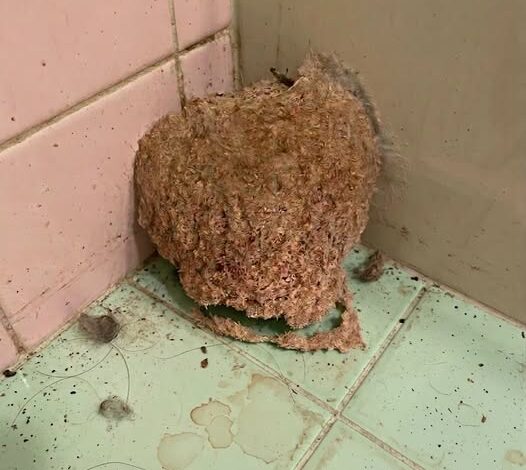
From across the space, it resembled something almost artistic.
Not in a human way.
Not in a crafted way.
But in the way nature sometimes produces shapes that feel designed without ever being designed at all. Layered curves extended outward in overlapping formations, each one slightly irregular yet somehow balanced against the others. The surface carried muted tones—gray softened into brown, brown fading into pale beige—like something aged slowly over time rather than placed all at once.
For a moment, nobody moved closer.
Nobody wanted to be the first to change perspective.
Because distance allowed ambiguity.
And ambiguity, while uncomfortable, was still safer than certainty.
The silence in the room became heavier than expected.
Not empty silence—but attentive silence. The kind that forms when multiple people are trying to interpret the same unknown object without yet admitting they are confused.
Something had made this.
That was the only shared assumption.
The question was what.
As we continued to look at it, the structure seemed to shift—not physically, but perceptually. Details emerged that hadn’t been obvious at first glance. Tiny repeating segments along the edges. Subtle compartments forming an almost geometric consistency. It no longer felt like decoration or accidental formation.
It felt intentional.
And that was the first moment unease entered the room.
Because intention implies presence.
And presence implies proximity.
Homes are built on the assumption of predictability. Even when messy or imperfect, they are supposed to be readable environments. You learn their sounds, their textures, their flaws. You understand what belongs and what doesn’t.
This did not belong.
And once that thought formed, it could not be unformed.
Someone suggested mold.
Another person shook their head too quickly, as if rejecting the idea would make it less real.
A different voice proposed water damage hidden inside the wall.
Someone else, more quietly, said they didn’t think it was coming from inside the wall at all.
That suggestion made the air feel tighter.
Because it implied movement.
Growth.
Life.
And once that possibility entered the conversation, everything changed.
Theories multiplied, each one worse than the last. Mold. Nesting material. Structural decay. Some unfamiliar biological growth none of us had words for. The brain, confronted with incomplete information, does what it always does—it begins constructing narratives to fill the gaps. Rarely comforting ones.
Fear doesn’t require certainty.
It only requires possibility.
Eventually, phones appeared almost simultaneously, as though we had silently agreed on the next step without speaking it aloud.
The glow of screens replaced the dim room light.
Search bars filled with fragments of panic disguised as questions.
“weird papery structure on wall”
“brown layered growth indoors”
“honeycomb texture inside house ceiling”
“strange nest-like formation bathroom”
Each query returned something different, but nothing definitive. Images almost matched but never fully matched. Explanations overlapped but never aligned. Every answer felt like it was pointing near the truth without ever landing on it.
And that is its own kind of psychological pressure—the feeling that the answer exists just beyond recognition.
The object remained still.
But stillness stopped reassuring us.
At some point, someone mentioned a sound.
That changed everything.
Because once attention shifted, memory reassembled itself.
Yes—there had been noise.
Faint, intermittent. Not constant enough to notice consciously. Not loud enough to demand acknowledgment. A low vibration that seemed to exist more in absence than presence, like something heard only when the rest of the house went quiet.
At the time, we dismissed it.
Old houses make sounds. Pipes settle. Air moves through vents. Foundations shift slightly with temperature. These explanations exist precisely to prevent people from investigating every small anomaly.
But now those explanations no longer felt sufficient.
The buzzing, once background noise, had become evidence.
And evidence transforms perception.
Suddenly, unrelated details resurfaced.
Small debris near the baseboard. Thin fragments that had been swept aside without thought. Dust that seemed ordinary at the time but now felt suspiciously structured. Even minor inconsistencies in the wall surface began to stand out.
The mind, once alerted, stops distinguishing between relevant and irrelevant details.
Everything becomes connected.
Whether it should be or not.
Then came the moment of recognition.
Someone—no one remembers who first said it—found a similar image online.
Not identical.
But close enough to collapse uncertainty.
A single word appeared beneath it.
Hornets.
And with that, the room changed shape.
Understanding arrived instantly and completely, the way it sometimes does—not gradually, not gently, but all at once. The structure was no longer mysterious. It was no longer abstract. It had identity.
And identity removes ambiguity.
But it replaces it with something sharper.
The papery layers made sense now.
The repetition.
The geometry.
The texture.
The buzzing.
All of it recontextualized in seconds.
Yet clarity did not bring relief.
It brought direction.
And direction, in this case, meant distance.
We stepped back without discussing it.
Slowly.
Carefully.
Not out of panic exactly, but out of recognition that proximity was no longer neutral. The room itself had changed meaning. The wall was no longer just part of the house. It was a boundary line between safety and something we did not want to disturb.
Someone closed the door.
Not slammed it.
Not locked it.
Just closed it, as though politeness might still matter in the presence of something that clearly didn’t care.
Then came the call.
Professionals.
Even dialing the number felt like a transition—from assumption to acknowledgment. From curiosity to responsibility.
There is a particular humility in that moment. The realization that understanding has limits, and beyond those limits, expertise becomes not optional but necessary.
When they arrived, their reaction told us everything we needed to know.
No surprise.
No confusion.
Only recognition.
That calm acknowledgment was more unsettling than any fear we had felt earlier, because it confirmed that what we had discovered was not unusual to them. It belonged to a category of problems that had already been categorized, studied, and solved many times before.
To us, it had been unknown.
To them, it was procedure.
They worked with deliberate precision. Equipment prepared in advance. Movements controlled and practiced. Every step communicated experience, not improvisation.
Watching them was its own lesson.
Not everything that looks chaotic requires emotional response.
Some things require process.
The nest came down in stages.
Carefully.
Methodically.
Without drama.
And yet the absence it left behind felt larger than expected.
Because removal doesn’t immediately restore normality.
It only removes the source.
The feeling lingers.
Even after the wall is empty again, attention keeps returning to it. Expecting movement. Expecting sound. Expecting confirmation that the threat was truly real and truly gone.
The nervous system is not convinced by logic.
It is convinced by repetition over time.
Days later, the house felt quieter in a way that was almost unfamiliar.
Not peaceful at first.
Just different.
We still paused near that room without realizing it.
Still listened for a sound that no longer existed.
Still checked corners out of habit rather than necessity.
Fear, once introduced, does not leave cleanly. It fades unevenly, in fragments, long after the cause is gone.
Eventually, gratitude replaced tension.
Not dramatic gratitude.
Quiet gratitude.
That it had been noticed early.
That no one touched it out of curiosity.
That no child or visitor had discovered it first.
That instinct had leaned toward caution instead of interference.
Because when you look back at it honestly, the outcome could have been very different.
A simple mistake of curiosity.
A misjudged attempt to “handle it quickly.”
A broom.
A spray.
A sudden reaction from something that was never passive to begin with.
Small decisions can divide outcomes sharply.
And this was one of those moments.
What stayed with us most was not the image of the nest itself, but the realization that danger does not always announce itself as danger.
Sometimes it begins as something almost beautiful.
Something easy to ignore.
Something easy to misinterpret.
And that is why the memory persisted long after the wall was empty again.
Not because of what it was.
But because of how long it took us to understand what it wasn’t.
And perhaps the real lesson was simple.
Not every mystery is meant to be solved immediately.
Not every unknown object is meant to be approached.
Sometimes intelligence is not about investigation at all.
It is about restraint.
About recognizing the difference between curiosity and risk.
Between observation and interference.
Between knowing something…
and needing to touch it.
And in the end, the smartest thing we did that day was not discovering what it was.
It was what we chose to do after.
Step back.
Close the door.
And let someone more experienced deal with what we had finally learned to see clearly.