The wedding day seemed perfect from the very beginning.
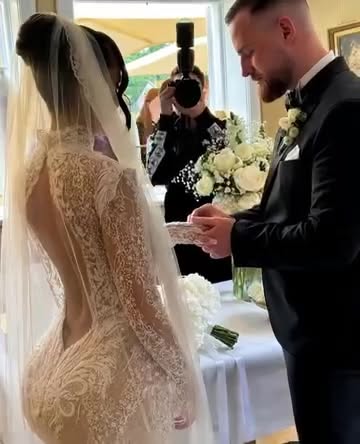
After months of planning, stress, decisions, and anticipation, everything had finally come together. The venue looked exactly the way the couple had imagined it. White roses lined the aisle in soft, elegant arrangements. Candles flickered gently near the altar. The chairs were filled with friends and relatives dressed in their finest clothes, smiling as they waited for the ceremony to begin.
Soft music drifted through the room.
Guests leaned toward one another, whispering about how beautiful everything looked. Some spoke about how quickly the years had passed. Others talked about how happy the couple seemed and how meaningful it was to witness the beginning of their married life.
To everyone watching, it felt like the kind of day people remember forever.
The bride looked radiant.
The groom appeared calm, proud, and happy.
There was nothing in the air to suggest that anything was wrong. No visible tension. No obvious hesitation. No sign that the celebration everyone had gathered for might suddenly turn into something entirely different.
It seemed like the start of a beautiful new chapter.
Then, only minutes before the vows were supposed to begin, the groom’s phone vibrated.
At first, it was such a small thing that nobody paid much attention.
He glanced down at the screen briefly, the way anyone might check a message before putting the phone away. But instead of returning to the moment, he frowned. His expression changed so slightly that most guests missed it.
Then another message arrived.
And another.
The smile that had been on his face slowly disappeared.
Those standing closest to him noticed first. His posture shifted. His eyes remained fixed on the phone longer than expected. The calm confidence he had shown all morning seemed to drain from him in a matter of seconds.
For a moment, he simply stood there.
Then he quietly stepped away from the ceremony area.
At first, people assumed it was nothing serious. Weddings often come with small last-minute complications. Maybe a vendor had a question. Maybe a relative was delayed. Maybe something needed his attention before the ceremony began.
But as the minutes passed, the atmosphere began to change.
The music continued for a while, then softened, then stopped.
Guests looked toward the front of the venue with growing confusion. Conversations became quieter. Smiles faded into uncertain expressions. The bride remained composed, but those close to her could see the worry beginning to show in her face.
Something was wrong.
Nobody knew what.
A few family members approached the groom to ask what had happened. He spoke with them privately, his voice low and serious. Whatever information he had received had clearly shaken him. He looked stunned, as if he were trying to process something he had never expected to confront on his wedding day.
The ceremony was delayed.
Then delayed again.
Guests continued to wait, hoping the situation would be explained and resolved quickly. Some assumed there had been a family emergency. Others wondered whether there had been a misunderstanding. A few quietly speculated that perhaps the groom had received news that made it impossible for him to continue.
But no official explanation was given.
The uncertainty made the room feel heavier with every passing minute.
What had begun as a joyful celebration now felt fragile, suspended between expectation and fear. The flowers still looked beautiful. The candles still burned. The aisle still waited. But the mood had changed completely.
Eventually, the bride and groom stepped away together for a private conversation.
No one else heard what was said.
No one knew exactly what had been revealed in those messages.
But when the couple returned, it was clear that something important had shifted. Their faces carried the weight of a decision no one had expected to make that day.
The groom informed those closest to him that he could not move forward with the wedding at that moment.
The shock spread quickly.
Guests who had traveled long distances sat frozen, unsure of how to react. Family members exchanged stunned looks. Friends who had spent months helping with preparations struggled to understand how a day filled with such promise had reached this point so suddenly.
The bride was devastated.
The groom looked heartbroken too.
Whatever had happened, it was clear that this was not a decision made lightly or casually. There was pain on both sides. There was disappointment, confusion, and grief. But there was also restraint.
There were no public accusations.
No shouting.
No dramatic confrontation in front of the guests.
No attempt to humiliate anyone.
Instead, the couple asked for privacy and understanding as they dealt with an extremely personal and difficult situation.
For many people in attendance, that quiet dignity made the moment even more emotional. It would have been easy for pain to turn into spectacle. It would have been easy for anger to take over. But despite the shock and heartbreak, both the bride and groom chose not to turn their private crisis into a public performance.
In the days that followed, people naturally searched for answers.
Rumors began circulating almost immediately. Some people claimed to know what the messages had said. Others repeated guesses as though they were facts. Online speculation grew quickly, with strangers trying to fill in the missing details of a story they did not fully understand.
But those closest to the couple understood that the real issue was not public curiosity.
It was trust.
Marriage is one of the most serious commitments two people can make. It is not only a celebration, a ceremony, or a shared name. It is a promise built on honesty, vulnerability, and the belief that both people are entering the future with open hearts and clear understanding.
Love matters deeply.
But love alone cannot carry what trust refuses to hold.
When doubts appear at the last moment, when unanswered questions suddenly become impossible to ignore, moving forward simply because everything is already arranged can become dangerous. The venue may be booked. The guests may be seated. The flowers may be in place. But a marriage cannot be built on pressure, appearances, or fear of embarrassment.
Sometimes stopping is not an act of cruelty.
Sometimes it is an act of honesty.
Walking away from a wedding, even temporarily, is painful in ways few people can fully understand. It affects families, friendships, finances, reputations, and dreams that may have been built over many years. It leaves people grieving not only what happened, but what they thought was about to happen.
And yet, many came to see the decision as a painful but necessary pause.
Because entering a marriage with serious doubts or hidden truths can cause far deeper damage later. A wedding lasts a day, but a marriage is meant to carry two people through years of ordinary life, hardship, change, disappointment, forgiveness, and growth. If something threatens the foundation before the vows are spoken, it must be faced.
The experience became a powerful reminder that relationships are not defined by how perfect they appear from the outside.
From a distance, everything can look flawless.
The flowers.
The music.
The dress.
The photographs.
The smiling guests.
The carefully planned details.
But beneath all of that, a relationship depends on things no camera can capture.
Trust.
Honesty.
Respect.
Courage.
The willingness to speak the truth even when the truth is uncomfortable.
The willingness to listen when answers are painful.
The willingness to pause rather than pretend.
For those who witnessed the day, the memory remained complicated. They remembered the beauty of the venue and the shock of the announcement. They remembered the bride’s heartbreak and the groom’s visible struggle. They remembered the silence that fell over the room when everyone realized the ceremony would not happen as planned.
But some also remembered the restraint.
They remembered that even in a moment of deep pain, the couple protected each other from public humiliation. They remembered that no one turned the altar into a battlefield. They remembered that dignity can still exist in heartbreak.
Although the wedding did not take place that day, the story left a lasting impression on everyone involved. It showed that love is not proven by ignoring serious concerns. It is not measured by pushing forward because guests are waiting or because plans have already been made.
Sometimes love requires celebration.
Sometimes it requires patience.
And sometimes it requires the courage to stop, step back, and ask whether two people are truly ready to make the promises standing before them.
Whatever future awaits the couple, the lesson remains clear.
A strong relationship cannot be built on uncertainty hidden beneath ceremony.
It cannot survive on appearances alone.
It must be built on truth, openness, and the confidence that both people are walking forward with nothing essential left unsaid.
The wedding day may not have ended the way anyone expected. But perhaps its most important message was not about a ceremony that stopped. It was about the difficult truth that sometimes a pause, however painful, can prevent a deeper heartbreak later.
And sometimes the bravest vow a person can make is the one spoken silently to themselves:
To choose honesty over convenience.
Truth over appearances.
And integrity over the fear of disappointing others.