MY DAUGHTER WAS THRILLED TO HOLD HER NEWBORN SISTER—UNTIL SHE WHISPERED ONE WORD THAT SHOOK ME TO MY CORE

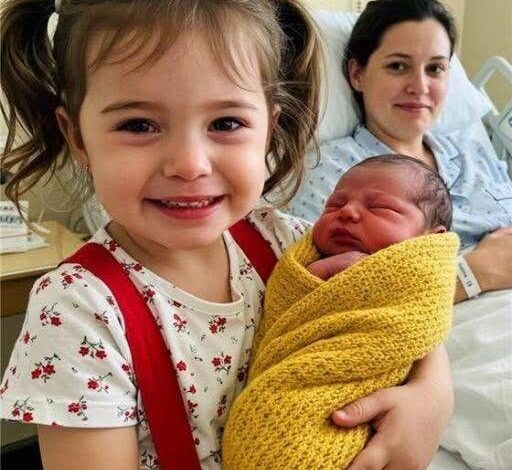
She sat cross-legged at the edge of the hospital bed, holding her newborn sister as if the entire world had been placed carefully into her lap.
My oldest daughter, Lina, was only four years old. She wore her favorite red suspenders over a wrinkled shirt, and her ponytail leaned crookedly to one side because she had insisted on brushing her own hair that morning. Her little knees were tucked beneath her, her socks mismatched, her small hands trembling as they cradled the tiny bundle wrapped in a pink hospital blanket.
For weeks, I had worried about this moment.
During the pregnancy, I had imagined every possible reaction. Jealousy. Confusion. Tears. Anger. Silence. Lina had been my whole world for four years, and now, suddenly, she was being asked to share that world with someone too small to understand what she was taking.
I had read articles, asked other mothers for advice, and prepared gentle speeches about how love does not divide when a new baby comes. It grows. I had repeated those words to myself so many times that I almost believed I was ready.
But nothing prepared me for the look on Lina’s face.
It was not jealousy.
It was not uncertainty.
It was wonder.
Her eyes shone as she stared down at her baby sister, her lips parted slightly, her face filled with a tenderness so intense it nearly broke me. She whispered soft “shh” sounds, rocking just a little, copying the way she had seen me soothe her dolls at home.
The hospital room was quiet except for the faint beeping of machines and the low murmur of nurses outside the door. The air smelled of antiseptic, warm blankets, and newborn skin. My body ached from labor. Every movement pulled at stitches and sore muscles, but in that moment, pain seemed distant.
All I felt was gratitude.
My husband stood near the foot of the bed, watching with a smile that looked tired but proud. A nurse lingered by the doorway, pretending to check the chart while clearly enjoying the sweetness of the scene. Everything felt soft, fragile, and perfect.
Then Lina leaned closer to the baby.
Her face hovered just inches above her sister’s.
She whispered something so quietly I almost missed it.
“Now I have someone.”
I smiled, tears gathering in my eyes.
“Someone to what, baby?” I asked gently.
Lina did not look at me.
She kept her eyes fixed on the baby, still rocking her in that tiny, careful rhythm.
“To keep the secrets with,” she whispered.
The warmth in the room vanished.
At first, I thought I had misunderstood her. Children say strange things. They repeat phrases from cartoons, dreams, games, and half-heard adult conversations. A four-year-old’s world is full of imaginary rules and hidden kingdoms. Secrets could mean anything.
A sticker hidden under a pillow.
A cookie taken before dinner.
A whispered promise between sisters.
Still, something about the way she said it made my skin tighten.
“Secrets?” I asked, forcing my voice to stay calm.
Lina finally looked up.
Her eyes were wide and serious.
Too serious.
Too still.
Too old for a child who still needed help buttoning her coat.
She nodded slowly.
“Like the ones I don’t tell Daddy.”
The room seemed to tilt.
My husband’s smile faltered.
The nurse in the doorway stopped moving.
For a moment, no one spoke. The baby shifted in Lina’s lap, making a soft little sound, but Lina only looked back down and touched one finger gently to her sister’s cheek.
I tried to breathe normally.
“What secrets, sweetheart?” I asked.
My voice sounded strange to me. Light, careful, almost cheerful. The voice parents use when they are terrified but cannot allow the child to see it.
Lina leaned close to the baby again.
Then she whispered words that made the heart monitor beside me seem suddenly too loud.
“She needs to know where we hide when Daddy gets angry.”
My husband went completely still.
The nurse looked at me.
And in that single moment, the life I thought I understood cracked open.
I stared at Lina, waiting for her to laugh or say something that would turn the sentence into a game. I wanted her to tell me she meant hide-and-seek. I wanted her to explain that Daddy pretended to be a monster and chased her around the living room. I wanted anything ordinary.
But Lina did not laugh.
She simply kept stroking the baby’s blanket, calm in a way that frightened me more than tears would have.
“Where do you hide?” I asked.
She glanced at her father.
The movement was quick, barely more than a flicker, but I saw it.
So did the nurse.
Lina’s shoulders rose toward her ears.
“In the closet,” she said softly. “Behind the coats. But only if I’m quiet.”
My husband took one step forward.
“Lina,” he said sharply.
She flinched.
That tiny movement told me more than any answer could have.
The nurse immediately moved closer to the bed.
“Maybe we should give Mom and the girls a little space,” she said, her voice professional but firm.
My husband looked at her, then at me.
“What is this?” he demanded. “She’s four. She doesn’t know what she’s saying.”
But I was no longer looking at him.
I was looking at my daughter.
Really looking.
For months, I had missed things.
The way Lina sometimes grew silent when he came home unexpectedly.
The way she asked whether he was “in a good mood” before running to greet him.
The way she clung to me on certain nights, refusing to sleep in her own room.
I had explained it all away.
Pregnancy made me tired. Lina was adjusting. Children have phases. My husband worked long hours. Everyone was stressed. Every excuse had seemed reasonable at the time because believing them was easier than asking the harder questions.
Now, sitting in that hospital bed with my newborn in my arms and my four-year-old trembling beside me, I understood that I had mistaken silence for peace.
The nurse asked my husband to step outside.
He resisted at first, his face tightening with anger, but hospital staff have a way of becoming immovable when they sense danger. Another nurse appeared. Then someone from security. The room that had been filled with soft joy minutes earlier became tense and clinical.
My husband left, but not before looking at Lina in a way that made her shrink against my side.
That was the moment I knew.
Whatever came next, I would not take my daughters home to the same house.
After the door closed, Lina began to cry.
Not loudly.
Not dramatically.
Just quietly, as though she had been holding the tears somewhere deep inside and finally no longer had the strength to keep them there.
“I wasn’t supposed to tell,” she whispered.
I reached for her with shaking arms.
“You did the right thing,” I said. “You did the bravest thing.”
She crawled carefully into the space beside me, still trying not to jostle the baby, and I wrapped one arm around her while the nurse took my newborn gently from her lap.
For the first time since Lina had entered the room, she looked like a child again.
Small.
Scared.
Exhausted.
I kissed the top of her head and felt something inside me harden—not into anger, though anger was there, but into resolve.
The hospital became the place where everything changed.
Not because my second daughter was born there, though that alone would have made it unforgettable. It changed because my first daughter finally found the words to tell me what she had been carrying alone.
In the hours that followed, questions were asked. Calls were made. A social worker came in with a soft voice and careful eyes. The nurses moved around me with a kind of quiet protection I will never forget. They did not push Lina too hard. They did not make promises they could not keep. They simply listened.
And listening was what she had needed all along.
Piece by piece, the story emerged.
Not all at once.
Not neatly.
Children do not tell fear in straight lines.
They tell it through fragments. Through drawings. Through sudden sentences that appear in the middle of unrelated conversations. Through the way their bodies react before their mouths can explain.
Lina had been living with fear in the same home where I thought I had built safety.
That truth nearly destroyed me.
But it also woke me up.
I had spent so much time preparing Lina to become a big sister that I had not seen how badly she still needed someone to protect her as a child. I had worried that she might feel forgotten when the baby arrived. I never imagined she had already been feeling alone.
That night, after everyone left and the room finally grew quiet again, I held both of my daughters close.
My newborn slept against my chest, unaware of the storm she had entered. Lina curled beside me, one hand gripping the edge of my hospital gown, as if afraid I might disappear if she let go.
I looked at their faces and made a promise I did not speak aloud.
No more secrets that protected the wrong person.
No more explanations that ignored fear.
No more pretending that a quiet house meant a safe one.
The life I returned to after that hospital stay was not the life I had planned. There were difficult conversations, legal steps, temporary arrangements, painful truths, and days when I felt as though I had failed in ways I could never repair.
But healing did not begin with certainty.
It began with one little girl whispering the truth over her baby sister.
It began with a nurse who heard enough to stop and listen.
It began with the moment I chose to believe my daughter instead of defending the version of my life I wanted to be true.
Months later, Lina began to laugh more easily again.
Not all at once.
Not every day.
But slowly.
She stopped asking whether the doors were locked. She stopped hiding behind furniture when voices grew loud. She started sleeping through the night. She drew pictures of our new home with bright yellow windows and four stick figures standing together under a huge crooked sun.
In every picture, she drew herself holding her sister’s hand.
One evening, I asked her why.
She shrugged and said, “Because she’s my person.”
This time, the words did not chill me.
They broke my heart in a different way.
Because now I understood.
Lina had not wanted someone to keep secrets with.
She had wanted someone who would never leave her alone inside them.
And from that day forward, neither of my daughters ever had to carry fear in silence again.