A Boy Walked up to My Wheelchair in a Crowded Café and Said He Could Make Me Walk Again – I Laughed, Until My Toes Moved After Twenty Silent Years

For twenty years, I lived in a wheelchair because of a choice I never regretted.
I had saved a little girl from drowning.
That was the story everyone knew.
That was the story printed in local newspapers, repeated at charity dinners, and brought up by strangers who recognized my name. It was the story people told when they wanted to call me brave. A young man dives into a lake. A child is pulled from the water. A life is saved.
But the rescue came at a cost.
Everything below my neck.
Or so I had been told.
For two decades, I accepted that truth because there was no reason not to. Doctors had explained it. Specialists had confirmed it. Therapists had worked around it. Friends had adjusted to it. I had built an entire life around the idea that the man I had once been ended on the day my body struck a submerged rock beneath the lake.
Then, on an ordinary Tuesday morning, a boy I had never seen before walked into a crowded café, placed his hand on my foot, and made my dead toes move.
One minute later, a woman I did not know accused the doctor I trusted most of lying to me for years.
And just like that, the life I had spent twenty years learning to accept began to unravel.
The café was filled with morning light when it happened. Sun poured through the tall front windows, turning the marble tabletops gold and catching in the steam rising from espresso cups. It was the kind of place where people spoke softly about money, mergers, property, and influence. The kind of place where deals were made with handshakes that looked casual but carried the weight of millions.
I sat at my usual table in the corner.
The same table I had occupied for years.
From there, I could see the entrance, the street, and the reflection of the room in the glass behind the bar. Routine mattered to me. After the accident, routine became more than comfort. It became control. When your body no longer obeys you, you learn to arrange the world in ways that do.
Across from me sat Mark and Greg, my oldest business partners and two of the few men who still treated me like Daniel Mercer the businessman, not Daniel Mercer the tragic hero.
Greg was telling a story that seemed to amuse him more than anyone else.
Mark was trying not to laugh.
I smiled when they did, but my mind was somewhere else.
“Daniel,” Mark said, snapping his fingers once in front of me. “You still with us?”
I blinked.
“Of course.”
“The Henley contract,” he said. “You’ve been staring at your coffee for five minutes.”
I looked down at the untouched espresso in front of me.
“Right,” I said. “I’ve been thinking.”
That was not exactly a lie.
I had been thinking.
Just not about the contract.
I had been thinking about the lake.
The memory came back sometimes without warning. No matter how many years passed, no matter how carefully I kept my life structured, it could still find me. One moment I would be in a boardroom or a restaurant or the back seat of my car, and the next I would be twenty-eight again, standing on a sunlit dock with the smell of pine and water in the air.
I remembered the scream first.
Always the scream.
Then the sight of the little girl thrashing in the water, disappearing once, coming up, then slipping under again. People froze. Someone shouted. Someone else ran toward the shore. I did not think. I jumped.
The water had been colder than I expected.
I remembered fighting toward her, my arms burning, my lungs tight, one thought beating through my skull: reach her.
I did.
I remembered her small fingers clawing at my shirt.
I remembered turning her toward the dock.
I remembered the relief of lifting her into her mother’s arms.
Then I remembered the wave.
The slip.
The impact.
A crack that seemed to happen inside the center of the world.
Then nothing.
When I woke, I was in a hospital bed.
My fiancée, Claire, sat beside me, holding my hand with both of hers. Her eyes were red from crying, though she tried to smile when she saw I was awake. Behind her stood doctors whose faces had already arranged themselves into practiced sympathy.
They told me my neck had been broken.
They told me there had been severe spinal trauma.
They told me I would likely never walk again.
Later, they told me it was a miracle I had survived at all.
People liked that word.
Miracle.
They used it often around me, usually in tones meant to comfort. It was a miracle the girl lived. A miracle I survived. A miracle I rebuilt my company from a wheelchair. A miracle I stayed strong.
No one ever asked what it felt like to become someone else’s miracle at the cost of your own body.
The only person I ever said that to was Dr. Elias Voss.
My doctor.
My confidant.
My friend.
Voss had entered my life during the worst months after the accident. He was younger then, intense, brilliant, and frighteningly certain of himself. While other doctors spoke in careful phrases, he spoke with authority. He guided my treatment, supervised my rehabilitation, recommended surgeries, adjusted medication, and helped me navigate the long, humiliating process of learning what my body could and could not do.
Over time, he became more than a physician.
He became the man who explained my new life to me.
The man who told me when hope was useful and when it was cruel.
The man I trusted when every other part of myself had failed.
So when the boy appeared beside my table that Tuesday morning, I had no reason to imagine that my entire life was balanced on the edge of a secret.
At first, I did not notice him.
The waiter had just delivered fresh espresso. Greg was still talking. Somewhere behind me, someone laughed too loudly into a phone. The café felt ordinary, elegant, predictable.
Then I sensed someone standing close.
Too close.
I turned my head.
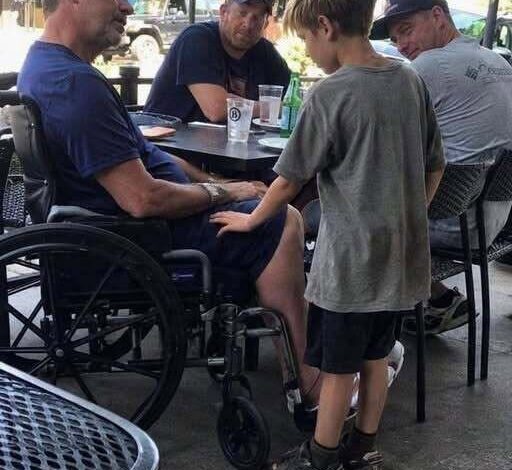
A boy stood beside my wheelchair.
He was thin, maybe ten or eleven, with dark hair that fell unevenly over his forehead. His clothes were too big for him. His backpack hung from one shoulder, faded and fraying at the seams. His sneakers were worn nearly smooth at the soles.
But none of that held my attention.
What held my attention was where he was looking.
At my foot.
Not my face.
Not my expensive suit.
Not the men across from me.
My foot.
It rested, motionless as always, on the metal plate of my wheelchair.
The boy stared at it with unsettling focus.
“You need something?” I asked.
He lifted his gaze slowly.
His eyes were calm.
Too calm for a child standing uninvited beside a stranger in an expensive café.
“No,” he said.
Mark and Greg exchanged a glance.
The boy pointed at my legs.
“I came to fix those.”
Greg coughed into his coffee.
Mark stared.
For a moment, I simply looked at the child, waiting for the joke to reveal itself.
When it did not, I laughed.
Not because I found it funny.
Because the alternative was too strange.
“Really?” I said. “That’s ambitious.”
The boy did not smile.
“It won’t take long.”
“How long?”
“A few seconds.”
Greg laughed openly now. Even Mark’s mouth twitched, though he looked uncomfortable.
I leaned back slightly in my chair.
“Tell you what,” I said. “If you make me walk, I’ll give you a million dollars.”
I expected him to blush.
Or run.
Or admit that someone had put him up to it.
Instead, he nodded once.
“As long as you count.”
The laughter at the table faded.
Something in his voice changed the air.
He stepped closer and knelt beside my wheelchair. Conversations around us began to slow as people noticed the strange scene unfolding in the corner. The boy reached out with one small hand and placed it gently on my right foot.
I felt nothing, of course.
I had not felt anything below my chest in years.
“Count,” he said.
I looked at Mark, then at Greg, then back at the boy.
“All right,” I said, playing along. “One.”
Nothing happened.
The café was quiet now.
“Two.”
Still nothing.
I opened my mouth to make some dry remark, but the words never came.
Because something flickered deep inside my leg.
Not pain.
Not pressure.
Not exactly sensation.
It was distant, faint, almost too small to trust.
Like a vibration traveling through water.
My heart began to hammer.
No.
Impossible.
“Three,” the boy said softly.
My toes moved.
It was not dramatic. My foot did not leap from the metal plate. My leg did not suddenly lift. There was no miracle worthy of a cathedral ceiling or a movie score.
It was smaller than that.
A tiny curl inside my shoe.
A motion so slight that anyone else might have missed it.
But I felt it.
For the first time in twenty years, I felt my toes move.
Greg’s cup slipped from his hand and shattered against the floor.
Mark whispered my name.
Across the café, silence spread like spilled ink. Chairs stopped scraping. Conversations died. Someone gasped near the counter. The waiter froze with a tray in his hands.
I stared at my foot.
Then at the boy.
Then back at my foot.
My chest tightened until I could barely breathe.
“That’s not possible,” I said.
The boy stood.
“My name is Eli.”
His voice was gentle now.
Almost sad.
As if he had not come to perform a miracle, but to deliver bad news.
Before I could ask what he meant, a hand settled on my shoulder.
The touch was steady.
Warm.
I turned.
A woman stood behind me.
She was in her late forties, perhaps early fifties, with dark hair streaked with gray and eyes that looked as if they had spent years watching people lie. She wore no jewelry except a thin silver chain tucked beneath the collar of her coat.
Something about her face stirred the edge of a memory.
Not recognition.
Not exactly.
More like the feeling of hearing a song from another room and knowing you once knew the words.
She looked at me with a strange mixture of pity and resolve.
“You don’t know me,” she said.
Her voice was quiet, but it carried through the café.
“But I know you.”
Mark stood abruptly.
“Who are you?”
The woman did not look at him.
Her eyes stayed on mine.
She glanced briefly at Eli, then back at me.
And then she said the words that broke open the last twenty years.
“Your doctor has been lying to you.”
The sentence made no sense.
For a moment, I thought I had misheard her.
“My doctor?”
“Dr. Voss,” she said.
The name struck the room like a dropped blade.
I felt something cold move through me.
“No.”
The word came out immediately.
Automatic.
Defensive.
“You’re mistaken.”
“I’m not.”
“You don’t know him.”
“I know exactly what he did.”
My hands tightened on the arms of my wheelchair.
Dr. Voss had been with me through everything. Surgeries. Rehabilitation. Failed treatments. Pain management. Depression. Public appearances where I pretended acceptance came easily. He had seen me at my weakest. He had helped me survive.
The idea that he had lied to me was not merely offensive.
It was impossible.
Mark moved closer, placing himself partly between me and the woman.
“That’s enough,” he said. “You don’t walk into a café and accuse someone’s doctor of—”
“He suppressed the nerve response,” she said.
The room went still again.
I stared at her.
“What?”
Her expression tightened, as though she hated saying the words aloud.
“He told you the damage was complete. It wasn’t.”
My ears began to ring.
“He told you there was no meaningful recovery pathway. There was.”
I shook my head.
“No.”
“He controlled the tests. He controlled the reports. He controlled the specialists you were allowed to see.”
“That’s not true.”
But even as I said it, something inside me shifted.
A small memory surfaced.
A doctor in Boston I had been scheduled to meet twelve years earlier. The appointment canceled suddenly after Voss said the specialist was unreliable.
Another memory.
An experimental program in Switzerland. Voss told me I was not a candidate.
Another.
Claire, years ago, asking whether I should get another opinion. Voss later warning me that false hope could destroy what stability I had built.
The woman watched those thoughts cross my face.
“You’re remembering,” she said.
I hated her for saying it.
Because I was.
“Who are you?” I asked.
This time my voice broke.
She looked toward the front window, where the morning light had begun to sharpen against the glass. For a moment, she seemed to gather herself.
“My name is Mara Vale.”
The name meant nothing.
Then she reached into her coat and pulled out an old photograph.
She placed it on the table in front of me.
My hands shook as I reached for it.
The picture was faded at the edges, creased from years of being folded and unfolded. It showed a lake in summer. A dock. A little girl with wet hair wrapped in a towel, clinging to a woman I recognized only from memory.
The mother.
The girl I saved.
My pulse pounded.
Mara touched the photograph lightly.
“That was my daughter,” she said.
The room seemed to shrink around us.
I looked from the photograph to Eli.
The boy stood beside her, quiet and solemn.
“And him?” I asked.
Mara’s eyes softened.
“My grandson.”
I could not understand why that mattered. Not yet.
But fear had already begun moving through me, slow and certain.
“What does your daughter have to do with Dr. Voss?”
Mara did not answer immediately.
Instead, she looked at my wheelchair.
Then at my foot.
Then back into my eyes.
“Everything.”
The word landed heavily between us.
I felt suddenly cold despite the sunlight pouring through the café windows.
“After the accident,” she said, “there were things you were never told. About the injury. About the hospital. About who was there that day. About why Voss became so interested in your case.”
I gripped the photograph so hard it bent in my hand.
“What are you talking about?”
Mara leaned closer.
Her voice dropped, but every syllable was clear.
“You didn’t lose the use of your body because the injury made recovery impossible.”
My breath caught.
“You lost it because someone made sure you never recovered.”
The café disappeared.
The light, the people, the shattered cup on the floor, Mark’s pale face, Greg’s stunned silence—all of it blurred into nothing.
All I could see was the photograph.
The lake.
The child.
The day my life ended.
Or the day someone decided it would.
For twenty years, I had believed I was living with the consequence of an accident.
Now a stranger was telling me that my paralysis had not been fate.
It had been managed.
Maintained.
Protected.
I wanted to reject it. I wanted to laugh, to call security, to demand that she leave. I wanted the world to return to what it had been ten minutes earlier, when my legs were dead and my life, though imperfect, made sense.
But my toes had moved.
No lie could erase that.
No explanation could make it ordinary.
The boy named Eli looked up at me.
“You can feel more,” he said quietly. “But not here.”
Mara placed a folded envelope beside the photograph.
Inside, I could see the corner of a medical report.
Old.
Stamped.
Hidden.
My name printed across the top.
Mark whispered, “Daniel, don’t.”
But I was already reaching for it.
Because the most terrifying thing was no longer the possibility that Mara was lying.
It was the possibility that she was telling the truth.
And if she was, then the man I had trusted for twenty years had not helped me accept my life.
He had helped steal it.
I opened the envelope with trembling hands.
And the first line of the report made the room spin.
Patient shows preserved lower-extremity response.
Preserved.
Response.
Two words.
Two impossible words.
Two words Dr. Voss had never allowed me to hear.
I looked up at Mara.
My voice came out barely louder than a whisper.
“Why?”
Her eyes filled with something that looked like grief.
“Because the accident wasn’t the only thing that happened at that lake.”
I felt my heart slam once against my ribs.
Then again.
Mara glanced toward the door, as if expecting someone to arrive.
“We don’t have much time,” she said.
The warning in her voice made every hair on my body rise.
“Voss knows Eli found you.”
For twenty years, I had believed my life ended in the water.
But as I sat there in that café, staring at a medical report that should never have existed, I understood something far worse.
My life had not ended.
It had been taken from me slowly.
Carefully.
By someone close enough to call himself a friend.
And now, for the first time in two decades, I had moved.
Which meant the truth was no longer buried.
It was waking up.