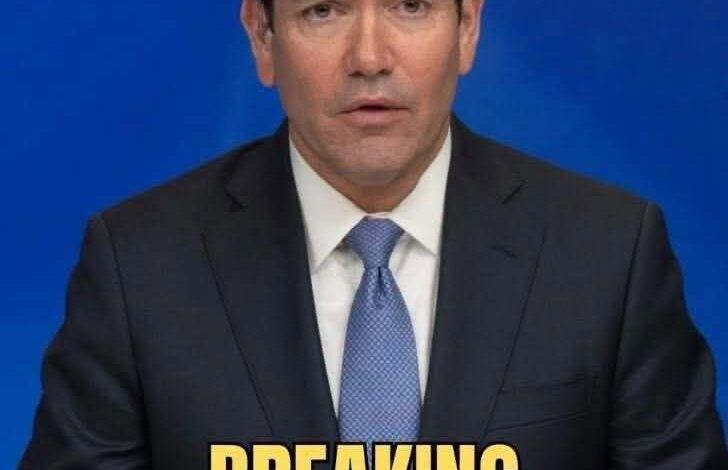
Secretary of State Marco Rubio revealed on Friday that back-channel discussions to halt the U.S.-Israel war with Iran is “a little bit of movement.”

The warning could hardly be more serious.
Sen. Marco Rubio says he is “not popping champagne,” even as diplomats move quietly and urgently behind the scenes, trying to prevent a crisis in the Persian Gulf from turning into something far more dangerous. His words carry the weight of a grim calculation: the situation may still be contained, but only if every side understands how little room remains for error.
Across the region, the signs of escalation are impossible to ignore.
Pakistan’s army chief is reportedly heading to Tehran, part of a high-stakes diplomatic effort to carry messages between Iran, Washington, and other anxious capitals. European officials are preparing sharper sanctions, aiming to punish those they believe are helping push the region toward confrontation. Iran, meanwhile, is threatening to impose a “toll” on one of the world’s most important oil routes, turning a vital international passage into a potential flashpoint.
The Strait of Hormuz is not just another narrow stretch of water.
It is one of the most strategically important chokepoints on Earth.
Nearly a fifth of the world’s oil moves through that passage, making it essential not only to regional powers but to the global economy. Any disruption there could send shockwaves far beyond the Middle East, affecting energy prices, shipping routes, financial markets, and governments thousands of miles away.
That is why Rubio’s language matters.
When he calls Iran’s threat “completely illegal” and a “threat to the world,” he is not merely making a political point. He is drawing a line. In Washington, and increasingly in European capitals, there appears to be a shared understanding that an attempt to charge, block, or control passage through the strait would not be treated as ordinary brinkmanship. It would be seen as a direct challenge to international order.
Behind the careful diplomatic language sits a much harsher reality.
If Iran tries to turn the Strait of Hormuz into a pay-to-pass corridor, the confrontation may not remain limited to speeches, sanctions, or closed-door warnings. It could quickly become a test of military resolve, economic endurance, and alliance unity. The danger is not simply that one country might threaten another. The danger is that a miscalculation in one narrow waterway could pull several powers into a wider crisis.
That is what makes the current moment so tense.
Diplomacy is still moving, but it is moving against a clock.
Pakistan’s involvement suggests that channels remain open, even if they are indirect and fragile. Messages are being carried. Proposals are being tested. Warnings are being delivered in language designed to leave space for retreat. At the same time, the European Union is preparing to target individuals and networks connected to the threatened blockade, signaling that patience is not unlimited.
The effort is clear: give Iran a path away from escalation while making the cost of defiance unmistakable.
But every new development narrows that path.
Israeli strikes in Lebanon have added another layer of volatility. Hezbollah’s defiance keeps the northern front tense and unpredictable. Iran’s creation of a so-called “Persian Gulf Strait Authority” appears designed to formalize its challenge over maritime passage, giving political shape to a threat that already has global consequences.
Each move feeds the next.
Each statement raises the stakes.
Each side insists it is acting defensively, even as the region edges closer to a confrontation that could be impossible to control once it begins.
President Trump may describe himself as cautiously optimistic about the possibility of a deal, but Rubio’s references to a mysterious “Plan B” hang over the crisis like a warning cloud. No one has publicly defined what that plan would involve, and that uncertainty is part of its power. It signals that Washington is still pursuing diplomacy, but also preparing for the possibility that diplomacy fails.
That is the message Iran is meant to hear.
There is still time to step back.
But not unlimited time.
The most dangerous part of the standoff is that all sides may believe they are demonstrating strength while actually reducing their options. Iran may see the threat of a toll as leverage. Washington may view any such move as a red line. European leaders may believe sanctions can still deter escalation. Regional actors may assume they can manage the pressure without triggering a broader conflict.
History offers little comfort in moments like this.
Crises often become uncontrollable not because anyone planned for disaster, but because each side believed the other would blink first.
That is why Rubio’s caution feels so pointed. His refusal to celebrate any diplomatic opening suggests that officials understand how fragile the situation remains. A single refusal, a single interception, a single misread signal in the Strait of Hormuz could transform a political confrontation into a global emergency.
For now, diplomacy continues.
Messages are moving.
Sanctions are being prepared.
Military planners are watching.
Oil markets are listening.
And the world is waiting to see whether Iran’s threat remains a bargaining tactic or becomes the spark for a far larger confrontation.
The central question is no longer whether the Strait of Hormuz matters. Everyone understands that it does. The question is whether the actors now circling it can still find a way to step back before the crisis hardens into conflict.
Because if the strait becomes a battlefield of economic coercion, the consequences will not stop at the Gulf.
They will move through oil markets, alliances, military commands, and diplomatic capitals around the world.
Rubio’s warning, stripped of political theater, is simple: this is not a symbolic dispute. It is a test of whether one of the world’s most important arteries remains open under international norms or becomes a weapon in a wider regional struggle.
And if that test fails, Washington’s “Plan B” may no longer be a shadow in the background.
It may become the next chapter.