Elvis Presley hid a heartbreaking secret while filming Blue Hawaii and secret behind the scenes footage reveals the tragic truth about his final paradise vacation

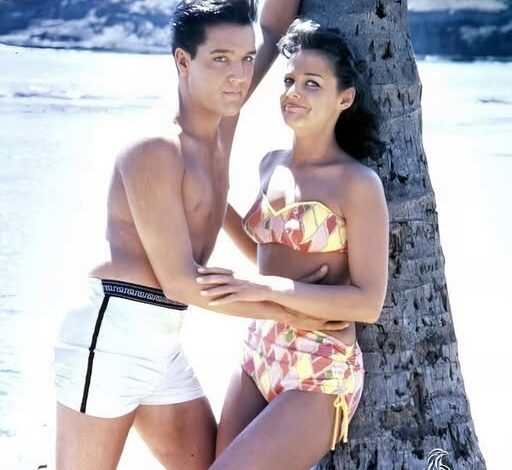
By the time Blue Hawaii burst into theaters near the end of 1961, Elvis Presley was already far more than a popular singer. He was a global phenomenon, one of the most recognizable entertainers in the world, and a performer whose presence could turn almost any project into an event.
Audiences did not simply go to see Blue Hawaii because they wanted to hear new Elvis songs. They went because they wanted Elvis himself. They wanted the smile, the voice, the easy confidence, the effortless charm, and the sense that whenever he appeared on screen, the entire movie seemed to brighten around him.
Critics have not always treated Blue Hawaii as one of the finest films in Elvis’s acting career. It was never meant to be a heavy drama or a serious artistic statement. But for fans, that has never really mattered. The movie captured Elvis at his most relaxed, playful, and magnetic. It placed him in a sunlit paradise, surrounded him with romance, comedy, music, and beautiful scenery, and gave audiences exactly the kind of escape they wanted.
The film quickly became a major commercial success. More importantly, it established a formula that would shape much of Elvis Presley’s later Hollywood career. That formula was simple, profitable, and extremely effective: exotic locations, attractive co-stars, lighthearted romance, gentle comedy, and enough songs to support a bestselling soundtrack album.
Colonel Tom Parker, Elvis’s powerful and famously controlling manager, immediately understood the value of that formula. Blue Hawaii proved that audiences did not need complex plots or deeply developed characters to fill theaters. They wanted Elvis in appealing settings, singing memorable songs and charming his way through a breezy story. From a business standpoint, it was a goldmine.
One of the unusual things about Blue Hawaii is that Elvis’s character, Chad Gates, is not written as a professional singer. He is a former soldier returning home to Hawaii, trying to decide whether to follow his family’s expectations or live life on his own terms. Unlike some musical films where the songs emerge naturally from a performer’s career, there is often no practical reason for Chad to suddenly begin singing.
And yet, he does.
He sings while paddling an outrigger canoe. He sings on the beach. He sings in casual moments where, in any realistic story, no one would suddenly break into music. But that randomness became part of the movie’s charm. The audience did not question it because Elvis made it feel natural. In the world of Blue Hawaii, if Elvis wanted to sing, the story simply made room for him.
The soundtrack became one of the film’s greatest triumphs. Its most enduring song, “Can’t Help Falling in Love,” became one of Elvis Presley’s signature ballads and remains instantly recognizable generations later. Even people who have never seen the film know the melody. It has become part of American popular music history, used at weddings, covered by countless artists, and remembered as one of the most romantic songs Elvis ever recorded.
But despite its commercial success and lasting popularity, Blue Hawaii was far from flawless.
In fact, part of the film’s enduring appeal comes from the little imperfections, technical slips, and behind-the-scenes stories that fans continue to notice and discuss decades later.
One amusing example appears during Chad’s airport arrival scene. When Elvis steps off the plane, careful listeners can hear the screams of real fans in the background. Local residents had gathered near the production hoping to catch a glimpse of Elvis, and their excitement was so intense that it slipped into the film’s audio. What was supposed to be a scripted movie moment accidentally captured the real-world hysteria surrounding Elvis Presley at the height of his fame.
The film also contains several continuity errors that eagle-eyed viewers have pointed out over the years. During the driving sequence connected to “Almost Always True,” Maile’s hands seem to shift positions on the steering wheel between cuts. Elvis’s arm also changes placement in ways that do not quite match from shot to shot. These are small details, but once noticed, they become hard to ignore.
Another noticeable mistake happens in the pineapple field sequence. A character appears to be seated on one side of the convertible, only to appear moments later on the opposite side. The change likely served the camera angle or blocking of the scene, but from a continuity standpoint, it creates a funny visual jump.
Then there is the famous ukulele issue. In one scene, Elvis strums a small ukulele with plenty of enthusiasm, but viewers paying close attention can see that his fingers are not really changing chords in a way that matches the music. The soundtrack moves smoothly through the song, while his hands appear to be doing something much simpler. It is the kind of movie-musical mismatch that fans lovingly tease rather than seriously criticize.
Some of the most interesting stories connected to Blue Hawaii happened away from the camera.
Before Joan Blackman was cast opposite Elvis, actress and dancer Juliet Prowse was reportedly expected to take the role. She had already appeared with Elvis in G.I. Blues, and their pairing had worked well on screen. However, the production reportedly ran into difficulties when Prowse made expensive requests, including asking the studio to provide travel for her personal makeup artist and secretary. When Paramount refused, she left the project.
That opened the door for Joan Blackman.
Her casting proved important because she and Elvis shared a strong screen chemistry. Blackman later spoke openly about the connection between them, describing an immediate spark. Elvis was reportedly very taken with her and wanted her to appear with him again in future films. He was even said to have imagined a more serious romantic future with her.
But Blackman was determined to maintain her independence. She did not want her career defined by a relationship with Elvis, nor did she want to receive roles simply because of their personal connection. She wanted to be valued as an actress on her own terms.
While audiences saw sunshine, romance, and a carefree Hawaiian atmosphere on screen, Elvis’s own feelings during production were more complicated. Behind the relaxed charm, he was reportedly frustrated by the direction his film career was taking. He had ambitions to become a more serious actor and believed he was capable of deeper dramatic work. Instead, he was increasingly being placed in lightweight musical comedies designed mainly to sell tickets and soundtrack albums.
Paramount publicity director Anne Fulchino later recalled that Elvis seemed embarrassed and unhappy with the artistic limitations of the project. To the public, he looked like the picture of confidence. But privately, he appeared to feel trapped by the kind of movies his management and the studio expected him to make.
That tension became one of the recurring themes of Elvis’s Hollywood career. He had the talent, screen presence, and ambition to do more challenging work, but the enormous financial success of films like Blue Hawaii made it difficult for him to escape the formula. The very success that kept him in movies also limited what those movies allowed him to become.
Still, Elvis found ways to enjoy himself on set. He was known for joking with the cast and crew, and one of the strangest stories from the production involved a prank he staged with his girlfriend Anita Wood. According to accounts, Elvis pretended to have stopped breathing, causing panic among members of his entourage and crew. Just when everyone feared something terrible had happened, he suddenly sat up laughing, revealing that it had all been a trick.
It was a dark prank, but it showed the mischievous side of Elvis that many people who worked with him remembered.
He also spent part of his downtime learning golf from champion golfer Gary Player. Player later joked that Elvis’s swing looked terrible, comparing it in colorful terms to something wildly awkward and unnatural. Elvis reportedly laughed it off, showing that even when he struggled at something, he could take the joke.
Another famous piece of Blue Hawaii history involves the bright red MGA roadster that appeared in the film. Elvis loved the car so much during production that he bought it for his personal collection. The vehicle eventually became part of the Elvis legacy and remains associated with Graceland, connecting the movie to the larger world of Elvis memorabilia.
Hawaii itself became deeply tied to Elvis Presley’s image and personal history. He filmed several movies there, and the islands became one of the places most strongly associated with his romantic, relaxed screen persona. In Blue Hawaii, the landscapes are almost as important as the plot. The beaches, mountains, ocean views, and resort settings give the film its dreamlike quality.
Several filming locations remain significant to fans. Tantalus Drive, with its sweeping views, became one of the memorable backdrops. The Coco Palms Resort became especially famous because it was used for the film’s wedding sequence and the performance of “Hawaiian Wedding Song.” For many Elvis fans, that scene became one of the most iconic moments in the movie.
The later history of Coco Palms added a bittersweet layer to the film’s legacy. The resort was severely damaged by Hurricane Iniki in 1992, and its ruins became a haunting reminder of old Hollywood glamour, Hawaiian tourism history, and the passing of time. For fans visiting the area, the location carried both nostalgia and sadness.
The film also included a subtle connection to Elvis’s real military service. Chad Gates is shown wearing a patch linked to the actual U.S. Army division in which Elvis served while stationed in Germany. It was a small detail, but it connected the fictional character to Elvis’s own life and public image as a returning soldier.
In a deeply poignant twist, Hawaii would remain important to Elvis until near the end of his life. It was one of the places he loved most, a refuge from the pressures of fame and a setting that seemed to offer him beauty, calm, and escape. In 1977, just months before his death, Hawaii became the destination of one of his final vacations.
That connection gives Blue Hawaii a special emotional weight. On the surface, it is a bright, colorful, easygoing romantic musical. But beneath that lightness, it captures a specific moment in Elvis Presley’s life and career. It shows him at the height of his charm, at the center of a massively successful Hollywood formula, and at the same time quietly struggling with the limitations that formula placed on him.
For fans, that mixture is part of what makes the movie unforgettable.
Blue Hawaii is not remembered because it was perfect. It is remembered because it was Elvis in paradise, singing some of his most beloved songs, surrounded by beauty, humor, romance, and the unmistakable atmosphere of early 1960s Hollywood escapism.
It gave audiences exactly what they wanted.
It gave the music world one of Elvis’s most enduring ballads.
It gave Hollywood a formula it would reuse again and again.
And it gave Elvis fans a film that, more than sixty years later, still feels warm, nostalgic, charming, and unmistakably connected to the legend of The King.