HOW A SINGLE DINNER WITH HER FAMILY REVEALED A PATTERN OF EXPECTATION, MANIPULATION, AND UNSEEN RED FLAGS—AND HOW ONE MAN’S QUIET EXIT FROM A $400 TRAP BECAME A DEEPLY HUMAN LESSON ABOUT INTUITION, SELF-RESPECT, AND THE COURAGE TO WALK AWAY BEFORE THE COST STRETCHED FAR BEYOND MONEY

By the time I turned twenty-seven, I thought I had deciphered the mechanics of modern dating. It felt almost procedural. Connections sparked easily, driven by chemistry and curiosity. The opening phase was always promising — lively conversations, shared humor, that early sense of possibility that suggests something meaningful might grow. And then, almost inevitably, things faded. No dramatic breakups. No confrontations. Just a slow, courteous withdrawal on both sides.
It left me uneasy. Not because of obvious incompatibility, but because of something subtler. I began to wonder whether there was an unseen flaw — not glaring enough for me to recognize, but present enough for others to sense. A pattern repeating itself without my awareness.
So when I matched with her and our conversations unfolded effortlessly, it felt different. There was no pressure to perform, no rush to impress. She asked thoughtful questions. She listened without interrupting. She was comfortable with pauses. With her, I didn’t feel evaluated — I felt grounded. That sense of ease alone made the connection feel promising.
Our dates confirmed it. The rhythm between us felt natural, unforced. We became official quickly, sooner than I expected. When she suggested I meet her family a few weeks later, I took it as a positive sign — evidence that things were moving in a healthy direction.
I imagined something simple: dinner with her parents, maybe a sibling. Casual, welcoming. I prepared myself for polite conversation and the familiar gesture of offering to cover the bill, more courtesy than expectation.
What actually happened was something else entirely.
The Dinner That Changed Everything
The restaurant was far more upscale than I had pictured — dim lighting, hushed conversations, the scent of wine and rich food in the air. Instead of leading me to a small table, she guided me toward a long one. A table already full.
Her extended family filled every seat: relatives of all ages, mid-conversation, forks midair. As we approached, dozens of eyes turned toward us at once. I waited for introductions. They never came.
She took her seat without hesitation. I quietly slid into the only empty chair.
Conversation resumed around me as though I were invisible. Discussions about work, vacations, grievances, and inside jokes flowed freely — none of them directed at me. No one asked who I was or how I knew her. I wasn’t being ignored aggressively; I was simply not included at all.
Orders began arriving without menus being opened. Oysters. Charcuterie. Steaks. Lobster pasta. Premium cocktails. Wine bottles opened in succession. Dessert menus appeared almost immediately. Every choice was made collectively, yet without acknowledging the stranger at the table.
I felt a tightening in my chest — not anger, but clarity. Something was deeply wrong, and she seemed entirely unbothered. She smiled, scrolled through her phone, chatted as if this were all perfectly normal.
When the Bill Told the Story
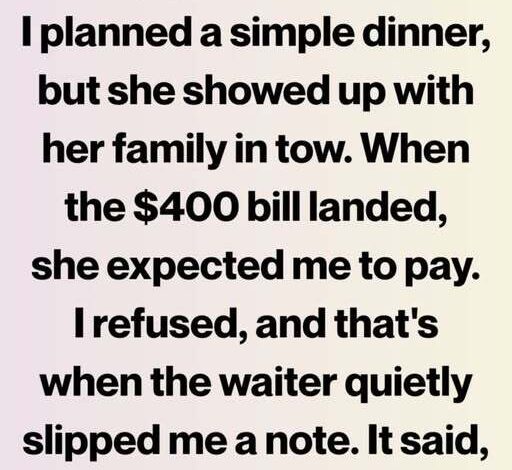
When the check arrived, it wasn’t placed between us or passed around. It was set directly in front of me.
Four hundred dollars.
She glanced at it, then at me. The brief irritation that crossed her face when I didn’t immediately reach for it was subtle — but unmistakable. Around the table, conversations paused. Eyes shifted. They were waiting.
That was the moment I understood: this wasn’t a family dinner. It was a test. Or worse — a setup.
Before I could fully process it, the waiter returned and discreetly placed a folded note beside the bill.
“She’s not who she says she is.”
There was a phone number beneath it.
I excused myself, citing the restroom. The waiter met me near a quiet corridor and explained softly that this situation wasn’t new. Similar complaints had surfaced before. Other dates had been brought into identical scenarios. The pattern was known.
And suddenly, I saw it too.
Choosing Myself
I returned to the table calm and resolved.
I removed the bill, placed cash for my own food and drink beneath it, and closed the folder neatly. Without raising my voice or offering explanations, I stood, excused myself politely, and left.
No argument.
No embarrassment.
No anger.
Just closure.
The cool night air outside felt steadying. No one followed me. No calls came. No messages arrived.
Later that evening, I searched online and found stories eerily similar to mine. Different names, same script. Excessive dinners. Silent expectations. Financial pressure masked as tradition.
The relief I felt wasn’t about avoiding the cost — though that mattered. It was about escaping something deeper: a dynamic built on entitlement and manipulation.
What I Learned
We often think of red flags as loud — shouting, insults, ultimatums. But the most dangerous ones are quiet. They hide in assumptions, in unspoken expectations, in the way someone allows discomfort to exist without addressing it.
That night taught me lessons I didn’t know I needed:
Intuition isn’t fear — it’s awareness.
That feeling in your chest isn’t anxiety inventing danger. It’s your mind recognizing a pattern before your logic catches up.
Generosity has limits.
Kindness is a virtue. Being taken advantage of is not. The difference is self-respect.
Patterns repeat until they’re recognized.
Once you see them, you can’t unsee them — and that’s a gift.
Walking away isn’t failure.
Sometimes it’s the strongest, healthiest decision you can make.
Not every lesson hurts.
Some simply clarify.
A Quiet Shift
What that night ultimately gave me was confidence. I realized the pattern I feared in my dating life wasn’t a flaw — it was discernment. The hesitation I once questioned wasn’t weakness; it was instinct.
Leaving wasn’t dramatic.
It wasn’t cinematic.
It wasn’t loud.
But it was deliberate.
It was self-respecting.
And it was freeing.
For the first time in years, I didn’t feel unlucky in dating. I felt aware. Grounded. Capable of protecting my peace.
Awareness is a form of safety.
Discernment is a form of strength.
And trusting yourself fully is a form of peace.
Sometimes the price of a lesson is money.
Sometimes it’s time.
And sometimes — when you listen closely — you walk away before the cost becomes anything at all.