What Psychology Quietly Reveals About People Who Help Waiters Clear the Table, From Hidden Traits of Empathy and Emotional Intelligence to Subtle Signals of Character, Social Awareness, and the Deep Human Need to Contribute in Everyday Interactions

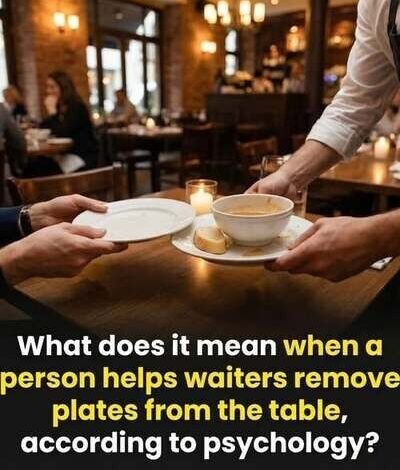
In everyday life, it is often the quiet, seemingly insignificant actions that reveal the most about a person’s character. While grand gestures capture attention and applause, they are often shaped by social expectations, the desire for recognition, or performance pressures. In contrast, small, almost unnoticed behaviors—like helping a waiter clear a table—tend to be instinctive, arising without thought or expectation. These acts occur when people assume no one is paying close attention, and that very invisibility makes them especially revealing. Psychology suggests that such spontaneous, low-stakes actions often provide a more accurate window into character than carefully orchestrated behaviors. When someone steps in to pass glasses, stack plates, or ease a server’s workload, they are engaging in subtle, unspoken communication that reflects their deeper thought patterns, emotional orientation, and approach to others.
A key trait reflected in this behavior is empathy. In psychological terms, empathy is the ability to perceive, understand, and resonate with the feelings of another. Helping a waiter often signals awareness of another’s effort—the recognition that someone is juggling multiple tasks, managing stress, and performing under pressure. This awareness does not require a deep emotional bond; it is a reflection of sensitivity to the experiences of others. Empathetic individuals notice details that often go unseen—tired eyes, tense shoulders, or the strain of multitasking—and respond in ways that ease those burdens, even in subtle ways. In this sense, assisting a waiter transcends the physical act: it becomes an expression of attentiveness and care for others’ wellbeing.
Closely linked to empathy is the concept of prosocial behavior. Prosocial actions are those intended to benefit others without expectation of reward or recognition. Helping a waiter is a classic example: it is voluntary, typically unnoticed, and unprompted. People who engage in such behavior are often guided by internal values rather than external incentives. Their motivation is not, “This will make me look good,” but rather, “This might help.” This orientation reflects a strong sense of social responsibility, a belief in the significance of small acts, and a willingness to act without prompting. Over time, these repeated low-cost choices can accumulate, shaping a consistent pattern of consideration and kindness.
Social awareness is another psychological component evident in this behavior. It encompasses the ability to understand the dynamics of a situation—who is doing what, what is needed, and how one’s actions may influence others. In a restaurant, many diners focus primarily on themselves: their meal, their conversation, their own comfort. A person who helps clear a table, however, notices the broader environment. They perceive when a server is overextended, when space is tight, or when a small action could improve workflow. Social awareness is a key element of emotional intelligence, which combines understanding one’s own emotions with perceiving and responding to the emotions and needs of others. Actions like these demonstrate situational attunement and responsiveness that go beyond mere etiquette.
This behavior also reflects an individual’s relationship with social roles and hierarchy. Many cultures maintain strict expectations in service settings: customers consume, staff serve. People who assist a waiter often demonstrate a flexible, egalitarian perspective—they see interactions as shared human experiences rather than fixed duties. Such behavior suggests lower social dominance orientation and a higher regard for equality, prioritizing cooperation and human connection over rigid role adherence.
Personal experience further informs this tendency. Individuals who have worked in service roles often develop experiential empathy: an understanding of the demands, timing, and physical effort required to meet others’ needs. They are more likely to recognize when their actions can make a tangible difference. Yet even without direct experience, many develop similar behaviors through observation, upbringing, or moral values that emphasize kindness and attentiveness.
Helping a waiter can also reveal agency and initiative. While some people prefer to wait for instructions, others take independent, small actions when they see an opportunity. Psychology links this tendency to proactive personality traits—individuals who act to influence their environment, not for control, but out of a sense of capability and responsibility. In the restaurant context, this manifests as quietly stacking plates or passing items without being asked, respecting boundaries while contributing meaningfully.
At the same time, psychologists caution against overinterpreting any single action. Behavior is shaped by context as much as by personality. Cultural norms, social settings, mood, or group dynamics can all influence decisions. What is polite in one culture may be intrusive in another. A person who usually helps might abstain in certain situations. Patterns over time, rather than isolated events, are what provide reliable insight into character.
Intention further distinguishes these behaviors. Helping a waiter may arise from genuine concern, efficiency, or social signaling. Multiple motivations can coexist, but actions primarily driven by internal principles tend to be more consistent and less contingent on external observation. The distinction between intrinsic and extrinsic motivation helps psychologists understand not just what people do, but why.
Ultimately, what makes this behavior meaningful is its context: a moment where no one is required to act, where the default is inaction. Choosing to intervene—even in a small way—signals an orientation toward connection, awareness, and contribution. It reflects empathy, attentiveness, initiative, and egalitarian thinking. Though subtle, these actions lay the foundation for positive social interactions, creating spaces where people feel seen, supported, and respected.
Over time, small gestures like helping a waiter reinforce social cohesion and kindness. They shape shared experiences, influence perceptions, and cultivate cultures of consideration. Individually, the acts may appear minor; collectively, they define the tone of community and shared spaces. Psychology treats these behaviors not as tests of morality but as glimpses into patterns of thought, feeling, and social understanding. Helping a waiter, in its quiet, unnoticed way, illustrates something fundamentally human: the instinct to notice, respond, and contribute, even when no one is watching.