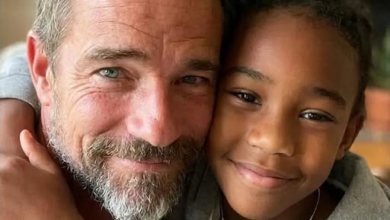
My Teen Son Sewed 20 Teddy Bears from His Late Dad’s Shirts for a Local Shelter – When 4 Armed Deputies Showed Up at Dawn, I Was Stunned by What They Pulled out of Their Cruiser

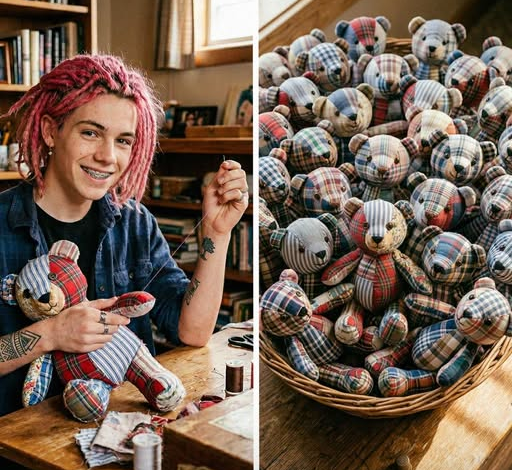
After my husband died, I thought our world had shrunk beyond repair—until my son began piecing something hopeful out of the wreckage. So when a line of sheriff’s cars pulled up before sunrise, I realized everything we thought we understood about loss—and about Ethan’s legacy—was about to shift.
You don’t realize how loud silence can be until you’re the only one left in a house. It’s not just the lack of voices—it’s the hum of the air, the buzz of the refrigerator, the way quiet settles into your chest when you try to sleep.
Fourteen months ago, my husband Ethan was killed on duty. He was a police officer—the kind who never hesitated to run toward danger.
He didn’t make it home from his final call.
I believed the hardest part would be the funeral. It wasn’t. It was everything after—the casseroles stopping, the visitors fading, the house emptying out until I was left staring at laundry that still smelled like him.
Since then, it’s just been me and Mason.
Mason is fifteen now. He’s always been quiet—the kind of kid who’d rather watch clouds drift than chase a ball. After Ethan died, he withdrew even more. No anger, no rebellion—just a quiet retreat inward while the house grew heavier with silence.
Sewing has always been his thing. My mother taught me, and I passed it down to him. When he was little, he’d sneak scraps from my sewing basket and make tiny pillows for his toys.
While other boys obsessed over sports, Mason preferred sitting at the table, focused and steady, working with his hands.
People teased him for it.
He never argued. He just kept stitching.
A few weeks after the funeral, I found him sewing a patch onto his backpack. He held the thread between his teeth, his fingers moving with practiced ease.
“What are you working on?” I asked lightly.
“Just fixing it,” he said with a shrug.
Then I noticed the fabric.
It was one of Ethan’s old blue plaid shirts—the one he wore on fishing trips.
My chest tightened.
“You miss him too?” I asked softly.
He nodded without looking up. “Every day, Mom.”
I wanted to say something meaningful.
But nothing felt big enough.
Over the next few months, Mason poured himself into sewing.
He repaired towels, hemmed jeans, made curtains for his room. Late at night, I’d hear the sewing machine humming long after I went to bed.
Slowly, Ethan’s clothes began to disappear—shirts, ties, old T-shirts. At first, I thought Mason was just holding on to memories.
But it became clear he was creating something.
I just didn’t know what.
One afternoon, I found him standing in front of Ethan’s closet, fists clenched.
“Mom,” he said, his voice tight, “can I use Dad’s shirts?”
The question hurt—but I could see how carefully he was asking.
He wasn’t taking.
He was asking permission.
I stepped closer, pulled one of Ethan’s favorite shirts from the closet, and handed it to him.
“Your dad spent his life helping people,” I said quietly. “I think he’d be proud of whatever you make.”
“Thanks, Mom.”
That night, he got to work.
He spread the shirts across the table, sorting them by color and texture, measuring, cutting, sewing—all in quiet concentration except for the faint tune he hummed, one Ethan used to whistle.
I tried not to hover, but I couldn’t help watching.
Sometimes I’d stand in the hallway, listening to the steady rhythm of the sewing machine.
One morning, I found him asleep at the table, surrounded by fabric scraps, a needle still in his hand.
“Mason,” I whispered, brushing his hair back. “Go to bed.”
“Almost done,” he murmured.
By the second week, the kitchen was chaos—fabric everywhere, thread trailing across counters, stuffing spilling near the fridge.
“Are you building a stuffed animal army?” I teased.
He laughed. “Not an army… more like a rescue team.”
He finished late one Sunday.
Twenty teddy bears sat lined up across the table.
Each one unique.
He looked at me, suddenly unsure. “Do you think I could give them away?”
“To who?” I asked, picking one up. It smelled faintly of Ethan.
“The shelter. The kids there… they don’t have much.”
My throat tightened.
“Your dad would love that.”
We packed them together, each bear tucked with a handwritten note:
Made with love. You are not alone. —Mason
At the shelter, Spencer greeted us warmly.
“Did you make all these?” he asked Mason.
Mason nodded shyly.
“The kids are going to love them,” Spencer said.
A little girl peeked around the corner.
Mason knelt. “Go ahead. Pick one.”
Her face lit up.
Spencer looked at me. “You’ve raised a good kid.”
“He gets that from his dad,” I said.
For the first time in months, something inside me felt lighter.
Spencer showed us around, including a small sewing corner with an old machine and worn-out materials.
Mason’s eyes lit up.
“Could I help here sometime?”
“We’d love that.”
On the drive home, Mason was quiet—but different.
“Did you like it?” I asked.
“Yeah,” he said softly. “I really did.”
That night, he left a small bear on my pillow.
“So you’re not alone,” he said.
I held it tightly.
For the first time, I believed we might be okay.
Then came Wednesday morning.
A loud knock at the door jolted me awake.
Outside—two sheriff’s cars and a black town car.
My stomach dropped.
“Mason,” I called. “Stay behind me.”
We stepped outside.
A deputy spoke. “Ma’am, we need you to come with us.”
Panic surged.
“Is my son in trouble?”
“Just come outside.”
Neighbors watched from behind curtains.
Another deputy opened a trunk.
Inside—
Sewing machines. Fabric. Thread. Supplies.
I blinked in disbelief.
Then they handed me an envelope.
“We need to know who made the bears,” one said.
“I did,” Mason said quickly. “I didn’t know if I used something I shouldn’t have—like Dad’s police shirt…”
Then a man stepped forward.
“My name is Henry,” he said.
“This started with your husband—but I’m here because of your son.”
He explained:
Years ago, Ethan had saved his life.
He’d never forgotten.
Yesterday, he saw Mason’s work.
“And I knew exactly whose son he was.”
He gestured to the supplies.
“I want to support this. These are for the shelter. My foundation is funding a sewing program—and a scholarship for Mason. We’re calling it the Ethan and Mason Comfort Project.”
I could barely process it.
“All this… because of twenty teddy bears?”
“Yes,” Spencer said, stepping forward. “The county approved everything this morning.”
Mason looked at me.
“If you want,” I said, “I’ll take you every day.”
He smiled.
“I want to.”
Henry handed him a small box.
Inside was a silver thimble engraved with Ethan’s badge number and the words:
For hands that heal, not hurt.
Mason held it carefully.
“I just didn’t want Dad’s shirts to sit there forever,” he said.
Henry smiled. “Your father saved lives with courage. You’re changing them with kindness.”
I looked at my son.
“Your dad ran toward people in pain,” I said. “You found your own way to do the same.”
That afternoon, the shelter buzzed with laughter as Mason showed kids how to sew.
I stood in the doorway, listening.
Back home, the hum of the sewing machine filled the house again.
But now, it wasn’t empty.
For fourteen months, grief had made everything feel smaller.
Now, something new was taking shape.
Not just memories.
Not just loss.
But a future.