The Backpack Burst Open and My Blood Ran Cold, The Terrifying Secret My Daughters Hungry Classmate Was Hiding

In our house, the word “enough” was never soft or comforting. It was something I calculated constantly—on grocery lists, on receipts, in the quiet moments when I stretched meals and hoped they would last just a little longer. We lived in that fragile middle ground where nothing was guaranteed, where one unexpected expense could unravel everything. I told myself that if I planned carefully enough, worked hard enough, we could stay afloat. That “enough” was something you could create if you just tried hard enough.
Then one ordinary Tuesday, that belief cracked.
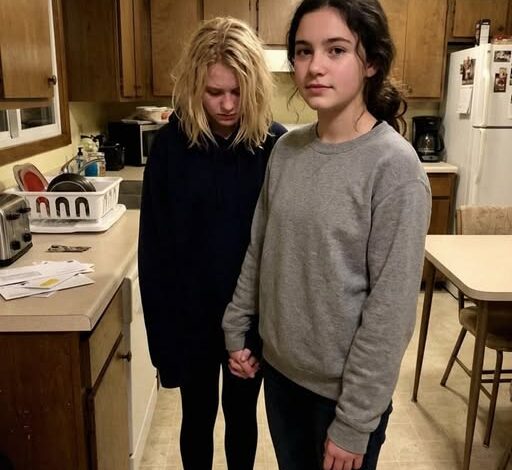
Sam came through the door with a girl I had never seen before. She didn’t ask—she announced.
“Lizie’s eating with us.”
The girl stood just behind her, small and quiet, almost as if she were trying to disappear. Her hoodie hung loosely on her frame, her sleeves pulled down over her hands. She didn’t look at me. She didn’t look at anything. She just stood there, holding her backpack tightly, like it was the only thing grounding her.
I looked at the table.
Three plates.
Three portions I had already measured out in my head for tonight and tomorrow.
And for a moment—just a moment—I felt it. That flash of frustration. That tight, defensive instinct.
We barely have enough.
But I stepped aside.
“Sit down,” I said.
She barely ate.
A small scoop of rice. A single piece of chicken. Careful. Measured. Like she was afraid of taking too much.
She drank water quickly, like her body needed it more than anything else.
And she flinched—at the sound of forks, at chairs moving, at voices that weren’t even raised.
Something about it didn’t sit right.
Not just hunger.
Something deeper.
By the end of the week, Lizie kept coming back.
Always quiet. Always polite. Always apologizing for being there.
Sam didn’t explain much at first. Just insisted.
“She’s staying for dinner.”
Again. And again.
And slowly, the irritation I had felt that first night disappeared, replaced by something heavier.
A question I didn’t want to ask.
The answer came on a Monday.
Her backpack fell open at our kitchen counter, papers spilling out across the floor. I bent down to help gather them, thinking they were school assignments.
They weren’t.
They were bills.
Crumpled. Overdue. Stamped with warnings.
And then I saw the notebook.
A simple page, written in careful handwriting:
“What we take first if we get evicted.”
My hands went cold.
“Lizie… what is this?” I asked quietly.
She froze.
For a second, she didn’t move at all. Then her shoulders tightened, like she had been caught doing something wrong.
“It’s nothing,” she whispered.
But it wasn’t nothing.
It was everything.
She told us in pieces.
Her father had been struggling since her mother died. Work wasn’t steady. Bills kept piling up. They had tried staying with relatives, but there wasn’t space.
They were close to losing everything.
And she had been carrying that reality alone.
Quietly.
In a purple backpack.
When her father came to pick her up, I understood something I hadn’t before.
He wasn’t careless.
He wasn’t irresponsible.
He was tired.
The kind of tired that settles into your bones after trying—and failing—to hold everything together for too long.
When he saw the papers on the table, his first reaction wasn’t anger.
It was pride.
Defensive. Wounded pride.
“She shouldn’t have brought that here,” he said.
But his voice didn’t hold.
Because the truth was already in the room.
That night changed everything.
Not because a problem was solved.
But because it was finally seen.
We stopped pretending.
We made calls.
To the school.
To local support services.
To anyone who might help.
And something unexpected happened.
People showed up.
Not all at once. Not in dramatic ways.
But enough.
Small solutions. Small support.
Enough to make a difference.
Lizie started staying with us some nights.
At first, she moved through the house like she was afraid to leave a mark.
But slowly, that changed.
She laughed.
She talked.
She ate—really ate.
And color came back to her face.
Sam changed too.
She became more focused, more grounded.
They helped each other—homework, conversations, just… being there.
And I realized something I hadn’t understood before.
Strength doesn’t always look like holding everything together.
Sometimes it looks like refusing to ignore someone else falling apart.
Our life didn’t suddenly become easy.
I still count groceries.
I still worry about bills.
That hasn’t changed.
But something else has.
The way I see “enough.”
Because now, when I set the table, I don’t hesitate.
There are four plates.
Not because it’s convenient.
Not because we suddenly have more.
But because we chose to make space.
One night, Lizie hugged me before leaving.
“Goodnight, Aunt Helena,” she said softly.
And in that moment, something settled inside me.
Not relief.
Not resolution.
But clarity.
We had spent so long believing we didn’t have enough to share.
But the truth was—
what we had been missing wasn’t resources.
It was perspective.
We aren’t wealthy.
We still live carefully.
But our house feels different now.
Louder.
Warmer.
Full.
And I understand something I didn’t before:
“Enough” isn’t always about what you have.
Sometimes, it’s about what you choose to give anyway.