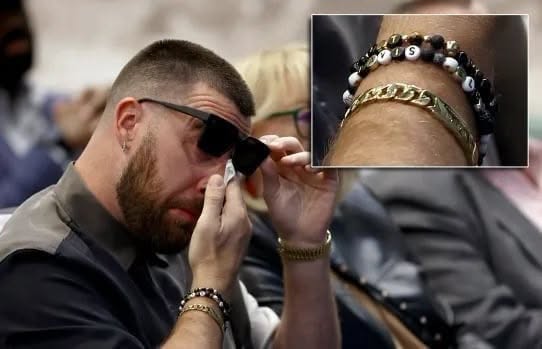
He chose to speak with care, not because he had something to hide, but because he understood how easily details can overshadow meaning. Instead of naming the diagnosis or inviting public analysis, Kelce centered his words on what the experience did to them—the emotional aftershock that followed, the way ordinary life was abruptly interrupted, and the quiet realization that nothing was as guaranteed as it once felt.
He described the moment as disorienting. One day everything had a clear rhythm—plans, routines, expectations—and the next, that structure dissolved. The future, once mapped out in comfortable assumptions, became uncertain. In its place came a sharper awareness of the present. Decisions that once felt distant suddenly became immediate, and priorities rearranged themselves without discussion. What mattered revealed itself quickly, almost instinctively.
Rather than facing that upheaval in public, they stepped back. They created distance from the noise—no speculation, no outside narratives—just a smaller, more protected space where they could process what was happening in their own time. In that space, presence became everything. It wasn’t about fixing the situation or having the right words; it was about being there, consistently, even in silence. The kind of presence that doesn’t demand answers, but offers steadiness.
Kelce spoke about how that period stripped life down to its core. The things that once filled their days—obligations, distractions, expectations—fell away, leaving behind something simpler but more meaningful. Time slowed. Conversations deepened. Even the quiet moments carried weight. Support from family and close friends wasn’t just helpful—it was essential. It became the framework that allowed them to keep moving forward, even when they didn’t know what the outcome would be.
What stood out most was how the experience reshaped their connection. There’s a common assumption that pressure exposes cracks, but for them, it revealed strength. The bond between them didn’t just endure—it evolved. There was a heightened awareness of each other’s needs, a deeper patience, and a kind of unspoken understanding that only comes from facing something difficult together. Love, in that context, wasn’t loud or performative—it was steady, intentional, and grounded in action.
Over time, the intensity of the fear began to soften. Not all at once, and not without moments of uncertainty, but gradually. Stability returned in small increments—first in routine, then in confidence, and eventually in the ability to look forward again. With that shift came a sense of gratitude that felt different from before. It wasn’t tied to achievements or milestones, but to presence itself—to the simple fact of being together, of having made it through something that once felt overwhelming.
When he finally chose to share the story, it wasn’t framed as a dramatic reveal. It was measured, almost understated, because the point wasn’t the specifics—it was the experience. He wasn’t asking for sympathy or attention. If anything, he was pushing against the idea that vulnerability needs to be fully exposed to be understood. Instead, he offered something more universal: the emotional truth of being blindsided by life and finding a way through it.
In doing so, he created space for others to see themselves in that experience. Because while the circumstances may differ, the feeling is familiar—the moment when everything changes without warning, when control slips away, and when the only thing left to hold onto is the people beside you. His story became less about what happened to them and more about what it revealed: that resilience often grows quietly, that love deepens under pressure, and that even in the most uncertain seasons, there is still a path forward.
It’s a reminder that strength isn’t always loud, and healing isn’t always visible. Sometimes, it’s found in the decision to stay present, to keep showing up, and to trust that even the hardest chapters can lead to something steadier on the other side.