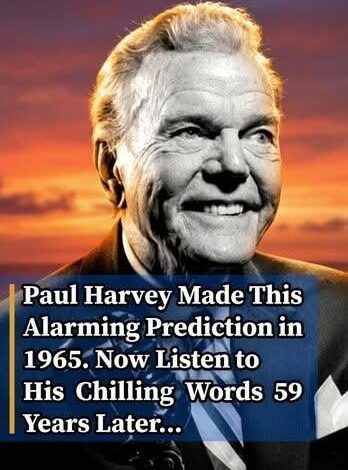
In 1965, legendary radio broadcaster Paul Harvey delivered a short commentary that would quietly outlive the moment in which it was created.
Known today by the phrase “If I Were the Devil,” the broadcast has continued to circulate for decades, passed from one generation of listeners to another. It is often shared as though it were a prophecy, a chilling prediction of modern life made long before many of today’s cultural and technological changes existed. But its lasting power does not come only from the idea that Harvey somehow saw the future clearly. Its deeper strength lies in the way it encourages people to think about how societies change, how values shift, and how small choices can slowly reshape the world around us.
At first, the title sounds dramatic, even alarming. “If I Were the Devil” suggests a warning about evil, collapse, and moral danger. Yet the commentary itself is not built around panic. Harvey does not describe a sudden catastrophe. He does not suggest that society falls apart all at once. Instead, he imagines a slower process, one that happens gradually, almost quietly, through compromise, distraction, comfort, and neglect.
That is what makes the message so memorable.
Harvey’s commentary uses symbolism rather than specific prediction. He speaks through a hypothetical voice to explore how a culture might weaken itself from within. His imagined scenario is not about one event, one political party, one generation, or one enemy. It is about the fragile nature of values when they are no longer practiced, protected, or passed down with intention.
In his vision, character does not disappear overnight. Responsibility does not vanish in one dramatic moment. Faith, discipline, family, patience, humility, and moral courage are not destroyed by a single force. They fade when people stop paying attention to them. They weaken when convenience becomes more important than conviction. They become less visible when noise replaces reflection and when comfort becomes the highest goal.
That idea made the commentary powerful in its own time.
When Harvey first delivered it, America was moving through a period of enormous change. The 1960s were marked by political conflict, generational tension, civil rights struggles, war, shifting social norms, and a growing sense that older certainties were being challenged. Radio commentators often used stories, parables, and moral reflections to help audiences process those changes. Harvey was especially skilled at presenting complex concerns in plain, memorable language.
Within that context, “If I Were the Devil” was not simply a message of fear. It was a call to awareness.
It asked listeners to consider what happens when people become careless with the things they claim to value. It challenged them to think about whether a society can remain strong if its people become too distracted to notice what they are losing. It suggested that cultural decline is rarely obvious while it is happening, because it often comes disguised as progress, entertainment, ease, or personal freedom without responsibility.
More than sixty years later, the commentary is heard very differently.
Modern listeners often encounter Harvey’s words online, far removed from the radio world of the 1960s. They hear the message in an age of smartphones, social media, instant communication, constant advertising, political polarization, digital outrage, and nonstop news. Because of that, many people feel that his concerns about distraction, moral confusion, weakened relationships, and misplaced priorities sound surprisingly familiar.
Harvey spoke long before the world carried the internet in its pocket. He spoke before social media feeds became a daily habit, before news alerts interrupted meals, before attention became one of the most valuable commodities in the economy. And yet, his warning about distraction resonates strongly in a time when many people feel pulled in every direction at once.
The struggle to focus is not new, but it has become more visible.
The difficulty of maintaining meaningful relationships is not new, but modern life often makes it easier to stay connected superficially while becoming emotionally distant. The temptation to choose immediate pleasure over long-term purpose is not new, but today it is reinforced by endless forms of entertainment, consumption, and instant reward.
That is why Harvey’s message continues to feel relevant. It speaks to problems that may appear modern but are rooted in timeless human weakness.
Every generation has faced distraction. Every generation has struggled with pride, greed, fear, impatience, and the desire for comfort. Every generation has had to decide whether it will protect the values it inherited, question them wisely, or abandon them carelessly. The details change, but the deeper challenge remains the same.
One reason “If I Were the Devil” continues to be shared is that it invites personal reflection. It does not require listeners to agree with every line in order to understand its larger point. Its power comes from the question it raises: what happens when people stop examining the direction of their own lives?
Harvey’s commentary does not only point outward at society. It points inward at the individual.
It asks listeners to consider their own habits. Their own priorities. Their own use of time. Their own willingness to stand for something meaningful. It suggests that culture is not shaped only by politicians, institutions, schools, churches, media, or corporations. It is also shaped by ordinary people making ordinary decisions every day.
A society changes when enough individuals change what they tolerate, what they celebrate, what they ignore, and what they teach.
That idea remains important today.
In a world filled with constant notifications, arguments, headlines, opinions, and distractions, reflection can feel increasingly rare. Many people move from one demand to another, one screen to another, one crisis to another, without ever stopping long enough to ask whether the life they are living matches the values they claim to hold.
Harvey’s message reminds listeners that reflection is not a luxury. It is necessary. Without it, people can drift into habits they never consciously chose. Families can grow distant without realizing it. Communities can become divided without remembering what once held them together. Individuals can become busy, entertained, and informed, yet still feel spiritually or emotionally empty.
That is why the commentary endures.
It is not simply because of nostalgia for Paul Harvey’s voice or the era in which he spoke. It is because he captured a truth that remains uncomfortable: meaningful decline often begins quietly. It begins when people become too distracted to notice what they are trading away. It begins when small compromises no longer feel small. It begins when values become slogans instead of practices.
But Harvey’s message can also be read as hopeful.
If negative change begins through small choices, then positive change can begin the same way.
A person can choose to be more present. A family can choose to talk more honestly. A community can choose to rebuild trust. A society can choose to value responsibility, compassion, patience, and truth more than noise and convenience. The direction of a culture is not fixed. It is shaped every day by what people decide to preserve and what they decide to let go.
That may be the most enduring lesson of the broadcast.
Harvey was not simply warning that things could get worse. He was reminding people that they have a role in whether they do. His commentary does not ask listeners to despair. It asks them to pay attention.
It asks them to notice what is being normalized. To question what is being sacrificed. To think carefully about what kind of world their daily choices are helping create.
More than six decades after it first aired, “If I Were the Devil” continues to spark conversation because it reaches beyond a single historical moment. It speaks to universal concerns about character, responsibility, family, attention, faith, morality, and the quiet ways human beings can lose sight of what matters most.
Revisiting Paul Harvey’s words today feels less like hearing an old broadcast and more like encountering a mirror.
It reflects the anxieties of the 1960s, but it also reflects the pressures of the present. It reminds us that technology may change, culture may shift, and public debates may take new forms, but the basic questions remain familiar.
What do we value?
What are we becoming?
What are we allowing ourselves to ignore?
Values do not disappear all at once. Priorities do not shift overnight. A society does not lose its direction in a single day. It happens slowly, through millions of choices, habits, silences, distractions, and compromises.
And perhaps that is why Paul Harvey’s message still resonates so strongly.
Not because it tells people exactly what to think.
But because it challenges them to think at all.
In an age when attention is constantly pulled outward, that may be the most important reminder of all.