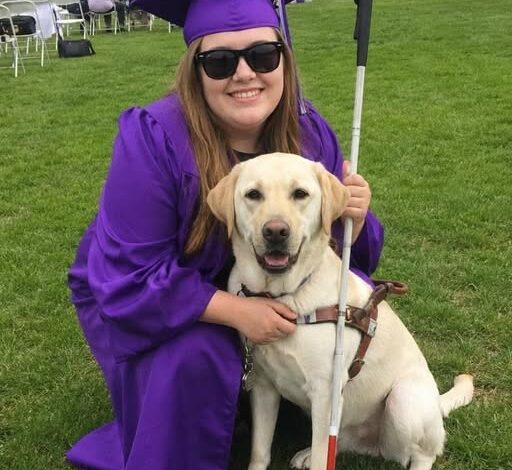
At Graduation, My Blind Daughter’s Guide Dog Started Barking at a Man – Then I Looked Up, and When I Saw Who Was Standing in Front of Me, My Knees Went Weak

The Truth Mark Left Behind
For years, I believed the worst thing that could happen to a family had already happened to ours.
I believed tragedy had reached its limit, that grief—no matter how cruel—eventually stopped multiplying, that it settled into something manageable over time.
I was wrong in ways I still struggle to fully name.
The crash had taken my husband.
The river had swallowed answers before it had swallowed metal.
Time had stolen certainty, replacing it with fragments of memory that refused to align cleanly.
And yet, somehow, even after all that loss, there was still more waiting for us.
More pain.
More truth.
More darkness hidden beneath the version of the story we had learned to survive.
The night Mark died became the dividing line of our existence.
Everything in life split into two halves: before the crash and after it.
Before, there had been routines so ordinary they felt invisible at the time.
Arguments about grocery lists left on counters.
School concerts we were almost late to.
Shared coffee in half-awake silence.
Missed appointments we laughed about later.
Sunday mornings filled with soft light and unremarkable happiness—the kind people only recognize in hindsight.
After the crash, there was only absence.
An empty chair that never stopped being noticed.
An unanswered phone that I still sometimes expected to ring.
A silence that did not fade but settled, as though the house itself had learned to grieve.
For years, I believed that silence was the final chapter.
That grief, once complete, simply endured without new revelations.
Then Jonah arrived with an envelope.
And everything changed again.
The Envelope
It looked ordinary in a way that felt almost offensive.
Plain brown paper.
Folded edges worn soft from handling.
No markings, no handwriting, no indication that inside it waited something capable of bending time backward.
Jonah placed it on my kitchen table without a word.
The wood beneath it felt suddenly too small, as though the object carried more weight than paper should be allowed to hold.
Sunlight drifted across the surface of the table, catching dust in slow motion.
I remember staring at it longer than I needed to.
Not because I didn’t understand what it was.
But because some part of me already did.
There are moments in life when you can feel change approaching before it reveals itself.
Not clearly.
Not logically.
Just as pressure in the air before a storm breaks.
Nora sat across from me.
She was twenty now, though in my mind she still sometimes existed as the child she had been before everything shattered.
She had grown into someone stronger than the world ever expected her to be.
People often confused blindness with fragility, as though the absence of sight meant the absence of strength.
Nora despised that assumption.
She had spent years dismantling it piece by piece.
Her head tilted slightly.
Her fingers reached forward, brushing the edge of the envelope with careful curiosity.
“What is it?” she asked.
Jonah hesitated, as though the answer carried consequences.
“A storage key,” he finally said.
The room changed temperature.
Not physically—but perceptibly, like the air had tightened.
Storage key.
Two words that should have meant almost nothing.
But they did not belong in a world where Mark had been gone for years.
Dead men were not supposed to leave anything behind except memory.
And yet here it was.
Proof that something had been waiting for us all along.
Hearing Mark Again
The storage facility sat far outside the places we usually traveled, as though it had been placed there intentionally to be forgotten.
Thirty miles of road separated it from anything familiar.
Rows of identical metal doors stretched across cracked concrete.
No signs of life beyond flickering lights and distant wind.
It felt less like a building and more like a pause in time.
Mark had chosen it carefully, or so it seemed now.
Inside, the air smelled of dust and old cardboard.
The silence was heavier than expected.
We found boxes first.
Then more boxes.
Then files—organized with a precision that made my chest tighten.
Documents.
Photographs.
Receipts.
Names written in margins.
Dates circled and underlined.
Entire narratives reconstructed in paper form, as though he had been preparing to testify against a future we had not yet reached.
And then, buried beneath layers of folders, was a small digital recorder.
I didn’t need to be told what it was.
I already knew.
My hands shook when I picked it up.
Pressing play felt like stepping off a ledge I hadn’t realized I was standing on.
Then his voice returned.
Not as memory.
Not as imagination.
But as sound.
Real.
Present.
Immediate.
The world narrowed instantly.
Mark spoke calmly, as if continuing a conversation interrupted by nothing more serious than a delayed return home.
Not death.
Not tragedy.
Not years of absence.
Just delay.
The cruelty of hearing him again nearly broke something inside me.
But the gift of it was worse.
Because it made everything real again in a way I had survived avoiding.
Nora sat beside me completely still, as though movement might fracture the moment.
Her hands held the recorder as if it were fragile life itself.
Mark’s voice filled the space between us.
He spoke of fear.
Not the kind that comes from strangers or accidents.
But a specific, quiet fear.
The fear of someone close.
Someone trusted.
Someone who should have been safe.
That sentence alone shifted the ground beneath everything we thought we knew.
Because grief had always pointed outward.
At fate.
At chance.
At randomness.
Now it turned inward.
Toward people we had loved without hesitation.
Toward relationships we had never questioned.
Toward betrayal we were not prepared to imagine.
Nora Refuses to Look Away
Most parents spend their lives trying to shield their children from pain.
I spent mine trying to shield Nora from uncertainty.
From unanswered questions.
From rumors that form when truth is absent.
From the kind of silence that invites people to invent their own explanations.
But Nora had inherited something from Mark that I could never protect her from.
Stubbornness.
Persistence.
The unwillingness to accept incomplete stories.
The moment she realized the boxes contained answers, she did not retreat.
If anything, she leaned closer.
I worried constantly as she worked through everything.
The documents were exhausting even for me.
The recordings were emotionally draining beyond expectation.
But Nora absorbed them differently.
Not less deeply—but more deliberately.
She learned through touch, through sound, through repetition.
Hours became days.
Days became weeks.
Every detail mattered.
Every inconsistency became a thread.
And she pulled at all of them.
Sometimes I would wake at night and find her still at the kitchen table.
Headphones on.
Shoulders slightly tense.
Listening again.
And again.
And again.
Not because she couldn’t move on.
But because she refused to miss anything.
Eventually I understood something that unsettled me.
She wasn’t trying to reopen the past.
She was trying to reclaim it.
Lydia
The name appeared where we least expected it.
Written in Mark’s handwriting.
Folded into documents that should not have connected to anything personal.
At first, I told myself it had to be another Lydia.
A coincidence.
A misinterpretation.
A fragment of unrelated information.
Because the Lydia we knew was not just a friend.
She was family in everything but name.
She had been present for years of our life.
Birthdays.
Holiday dinners.
Hospital visits.
School milestones.
Grief itself.
People imagine betrayal as loud.
As explosive.
As dramatic confrontation followed by immediate confession.
Real betrayal is rarely like that.
It is quieter.
Slower.
More exhausting.
It lives in hesitation.
In rereading the same sentence hoping it changes meaning.
In the growing realization that it does not.
When we finally confronted Lydia, there was no shouting.
No chaos.
Only silence that stretched too long between words.
And eventually, tears.
Not from one person.
From all of us.
The truth came in pieces, reluctantly, as though even it resisted being spoken aloud.
Lydia had known more than she admitted.
Not everything.
But enough.
Enough to shift outcomes.
Enough to redirect investigations.
Enough to allow certain questions to disappear before they were fully asked.
Fear had guided her.
Fear of consequences.
Fear of exposure.
Fear of losing the life she had built.
And in choosing safety for herself, she had unknowingly helped bury the truth we had spent years searching for.
The Weight of Knowing
People often assume truth feels like relief.
It does not.
Truth is heavier than uncertainty.
Uncertainty allows imagination to soften edges.
Truth removes that privilege.
Once you know, there is no longer room for alternative stories that comfort you.
The answers did not bring Mark back.
They did not restore what was taken.
They did not repair the years that had already passed.
But they did something else.
They gave direction.
For the first time, the story had shape.
Not a comforting shape.
But a real one.
And reality, even when painful, is stabilizing in a way illusion never can be.
The fragments began to align.
The gaps narrowed.
The darkness stopped being infinite.
It started having edges.
The Recital
Months later, Nora stood backstage holding her violin.
The air inside the auditorium carried the quiet hum of anticipation.
Programs rustled.
Seats shifted.
Soft conversations rose and fell like waves.
She had chosen this performance herself.
She wanted it dedicated to Mark—not privately, but openly.
She wanted his name spoken in a room full of strangers.
Not as tragedy.
But as presence.
When her name was announced, the room fell into stillness.
She walked onto the stage with steady steps.
Confident.
Composed.
Completely certain in a way I had never seen before.
The first note she played changed the atmosphere instantly.
Then another.
Then another.
Music filled the space where words could not.
And as she played, I realized I was no longer thinking only about what we lost.
I was thinking about what had survived.
His voice.
His intention.
His insistence that truth mattered even when it was dangerous.
Especially then.
Halfway through the piece, I stopped trying to hold back tears.
Not because I was only grieving.
But because something inside me finally understood what he had left us.
The Last Inheritance
Mark had known, in some part of himself, that he might not return.
That knowledge was embedded in every decision he made afterward.
He did not leave behind chaos.
He left structure.
Evidence.
Instructions.
Paths that would only make sense later.
Not for revenge.
Not for recognition.
But for truth.
He could not guarantee justice.
He could not guarantee resolution.
He could only guarantee possibility.
And somehow, that possibility survived long after him.
Jonah brought the envelope.
Scout uncovered the storage unit.
Nora interpreted what others could not.
And I finally stopped turning away.
Grief had kept me orbiting truth without entering it.
But orbiting is not the same as living.
Living requires contact.
Even when it burns.
What Remains
People ask what closure feels like.
The honest answer is that it does not arrive as an ending.
It arrives as integration.
Loss does not disappear.
Neither does love.
Neither does memory.
What changes is your capacity to carry them without breaking under their weight.
The recital ended with applause that filled the entire hall.
Nora bowed.
Mark’s name appeared beneath hers in the program.
Not as absence.
But as connection.
And as the sound of applause faded, I understood something I had spent years resisting:
We do not move on from truth.
We move with it.
And for the first time since the river took him, I stopped carrying it at a distance.
I let it stay where it belonged.
Within me.
Not as burden.
But as inheritance.