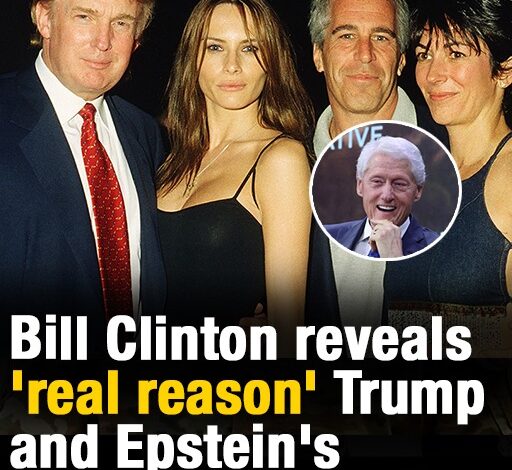
Clinton’s sworn testimony cuts directly into the core of the narrative Donald Trump and his allies have repeated for years about his relationship with Jeffrey Epstein. For a long time, Trump supporters have maintained that Trump distanced himself from Epstein out of moral concern, claiming he had grown uncomfortable with Epstein’s behavior and had ultimately barred him from Mar-a-Lago after inappropriate conduct involving young women. That version of events has often been framed as evidence that Trump recognized something troubling and chose to sever ties.
Clinton’s account, however, paints a noticeably different picture. According to his testimony, Trump did not describe the split with Epstein as a moral stand or a reaction to disturbing allegations. Instead, Clinton recalled a more personal and almost reflective moment during a charity golf event years ago. In that setting, Trump reportedly spoke about Epstein in a tone that suggested nostalgia rather than condemnation. Clinton said Trump remarked that the two of them “had some great times,” before explaining that their falling-out had stemmed from a dispute over a high-value property deal. The disagreement, described as a competitive bidding war over a luxury Palm Beach estate, appears in Clinton’s telling to have been the real breaking point.
Clinton recalled Trump expressing regret that things had ended the way they did, adding a simple remark along the lines of “I’m sorry it happened.” The exchange, as described, sounded less like someone describing a principled decision to cut off a problematic acquaintance and more like someone reflecting on a business relationship that had soured. In Clinton’s version, there was no dramatic declaration about protecting his club or distancing himself from troubling behavior—just a quiet acknowledgement that their relationship had ended badly.
That contrast between Trump’s public narrative and Clinton’s sworn recollection is what has now drawn attention in political circles. Trump has frequently pointed to his claimed early break with Epstein as proof that he was not aligned with him once allegations about Epstein began circulating. Clinton’s testimony, however, suggests that the personal dynamic between the two men may have been more complicated and perhaps ended for reasons unrelated to the conduct that later brought Epstein global scrutiny.
The moment described by Clinton might sound small on its own, but it carries broader implications when placed alongside the long history of public interactions between Trump and Epstein. Over the years, photographs have surfaced showing the two men together at social events in the 1990s and early 2000s. There are also well-known quotes from Trump during that era describing Epstein in friendly terms, remarks that critics often cite when questioning how closely the two moved within the same social circles. When those older records are considered together with Clinton’s testimony, the timeline of their relationship appears more layered than the simplified version that has often been presented.
The political reaction has been predictably divided. Some Republicans argue that Clinton’s statements should be viewed cautiously, suggesting that testimony alone does not change the basic fact that Trump and Epstein eventually went their separate ways. They maintain that business disputes frequently end relationships in elite social circles and that Clinton’s recollection does not prove anything about the deeper nature of the relationship.
Democrats and Trump critics, on the other hand, argue that the difference between the two narratives is significant. If the split was truly the result of a real-estate rivalry rather than concerns about Epstein’s behavior, they say it raises questions about how the relationship has been publicly characterized over time. For them, Clinton’s account adds another piece to a puzzle that investigators, journalists, and political observers have been examining for years.
What makes the testimony resonate in Washington is not just the story itself but the tone of the moment Clinton described. The casual remark—Trump reflecting that they once “had some great times” before their falling-out—suggests familiarity and social closeness during an earlier period. It implies a relationship that ended not with outrage or moral distance but with frustration over competition and personal disagreement.
As more documents, interviews, and testimonies continue to surface about the networks of wealthy figures who moved through Epstein’s orbit, each new account adds another layer of complexity. Clinton’s recollection does not by itself settle the debate over the exact nature of Trump’s relationship with Epstein, but it does challenge the idea that the break between them was clear-cut or driven purely by ethical concerns.
In the end, the story that emerges is one that appears less tidy than the simple narrative often presented in political messaging. Instead of a dramatic and principled separation, Clinton’s description suggests a relationship that faded after business tensions and personal rivalry intervened. And as old photographs, past interviews, and sworn testimony continue to circulate, the broader picture of how powerful figures once interacted with Epstein remains a subject of ongoing scrutiny and debate in American politics.