For Years My Mother Quietly Delivered a Christmas Eve Meal to a Man at the Laundromat—After She Passed Away, I Continued the Tradition and Discovered a Hidden Story of Gratitude, Redemption, and a Childhood Moment That Changed Our Lives in Ways I Never Fully Understood

Growing up, Christmas Eve in our home followed a rhythm that felt both comforting and quietly mysterious—a pattern so familiar that I never questioned it, yet so meaningful that I would spend years trying to fully understand it.
Like many families, we decorated a small tree and filled our apartment with soft lights that glowed warmly against the winter darkness. Music played gently in the background—sometimes classic carols, sometimes old songs my mother loved. By late afternoon, the kitchen would come alive with the scent of roasted meat, buttery potatoes, and fresh cornbread. It was the kind of warmth that made the outside cold feel distant, almost unreal.
But woven into all of that was something quieter—something my mother did every single year without ever explaining it.
After preparing dinner, she would always make one extra plate.
She didn’t rush it. She treated that plate with the same care as the ones we would eat ourselves—arranging the food neatly, making sure everything was warm, wrapping it carefully in foil. Then she would place it into a simple grocery bag. Sometimes she added small things: a pair of gloves, thick socks, or a scarf when the winter felt especially unforgiving.
And then we would leave.
At first, I assumed it was just part of the evening—a short drive, maybe a walk before coming back home. But as the years passed, the quiet repetition of it began to stir my curiosity.
One Christmas Eve, when I was about eight, I finally asked.
“Mom, who is the extra meal for?”
She paused, looked at me, and smiled in that gentle, knowing way she had.
“It’s for someone who might need it more than we do.”
That was all she said.
At the time, it felt like a simple answer. But in reality, it was the beginning of something much bigger than I could understand.
We drove just a few blocks to a small laundromat in our neighborhood. It was always nearly empty on Christmas Eve. The steady hum of machines echoed in the space, and the fluorescent lights gave everything a quiet, almost still feeling.
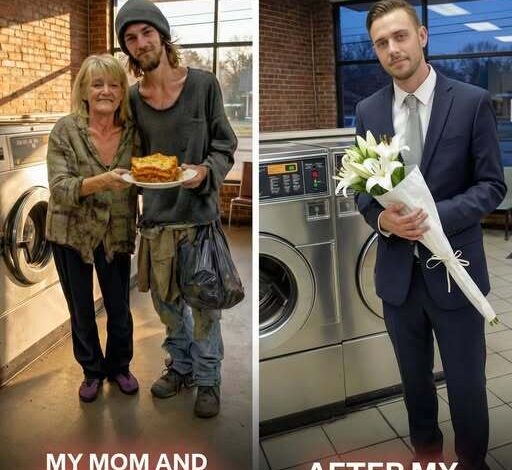
In the far corner, there was usually a young man sitting alone.
His name was Eli.
He never looked much older than his early twenties back then. His clothes were worn, but he carried himself with a quiet dignity that even I could sense as a child. My mother would walk over, kneel beside him, and hand him the bag.
“Merry Christmas,” she would say softly.
He would smile—small, grateful, almost shy—and thank her.
That was it. No long conversation. No attention drawn. Just a moment, shared quietly, and then we would leave.
As a child, I didn’t fully understand what I was witnessing. But over time, I began to see it more clearly.
My mother never treated Eli as someone beneath her.
She never spoke with pity.
She treated him like a person—someone worthy of respect, someone whose dignity mattered just as much as anyone else’s.
The meal wasn’t about charity.
It was about connection.
Year after year, the tradition continued.
Dinner at home.
One extra plate.
A short trip to the laundromat.
Eli never expected it. He never asked for anything more. But slowly, through brief conversations, pieces of his life began to surface. He had grown up in instability, moving between foster homes after losing his only sibling. Trust, for him, had never come easily.
And yet, he remained kind. Gentle. Grateful.
My mother listened when he spoke, but never pushed him. She offered help in small, careful ways—once mentioning a program that could help with job training and housing. When he hesitated, worried about becoming dependent, she didn’t insist.
She understood something I would only come to appreciate much later: that dignity sometimes means allowing people to choose their own path, even when it’s harder.
Years passed.
I grew up. Life moved forward the way it always does—quietly, steadily, without asking permission. School turned into work. Childhood softened into memory.
But every Christmas Eve, the tradition remained.
Until the year it didn’t.
My mother became ill, and it happened quickly. Faster than any of us were ready for. Within months, she was gone.
The silence she left behind was overwhelming.
The house felt different—too still, too empty. The traditions that once brought comfort now carried a weight I didn’t know how to hold.
When Christmas Eve came again, I stood alone in that same kitchen, staring at the counter where she had prepared so many meals. For a long time, I didn’t move.
Part of me wanted to let the tradition go.
It felt too painful.
But another part of me knew—deep down—what she would have wanted.
Kindness doesn’t end just because someone is gone.
So I cooked.
The same meal. The same way.
Roasted meat. Buttery potatoes. Cornbread.
And then I made one extra plate.
I wrapped it carefully, placed it in a grocery bag, and drove to the laundromat.
When I stepped inside, I froze.
Eli was there.
But he wasn’t the same man I remembered.
He stood taller somehow, wearing a neatly pressed suit. In his hands, he held a bouquet of white lilies.
For a moment, neither of us spoke.
Then he smiled.
And everything changed.
He told me that years earlier, something had shifted in his life. After many quiet conversations with my mother, he had finally taken her advice and reached out to a support program. It wasn’t easy, but step by step, he built something stable.
He found work. Gained confidence. Created a life.
And he never forgot her.
The lilies were for her.
He had come back to show her that her kindness had mattered—that it had made a difference.
He didn’t know she was gone.
Then he told me something I had never known.
When I was very young, I had gotten lost at a crowded county fair. I remembered the fear—the noise, the confusion—but not how it ended.
Eli had found me.
He had walked me to safety, to someone who could help me find my parents.
My mother never forgot that moment.
And every Christmas Eve after that, she repaid that kindness—not loudly, not publicly, but quietly, year after year.
Standing there, everything finally made sense.
Her tradition wasn’t about giving.
It was about gratitude.
Later that night, Eli and I visited her resting place. We laid the lilies beside her name. The air was cold, but there was a strange warmth in that moment—a sense that something had come full circle.
That her kindness hadn’t ended.
It had continued. Grown. Multiplied.
That night, I understood something I had missed for most of my life.
Kindness doesn’t have to be loud to be powerful.
It lives in small gestures.
In consistency.
In the quiet decision to see someone—to remind them they are not invisible.
Now, every Christmas Eve, I make an extra plate.
Not out of obligation.
But because I finally understand what it means.
My mother’s legacy isn’t something you can touch or measure.
It’s something that moves.
Through people.
Through time.
Through simple acts that ripple outward in ways we may never fully see.
Because sometimes, the most meaningful thing a person leaves behind isn’t something they said.
It’s something they did—quietly, consistently, and with love.