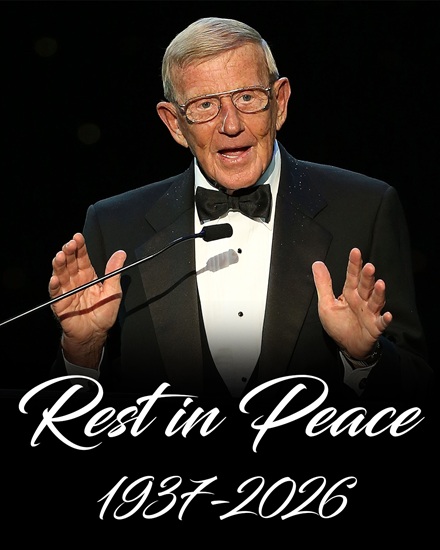
One of the most accomplished and respected figures in college football history has passed away. Lou Holtz, the Hall of Fame coach whose influence reached far beyond the scoreboard, died on March 4, 2026, at the age of 89.
His family confirmed his passing on Wednesday, sharing that he died in Orlando, Florida, surrounded by loved ones. No official cause of death was publicly announced.
Holtz’s death marks the end of an extraordinary life and career that spanned decades. More than just a successful football coach, he was known as a mentor, motivator, and teacher whose lessons extended well beyond the playing field. His impact touched thousands of players, colleagues, students, and fans.
Early Life and Introduction to Football
Louis Leo Holtz was born on January 6, 1937, in Follansbee, West Virginia, a small steel-town community along the Ohio River.
From a young age, Holtz developed a strong interest in sports. He later attended Kent State University, where he played linebacker and demonstrated the leadership qualities that would later define his coaching style.
His coaching career began in 1960 as a graduate assistant at the University of Iowa. There, he began learning the fundamentals of coaching, strategy, and leadership that would shape his future career.
After working as an assistant coach at several universities, Holtz received his first head coaching opportunity in 1969 at the College of William & Mary.
Building a Reputation as a Program Builder
Holtz quickly became known for his ability to transform struggling teams into competitive programs. Over the next 33 years, he coached six different college teams and even briefly entered the professional ranks.
William & Mary (1969–1971)
His first head coaching role allowed him to establish the foundation of his leadership philosophy. Although William & Mary was not a national powerhouse, Holtz’s focus on discipline and team culture began to take shape.
North Carolina State (1972–1975)
At NC State, Holtz strengthened his reputation as a capable program builder. His teams consistently posted winning records and helped raise the profile of the school’s football program.
New York Jets (1976)
Holtz briefly stepped into the NFL in 1976 as head coach of the New York Jets. Though the season ended with a 3–10 record and his tenure was short, the experience influenced his decision to focus on college coaching moving forward.
Arkansas (1977–1983)
Holtz gained national attention during his time at Arkansas. He compiled a record of 60–21–2, led the Razorbacks to six consecutive bowl games, and guided the team to a famous upset victory over top-ranked Oklahoma in the 1978 Orange Bowl.
Under his leadership, Arkansas became a respected and nationally competitive program.
Minnesota (1984–1985)
Holtz’s time at Minnesota was brief but productive. He helped improve the program’s competitiveness and set the stage for the next major chapter of his career.
The Notre Dame Era — His Defining Legacy
In 1986, Lou Holtz accepted the head coaching position at the University of Notre Dame, one of the most storied programs in college football. At the time, the team was struggling to reclaim its national prominence.
Holtz quickly changed that.
Winning Success
Over the next 11 seasons, he led Notre Dame to 100 victories, finishing with a record of 100–30–2. His teams were known for disciplined play, strong defense, and relentless preparation.
The 1988 National Championship
The defining moment of Holtz’s Notre Dame career came in 1988. That season, the Fighting Irish finished undefeated with a 12–0 record and won the national championship.
A dramatic victory over No. 1 Miami during that season became one of the most memorable games in college football history and cemented Holtz’s reputation as one of the sport’s great motivators and strategists.
Building Tradition
Holtz also reinforced traditions that remain part of Notre Dame football today. Among them was the famous “Play Like A Champion Today” sign that players touch before entering the field.
He also emphasized team unity by removing player names from jerseys, placing the focus on the team rather than individual recognition.
Developing Great Players
During his time at Notre Dame, Holtz coached many future stars, including:
- Tim Brown, the 1987 Heisman Trophy winner
- Raghib “Rocket” Ismail
- Michael Stonebreaker
- Aaron Taylor
- Chris Zorich
Many of these players later entered the College Football Hall of Fame.
Later Coaching Career
After leaving Notre Dame in 1996, Holtz briefly worked as a television analyst before returning to coaching in 1999 at the University of South Carolina.
Reviving South Carolina
When he arrived, the Gamecocks program had struggled, finishing the previous season with a 1–10 record.
Although his first year remained difficult, the program improved dramatically. In 2000, South Carolina finished 8–4 and won the Outback Bowl — one of the most impressive turnarounds in college football that season.
Holtz received national Coach of the Year honors for the achievement.
He coached at South Carolina until retiring in 2004.
By the end of his career, Holtz had compiled a record of 249 wins, 132 losses, and 7 ties, placing him among the most successful coaches in college football history.
He remains the only coach to lead six different college programs to bowl games.
Life After Coaching
Following retirement, Holtz became a familiar voice in sports broadcasting.
He served as a college football analyst for ESPN, where his lively personality, humor, and sharp insights made him a popular figure among viewers.
Beyond television, Holtz wrote books and became a sought-after motivational speaker. Drawing from his experiences in football, he spoke widely about leadership, perseverance, and character development.
His philosophy emphasized that sports were not only about winning but about shaping individuals to face life with integrity and determination.
Faith, Family, and Personal Values
Throughout his life, Holtz openly spoke about the importance of faith and family.
A devoted Roman Catholic, he often credited his beliefs with guiding his approach to coaching and leadership.
Holtz was married to his wife Beth for nearly 60 years until her death in 2020. Together they supported numerous charitable and educational initiatives.
The couple also contributed significantly to the University of Notre Dame, including funding chapel renovations and establishing scholarships for students.
Holtz is survived by their four children, nine grandchildren, and two great-grandchildren.
Honors and Recognition
Lou Holtz received numerous awards during his lifetime, including:
- Induction into the College Football Hall of Fame (2008)
- The Presidential Medal of Freedom (2020) — one of the highest civilian honors in the United States
However, many believe his greatest legacy lies not in trophies or titles, but in the lives he helped shape.
Thousands of former players credit Holtz with teaching them lessons about discipline, accountability, leadership, and resilience.
Tributes from the Football Community
Following the announcement of his death, tributes poured in from across the world of sports.
Former players, fellow coaches, broadcasters, and fans shared stories about how Holtz influenced their careers and personal lives.
At Notre Dame in particular, his impact remains deeply embedded in the program’s identity and traditions.
A Legacy Beyond Football
Lou Holtz’s life demonstrated the power of leadership grounded in humility, faith, and determination.
While his coaching achievements alone secured his place in football history, his broader legacy comes from the life lessons he shared and the example he set.
As many who knew him have said:
“Lou Holtz didn’t just coach football — he coached life.”
Though he is gone, the values he championed — faith, family, perseverance, and service — will continue to influence generations of athletes, coaches, and fans.