Jesse Jackson’s son slams Obama and Biden for using father’s funeral to ‘take shots at Trump’

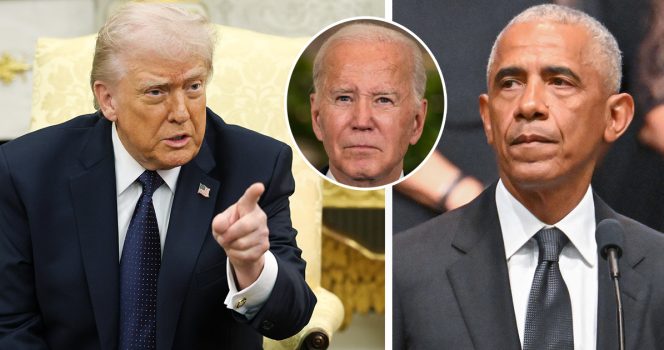
The farewell for Rev. Jesse Jackson drew some of the most prominent figures in American politics, but in the days following the memorial, public focus quickly shifted from the tributes themselves to the pointed criticism that emerged.
Jackson, who passed away on February 17 at age 84, had faced serious health challenges in his later years. He publicly disclosed a Parkinson’s diagnosis in 2017, and the Rainbow PUSH Coalition noted that he had also been living with progressive supranuclear palsy, a degenerative brain condition affecting movement, swallowing, and overall health. Throughout his life, Jackson became a towering figure in the civil rights movement, marching alongside Martin Luther King Jr., founding influential activist organizations, and running for the Democratic presidential nomination in both 1984 and 1988. His life and work reshaped the American political and social landscape, championing the rights of marginalized communities and inspiring generations of activists.
On March 6, thousands gathered at the House of Hope for a public memorial celebrating Jackson’s life. Among those in attendance were former Presidents Barack Obama, Joe Biden, and Bill Clinton, along with former Vice President Kamala Harris and other political and civic leaders. Media outlets described the gathering as a major public tribute, with speakers emphasizing Jackson’s role as a transformative force in politics, race relations, and faith-based activism. His legacy, they argued, was one of unwavering moral commitment and tireless advocacy for the disenfranchised.
Yet the memorial quickly became the backdrop for political debate. During their remarks, both Obama and Biden used the platform to address what they framed as threats to American democratic norms. Obama spoke of “daily assaults on democracy,” warning that Americans were waking up to repeated attacks on institutions, the rule of law, and basic decency. While he did not mention Donald Trump by name, his comments were widely interpreted as a critique of the former president and his influence on public institutions. Biden similarly commented on the “tough spot” in which the nation found itself, implicitly critiquing the current administration’s values.
While many attendees welcomed these observations as timely and necessary, not everyone agreed. The strongest criticism came from Jesse Jackson Jr., who spoke the following day at a smaller, private memorial at Rainbow PUSH Coalition headquarters. Jackson Jr. chastised the former presidents, stating that he had “listened for several hours to three United States presidents who do not know Jesse Jackson.” He emphasized that his father’s work transcended partisan politics, rooted instead in a moral mission to uplift the marginalized and advocate for justice. Jackson Jr. reminded attendees that the memorial should honor the full breadth of his father’s life, not serve as a stage for political messaging.
The critique was not entirely unexpected. In the wake of Jackson’s death, Jackson Jr. had urged the public and speakers alike to avoid overt political rhetoric during the memorial, emphasizing that people of all political backgrounds were welcome as long as they approached the service with respect. His insistence reflected a belief that Rev. Jackson’s life should not be reduced to partisan commentary but celebrated as a moral and civic touchstone for all Americans.
Meanwhile, the memorial unfolded amid additional controversy. On the day of Jackson’s passing, Donald Trump issued a statement on Truth Social praising Jackson while also taking a pointed jab at Obama, claiming that Jackson “could not stand” him. Multiple outlets reported that this claim lacked evidence and was widely considered false, highlighting the ongoing politicization of Jackson’s death and the way even his passing became embroiled in partisan disputes.
What makes the post-memorial debate so striking is that it underscores the enduring weight of Jackson’s life and legacy. He spent decades challenging inequality, injustice, and hypocrisy, and even in death, he remained a figure capable of drawing presidents, igniting public discussion, and spotlighting tensions between tribute and politics.
For some mourners, Obama and Biden’s speeches captured the moral urgency that Jackson exemplified throughout his life. For others—most notably his son—they represented a diversion from the true purpose of the memorial: to honor a man whose influence reached beyond partisan boundaries.
In the end, the public discourse following Rev. Jesse Jackson’s memorial made one thing unmistakably clear: his legacy is far from quiet or settled. It continues to inspire, provoke debate, and remind the nation that the struggle for justice and equality remains an ongoing challenge. Jackson’s life and work, and even the conversations surrounding his passing, remain a testament to the profound impact of a man who dedicated himself to speaking truth to power.