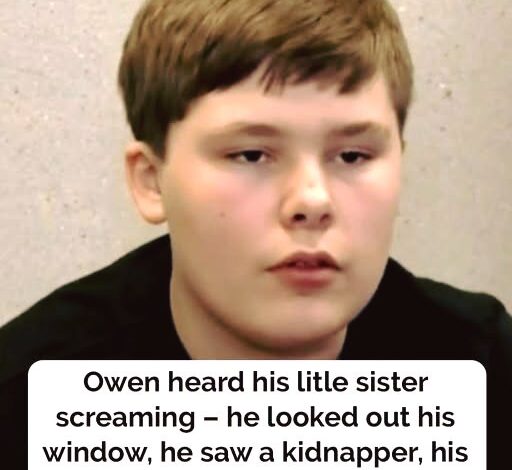
What unfolded in that Michigan yard lasted only moments, but its impact stretched far beyond them. One second, it was an ordinary day—familiar, predictable, safe. The next, that sense of normalcy fractured. Owen didn’t have time to think in abstract terms about danger or consequence. He reacted. A scream, a split-second decision, and a slingshot—something simple, almost childlike—became the interruption that mattered. It was enough to break the moment, enough to create a gap, enough for his sister to run.
She made it back inside.
And that, more than anything else, is what stays.
Within minutes, the quiet rhythm of the neighborhood was replaced by urgency. A mother racing home, fear already forming before she had the full picture. Doors opening, voices raised, sirens cutting through what had just been an ordinary afternoon. The kind of shift that leaves people standing in their driveways, trying to understand how something so serious could happen so quickly, and so close.
Police moved fast, detaining a teenage suspect nearby and beginning the process that always follows—gathering statements, reconstructing events, separating what is known from what is assumed. In the hours that followed, the story spread outward, picked up and retold, often with added certainty or detail that hadn’t yet been confirmed. Online, Owen was quickly framed as a hero, his actions distilled into a clear narrative people could hold onto.
Authorities, however, urged caution. They emphasized the importance of verified facts, of allowing the investigation to unfold before drawing conclusions. In situations like this, where fear and relief coexist, it’s easy for the story to become something larger than what can immediately be proven.
But even within that uncertainty, one thing remains clear.
A child is safe.
Because another child chose to act instead of freeze.
That doesn’t turn the moment into something simple or clean. It doesn’t erase the fear, or the questions that follow. For the family, the aftermath is not about headlines or labels—it’s about processing what almost happened. About replaying the moment in quieter, more personal ways. About realizing how thin the line can be between routine and crisis.
In the days that follow, the yard will look the same. The street will sound the same. But the feeling will be different. Awareness lingers in places where ease once lived. The ordinary takes on a sharper edge.
What happened didn’t last long.
But it will be remembered that way—
as the moment everything could have changed,
and didn’t.