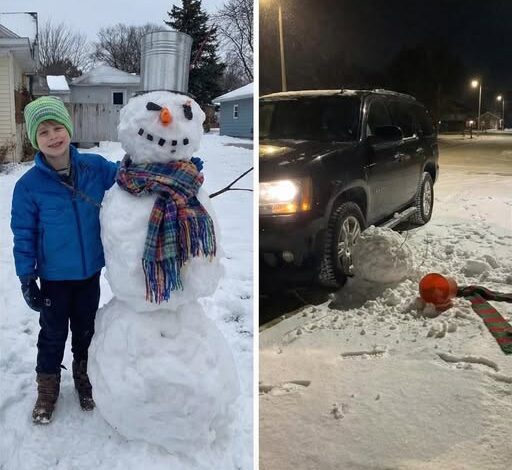
One winter not long ago, my eight-year-old son discovered a small tradition that quickly became the highlight of his afternoons. Every day after school, before even taking off his backpack, he would rush outside to the front yard to build a snowman. He always chose the same little corner of the lawn, near the edge of our driveway, where the snow seemed to gather perfectly after each snowfall.
What started as one snowman soon turned into a daily routine. Each figure he built had its own personality. Some had crooked smiles made of pebbles, others had stick arms raised like they were waving to passing cars. He even gave every one of them a name and a little backstory. One day it might be “Captain Snow,” a brave explorer of frozen lands, and the next day it might be “Mr. Frost,” a quiet snowman who liked watching the neighborhood from his spot near the road.
No matter what character he created, there was always one finishing touch: a bright red scarf that he carefully wrapped around the snowman’s neck. The scarf had belonged to him when he was younger, and he insisted that every snowman needed it to feel “complete.”
From the kitchen window, I loved watching him work. He would kneel in the snow, packing handfuls of powder into perfect spheres, occasionally stepping back to admire his progress like a tiny architect reviewing his design. Seeing him so absorbed in something simple reminded me how naturally children create joy out of the smallest moments.
But that little corner of our yard had another story unfolding.
Our neighbor had a habit of cutting across that exact patch of grass whenever he pulled his car into his driveway. Instead of turning properly into his parking spot, he would swing wide and drive over the edge of our lawn.
Every time he did it, his tires left deep tracks through the snow.
And more often than not, those tracks went straight through my son’s snowmen.
The first time it happened, my son was confused more than upset. He stood there staring at the crushed pile of snow where his creation had been.
“Maybe it just fell,” he said quietly.
But when it happened again the next day—and the day after that—he began to understand what was going on.
I decided to talk to our neighbor about it.
I approached him politely one afternoon and explained the situation. I told him that my son had been building snowmen there and asked if he could avoid driving over that section of the yard.
He nodded and said he would try.
But the next day, another snowman was flattened.
My son would come inside slowly after school, brushing snow off his gloves and boots, trying not to show how disappointed he was. He never cried, but I could see the frustration building in his eyes.
I suggested moving the snowmen closer to the house where cars couldn’t reach them.
But he shook his head.
“That’s my snowman spot,” he said firmly.
To him, it wasn’t just about building snowmen. It was about that particular place in the yard, the place he had claimed as his little creative corner.
After the fourth snowman was destroyed, I expected him to be angry or discouraged.
Instead, he walked inside that afternoon with an unusual calmness.
“I have an idea,” he said.
I assumed he might put up a sign or maybe build a small snow wall to protect his creations.
The next afternoon, I watched him from the kitchen window as he worked in the snow again.
This time, though, he built the biggest snowman I had ever seen him make. It was taller and wider than the others, standing proudly near the edge of the lawn where the driveway curved.
As he packed the snow around the base, I noticed something red peeking through near the bottom, but I didn’t think much about it at the time. I assumed it was just part of the scarf or maybe something he had used for decoration.
Later that evening, just as the sky was starting to darken, a loud crashing sound echoed outside.
I rushed to the window.
Our neighbor’s car had slammed directly into the fire hydrant at the corner of our yard.
Water was shooting high into the air like a fountain, spraying across the street and quickly freezing into sparkling mist in the cold evening air.
Within minutes, neighbors began stepping outside to see what had happened.
That’s when I realized what my son had done.
The hydrant had always marked the boundary where cars weren’t supposed to drive. But during heavy snowfall, it sometimes became hard to see.
My son had built his giant snowman around the hydrant, covering it with snow so that the bright red metal blended into the base of the figure.
When our neighbor drove across the yard again, he hadn’t noticed the hydrant hidden inside the snowman.
Thankfully, no one was injured.
City workers arrived soon after to repair the hydrant and shut off the spraying water. Our neighbor stood nearby looking embarrassed while explaining what had happened.
After that day, something changed.
He never drove across our lawn again.
For the rest of the winter, my son continued building snowmen in that same little corner of the yard. Some of them leaned to the side after a few warm afternoons, some melted slowly in the sun, and others collapsed after fresh snow fell overnight.
But not a single one was ever crushed by tire tracks again.
Looking back on that winter now, I realize it wasn’t just about snowmen. My son had quietly shown me something important—that sometimes the clearest way to protect a boundary isn’t through arguments or repeated requests.
Sometimes, it just takes a little creativity, a little patience, and a snowman built in exactly the right place.