Man Turns to AI for 2028 US Presidential Prediction and Receives a Jaw-Dropping Response, Sparking Shock, Debate, and Curiosity Online, Leaving Viewers Stunned by What the AI Suggested, Raising Questions About Technology, Human Fascination with the Future, and How Far People Will Go to Seek Answers That Might Never Truly Exist

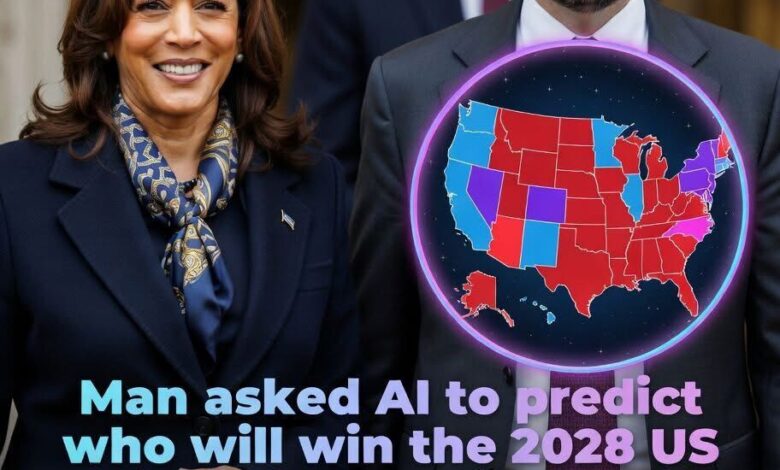
A recent AI-driven simulation of the 2028 U.S. presidential election has sparked widespread discussion online, blending political analysis with emerging technology to explore a hypothetical matchup between Kamala Harris and JD Vance. Created through a collaboration between the YouTube channel Election Time and xAI’s Grok AI, the project walks viewers through a full Electoral College scenario—drawing on polling data, demographic trends, historical voting patterns, and betting market signals. While clearly labeled as a simulation rather than a prediction, it has captured attention for how it frames possible dynamics of the next presidential race.
On the Democratic side, the model places Harris at the front of an early primary field, showing her with a noticeable lead over Gavin Newsom, while Pete Buttigieg and Alexandria Ocasio-Cortez trail further behind. The simulation highlights Harris’s potential for a political rebound following her loss to Donald Trump in 2024, pointing to factors like national recognition, fundraising strength, and renewed support within the party. It suggests that even after a major defeat, established figures can regain momentum when conditions shift in their favor.
On the Republican side, the projection shows Vance as a dominant force in the early stages, holding a significant lead over potential rivals like Donald Trump Jr., Marco Rubio, and Ron DeSantis. The model attributes this advantage to incumbency, party alignment, and continued Republican strength in key regions following the 2024 election cycle. It also reflects how quickly party bases can consolidate around a leading figure when political momentum is clear.
When mapping the Electoral College, the simulation begins with “safe” states—those with strong, consistent voting patterns. These initial allocations give Vance an early edge, reflecting Republican dominance across much of the South, Midwest, and interior West. Harris maintains a solid base along the West Coast and in parts of the Northeast, but the early numbers illustrate a structural challenge: Democrats must compete more aggressively in contested regions to close the gap.
As the model expands into “likely” states, the advantage for Vance grows. States such as Florida, Texas, and Arizona are projected to lean Republican, while Harris holds onto states like New York, Illinois, and Virginia—though sometimes with narrower margins than in previous cycles. This shift underscores how even traditionally “safe” regions can become more competitive over time, depending on turnout, messaging, and demographic changes.
The most critical part of the simulation lies in the battleground states. Places like Wisconsin, Michigan, and Pennsylvania—often decisive in modern elections—are shown narrowly favoring Vance, echoing patterns seen in recent cycles. Meanwhile, states like Minnesota and New Hampshire, long considered more reliably Democratic, are projected as extremely close, even tipping slightly Republican in this scenario. These subtle shifts highlight how small changes in voter behavior can have outsized effects on the final outcome.
In the end, the simulation produces a clear Electoral College victory for Vance, with a total well above the 270 threshold needed to win. Harris’s support remains concentrated in traditional Democratic strongholds, while Republican gains in swing states ultimately decide the map.
What makes this simulation noteworthy isn’t just the outcome—it’s the method. By combining data analysis with AI modeling, tools like Grok offer a way to explore “what-if” scenarios that help people better understand political trends. They don’t predict the future, but they do reveal patterns: how coalitions shift, how geography matters, and how fragile electoral advantages can be.
Ultimately, the takeaway is less about who wins in a hypothetical 2028 race and more about how elections are evolving. Demographics, regional changes, candidate positioning, and voter turnout all interact in complex ways—and simulations like this provide a lens through which those interactions can be examined.