My Daughter Revealed She Had Moved My Late Husband’s Savings — But She Never Knew About the Secret He Left Behind

After Arthur died of cancer, seventy-one-year-old Eleanor Vance felt as if the entire world had gone quiet.
For more than forty years, she and Arthur had built a life together. It had not been perfect, but it had been theirs. A house full of familiar routines. Morning coffee at the kitchen table. Quiet evenings in the garden. Shared bills, shared worries, shared laughter, and the comfort of knowing another person understood the shape of your life without needing every detail explained.
Then cancer came, and slowly their world narrowed.
Doctor appointments.
Medication schedules.
Hospital rooms.
Whispered prayers.
And finally, a silence so complete that Eleanor sometimes found herself turning toward Arthur’s chair before remembering he would never sit there again.
At the funeral, grief blurred most things together. Faces passed in front of her. Hands squeezed hers. Voices offered sympathy in soft tones that all began to sound the same. But one thing stayed sharp in her memory.
Her daughter Sarah and Sarah’s new husband, Patrick, seemed unusually interested in paperwork.
Not memories.
Not Arthur’s final days.
Not how Eleanor was holding herself together.
Accounts.
Documents.
Insurance.
Access.
They asked careful questions when they thought no one was paying attention. Patrick spoke in low tones about probate. Sarah mentioned bank forms twice before the burial had even happened.
Eleanor noticed it, but grief made her doubt herself.
Surely her daughter was only trying to help.
Surely Patrick, though still new to the family, was trying to be practical.
Surely no one would look at a widow standing beside her husband’s casket and think first of money.
So Eleanor pushed the discomfort aside.
But Arthur had noticed more than anyone realized.
Even near the end, when pain had thinned his voice and exhaustion had settled into his bones, Arthur remained observant. He had seen the way Patrick’s eyes moved around the house. He had heard Sarah’s questions about accounts and property. He had watched Eleanor excuse behavior that should have troubled her.
And because Arthur loved his wife more than anything, he prepared for the possibility that she might need protection after he was gone.
A few weeks after the funeral, Sarah came to the house with a folder tucked beneath her arm.
She sat across from Eleanor at the kitchen table, the same table where Arthur had once read the newspaper every morning, and spoke in a voice carefully shaped to sound helpful.
“Mom, there are some forms we need to update,” Sarah said. “It’s just for the joint savings account Dad set up years ago. Nothing complicated.”
Eleanor was tired. Grief had made every task feel heavier than it should. She trusted her daughter. She wanted to believe that family meant safety.
So she signed where Sarah pointed.
She did not ask enough questions.
She did not read every line.
She simply believed that her daughter had come to help.
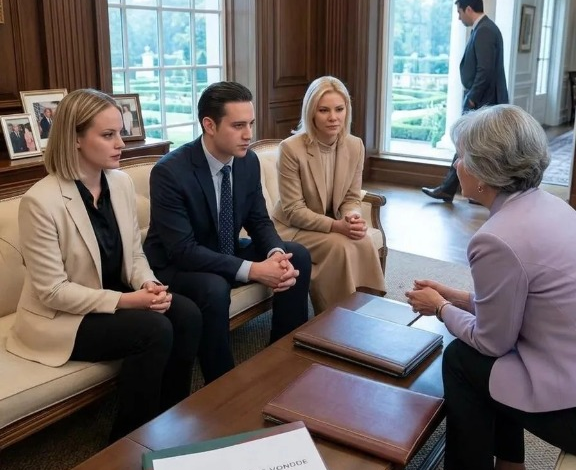
Soon after, Sarah and Patrick returned to the house together.
This time, they did not bother pretending for long.
Patrick stood near the fireplace with the stiff confidence of a man who believed he had already won. Sarah sat on the edge of the sofa, her hands folded in her lap, unable or unwilling to meet Eleanor’s eyes.
“We moved the money,” Patrick announced.
Eleanor looked at him carefully.
“What money?”
“The savings account,” Sarah said, her voice quieter. “The one Dad left accessible.”
Eleanor felt something cold move through her chest.
“How much?”
Patrick answered before Sarah could.
“All of it. One hundred thousand.”
For a moment, Eleanor could not speak.
Patrick continued, as if explaining something reasonable.
“It went into my business account. It makes more sense there. Your expenses are small now, and honestly, Eleanor, you’ve already lived your life. Sarah and I are building ours.”
The words landed harder than the number.
You’ve already lived your life.
As if she were no longer a person with mornings ahead of her.
As if love, comfort, safety, and choice belonged only to the young.
Sarah finally looked up.
“Mom, we need stability,” she said. “Patrick’s business has real potential. And you don’t need that money just sitting there.”
Eleanor stared at her daughter.
The child she had once held through fevers.
The girl whose lunches she packed, whose tears she wiped, whose school projects she stayed up late helping finish.
Now Sarah sat in front of her and spoke about Eleanor’s future as though it had already expired.
Patrick stepped farther into the room.
“There’s also the house to consider,” he said. “It’s too much for you to manage alone. Selling it would be the smart thing. You could move somewhere smaller, and the family could use the equity better.”
The family.
Eleanor almost smiled at the word.
By family, Patrick meant himself.
By better, he meant under his control.
For a moment, heartbreak rose inside her so fiercely that she thought it might break through her composure. But then she heard Arthur’s voice in her memory.
Steady, warm, and practical.
Do not react before you understand the whole board.
Arthur had loved chess. He had always said people revealed themselves when they believed the game was already won.
So Eleanor did not shout.
She did not cry.
She did not beg.
She simply looked at Patrick and Sarah and said, “I see.”
Patrick frowned slightly, as if her calm response disappointed him.
Sarah began speaking again, explaining how the transfer was “for everyone’s good,” how Eleanor needed to be realistic, how Arthur would have wanted the family supported.
Eleanor listened.
Then she asked them to leave.
That evening, after the house finally fell quiet, Eleanor went into Arthur’s study.
For weeks, she had avoided the room. His reading glasses still sat beside his favorite chair. A bookmark remained tucked inside a novel he would never finish. The faint scent of his pipe tobacco still clung to the shelves, though he had given up smoking years before.
She opened drawers slowly, touching his things with the tenderness of someone afraid memory itself might shatter.
In the bottom drawer of his desk, beneath a stack of old tax documents, she found a leather binder.
Her name was written on the front.
Eleanor.
Her hands trembled as she opened it.
Inside was a letter from Arthur.
My dearest Eleanor, if you are reading this, then I am no longer there to explain it myself. I am sorry for that. More than anything, I wanted to protect you in person. Since I cannot, I have done the next best thing.
Eleanor sat down in his chair before her knees could weaken.
Arthur’s letter explained everything.
The joint savings account had been deliberate.
Visible.
Accessible.
A test.
He had suspected that Sarah and Patrick might act out of greed once he was gone. He had hoped he was wrong, but he had refused to leave Eleanor defenseless if he was right.
The one hundred thousand dollars was real, but it was not the foundation of their security.
It was bait for anyone who saw Eleanor as vulnerable.
The true estate was protected elsewhere.
Private trusts.
Secure investments.
Real estate holdings.
Accounts only Eleanor could access.
Arthur had spent years organizing their finances carefully, not because he loved money, but because he loved her freedom.
The total value was more than two million dollars.
Enough to keep Eleanor safe, independent, and comfortable for the rest of her life.
Eleanor pressed one hand over her mouth as tears filled her eyes.
Not because of the money.
Because Arthur had known.
He had seen what she did not want to see.
And even while dying, he had used the strength he had left to protect her future.
The binder contained names and phone numbers: attorneys, financial advisers, property managers, trust officers. Every instruction was clear. Every document labeled. Every safeguard explained in Arthur’s steady, familiar handwriting.
At the back of the binder was another note.
Do not spend your remaining years begging anyone to love you correctly. Love that requires your fear is not love. Protect your peace. Live fully. I will be proud of you every time you choose yourself.
Eleanor cried then.
Not the controlled tears she had allowed at the funeral.
These were deeper.
Heavier.
Tears for grief, betrayal, gratitude, and the strange comfort of being loved beyond death.
The next morning, Eleanor called the attorney Arthur had listed first.
Within days, she began making changes.
She updated her legal documents.
She strengthened financial protections.
She removed Sarah from any future authority over her affairs.
She documented the unauthorized transfer but chose not to build the rest of her life around fighting for the stolen money.
Her attorney explained that she had options.
Eleanor listened.
Then she made her decision.
“I will not waste years chasing what they took,” she said quietly. “Arthur gave me more than enough. I want peace.”
And for the first time since the funeral, peace felt possible.
Over the following months, Eleanor’s life slowly widened again.
At first, she barely knew what to do with freedom. For years, she had lived in the rhythm of caring for Arthur, then grieving Arthur, then defending herself from people who mistook her sorrow for weakness.
But little by little, she began returning to herself.
She called old friends she had not seen in years.
She joined a watercolor class at the community center.
She learned to make dinner for one without feeling ashamed of the empty chair across from her.
She traveled to the coast for a weekend and stood barefoot in the sand, laughing when the cold water soaked the hem of her pants.
She began saying yes to invitations.
And, more importantly, no to demands.
The person who helped her most was Grace, Sarah’s daughter.
Grace visited often, not because she wanted money or favors, but because she loved her grandmother. She brought groceries without making a production of it. She sat beside Eleanor on the porch and asked about Arthur’s stories. She helped organize old photographs and listened when Eleanor cried without trying to hurry her through grief.
One afternoon, while they were planting lavender near the back fence, Grace looked at her grandmother and said, “Grandpa would want you to have adventures.”
Eleanor smiled sadly.
“He always wanted me to rest first.”
“Maybe adventure is rest,” Grace said. “Just a different kind.”
That stayed with Eleanor.
Not long afterward, she booked a trip to Italy.
It was a dream she and Arthur had once shared. They had planned it many times in small conversations over coffee, always saying they would go “one day.” Then illness arrived, and one day became a place they never reached together.
Eleanor almost canceled twice.
Then she found Arthur’s note again.
Live fully.
So she went.
In Italy, she walked through narrow streets warmed by afternoon sun. She sat in quiet churches and lit candles for Arthur. She drank espresso at small tables outside cafes and watched people move through their lives in a language she barely understood but somehow felt comforted by.
She stood before old paintings and thought about time.
She visited gardens and thought about Arthur.
She cried one evening overlooking the Arno, not because she was miserable, but because beauty had found her again and she had not expected it.
While she was there, Sarah called.
Eleanor almost did not answer.
But something in her felt steady enough now.
Sarah’s voice sounded different. Smaller. Stripped of its old certainty.
“Mom,” she said, “Patrick left.”
Eleanor closed her eyes.
Sarah explained that the business had failed. The stolen money was gone. Patrick had blamed her, then abandoned her. There were debts, arguments, and consequences Sarah had never imagined when she believed the money would solve everything.
Then Sarah began to cry.
“I’m sorry,” she said. “I am so sorry. I don’t know how I became that person.”
Eleanor listened quietly.
There was a time when those tears would have pulled her instantly back into rescue mode. She would have forgiven too quickly, given too much, accepted too little, and called it love.
But Arthur had left her more than financial security.
He had left her clarity.
“I hear your apology,” Eleanor said gently. “But trust is not rebuilt by words alone.”
“I know,” Sarah whispered.
“I hope you do know,” Eleanor said. “Because I love you. But loving you does not mean giving you access to hurt me again.”
Sarah cried harder.
Eleanor did not harden her voice.
She did not need to.
“We can begin with honesty,” she said. “And time. Nothing more.”
When Eleanor returned home weeks later, the house felt different.
Not because Arthur was less absent.
He was still gone. His chair was still empty. Some mornings still hurt before she even opened her eyes.
But Eleanor no longer felt like a woman waiting for the rest of her life to be taken from her.
She felt like its owner.
Grace came over that evening with flowers and a loaf of bread. They made soup together in the kitchen while Eleanor told her stories about Italy, about the food, the old streets, the garden courtyards, the little hotel with blue shutters.
Grace listened with shining eyes.
“You sound happy,” she said.
Eleanor looked toward the window, where the last light of day touched the glass.
“I think I am learning how to be.”
Arthur’s greatest gift had not been the trusts, the investments, or the protected accounts.
Those things mattered.
They gave her safety.
But the deeper gift was the reminder that love does not control, consume, or demand self-erasure.
Real love protects.
Real love respects.
Real love prepares the person left behind to keep living.
Eleanor had spent much of her life believing sacrifice was proof of devotion. But now she understood that giving everything away to keep others comfortable was not love. It was disappearance.
She would not disappear.
Not for grief.
Not for guilt.
Not for Sarah.
Not for anyone.
Arthur had loved her enough to protect her future.
Now Eleanor would honor him by living it.
THE END.