My Daughter Slipped a Note into My Hand Before Surgery and Whispered, “Just in Case” — When I Read It in the Waiting Room, My Legs Gave Out Beneath Me

It began like any other morning.
My daughter pressed a folded note into my palm just moments before surgery and whispered, “Just in case.”
I promised her I would not open it unless something went wrong.
But after the nurses wheeled her through the operating room doors, that small piece of paper felt impossibly heavy in my pocket. It was as if all my fear had been folded into it.
When I finally opened it in the waiting room, I nearly collapsed.
For seven months, I had learned a truth no one tells you before your life becomes tied to a hospital.
Hospitals are never truly silent.
At forty-two, I had memorized every sound inside St. Mary’s Hospital.
The steady buzzing of the lights above.
The soft squeak of nurses’ shoes against the polished floor.
The distant rattle of vending machines.
The quiet beeping of monitors behind closed curtains.
The low voices of strangers trying not to sound afraid.
But none of those sounds were as loud as uncertainty.
Waiting was louder than everything.
And for seven months, waiting had become my entire world.
My daughter Sophie had been the center of my life for seventeen years.
For the past six years, it had been just the two of us.
We had faced everything together.
School meetings.
Medical bills.
Feverish nights.
Homework disasters.
Broken appliances.
Empty chairs at important moments.
And the absence of her father, who had walked away from us but still somehow expected us to protect the image of the man he pretended to be.
That morning, I sat beside Sophie in the pre-op area while she changed into her hospital gown.
A thin curtain separated us from the rest of the room.
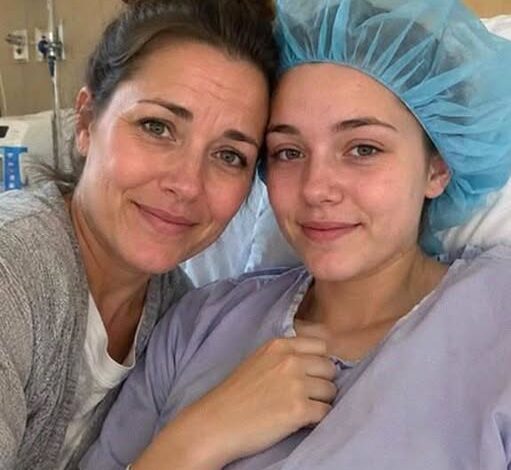
When it opened, she stepped out wearing a pale blue surgical cap that made her look far too young and far too brave.
The hospital bracelet around her wrist looked oversized, sliding against her skin whenever she moved.
I forced a smile.
“That hat is terrible.”
She rolled her eyes immediately.
“You look worse.”
For one brief moment, we both laughed.
It was small.
But it mattered.
Then the laughter faded, and the silence returned.
Sophie climbed onto the gurney and reached for my hand.
Her fingers were cold.
Too cold.
“Mom,” she said softly.
“I’m here.”
She looked at me with an expression that made my chest tighten.
“Promise you’ll eat something while I’m in surgery.”
I tried to smile.
“I’ll try.”
“That’s not a promise.”
“I’ll strongly consider it.”
She gave me a disappointed look, the kind only a daughter can give her mother.
Then her face changed.
The lightness disappeared.
The joking left her eyes.
For a moment, she looked older than seventeen. She looked like someone who had been carrying something too heavy for too long.
“Can I give you something?” she asked.
“What is it?”
Instead of answering, she reached into the pocket of her gown and placed a folded piece of paper into my hand.
It was warm from her palm.
“Just in case,” she whispered.
Those three words hit me harder than anything the doctors had said.
I stared at her.
“Just in case what?”
She tried to smile.
“Just in case nothing.”
“Sophie.”
“Mom.”
“Should I be scared?”
She squeezed my hand gently.
“You’re always scared.”
I wanted to deny it.
But I couldn’t.
She was right.
Her expression softened.
“Don’t read it unless something goes wrong.”
Then she folded my fingers around the note, one by one, as if making sure I would keep it safe.
“Promise me.”
I hesitated.
Then I nodded.
“I promise.”
Before I could say anything else, a nurse stepped through the curtain with a clipboard in her hands.
She smiled gently at Sophie.
“We’re ready for you now.”
The words made my chest tighten.
Everything suddenly became real again.
Sophie squeezed my hand one last time and leaned closer.
I could smell hospital soap on her skin.
“You were always the one who stayed, Mom,” she whispered.
The sentence sank into me.
There was something hidden inside it.
Something bigger than gratitude.
Something she had not said before.
Before I could ask what she meant, the nurse began guiding the gurney toward the double doors.
I walked beside Sophie as far as they would let me.
Then I had to stop.
She lifted her hand and gave me one last small wave.
The bracelet slipped down her wrist.
“Tell me when you wake up,” I called after her.
She smiled.
Then the doors closed.
And she was gone.
The waiting room felt colder after that.
I sat in a hard plastic chair beneath a television no one was watching. Around me, other families waited with their own fears pressed into their faces.
Some prayed quietly.
Some stared at their phones.
Some watched the clock as if they could force time to move faster.
I reached into my pocket and touched the folded note.
I reminded myself of my promise.
Do not open it unless something goes wrong.
So I left it there.
For one hour.
Then two.
Every minute stretched longer than the last.
I walked the hallway.
Bought coffee I never drank.
Checked my phone again and again, even though there were no messages.
All the while, the note stayed in my pocket.
Waiting.
Eventually, I could not ignore it anymore.
I pulled it out and stared at the front.
One word was written in Sophie’s neat handwriting.
Mom.
That was all.
Just Mom.
My hands started to tremble.
A hundred awful thoughts rushed through me.
Why would my seventeen-year-old daughter write me a letter before surgery?
Why had she made me promise not to read it?
What had she been holding inside while I was pretending to be strong?
The longer I looked at the paper, the heavier it became.
Finally, I unfolded it.
The first line stole the breath from my body.
As I kept reading, the room seemed to shift around me.
By the time I reached the final sentence, tears had blurred the words completely.
The note slipped from my shaking hands.
My knees nearly gave out beneath me.
Because Sophie had not written a goodbye.
She had written the truth.
The truth she had been carrying alone.