My Step Siblings Left Our 81-Year-Old Grandma at a Seaside Restaurant to Dodge a $412 Bill – The Lesson I Taught Them Will Haunt Them Forever

Some moments don’t announce themselves as turning points. They arrive quietly, disguised as ordinary evenings, until something happens that reveals exactly who people are—and forces you to decide who you’re going to be in response.
The night my step-siblings made their choice, I made one too. And it changed everything about how our family worked from that point on.
I never really had a relationship with Alan and Daria. We existed in the same spaces, shared the same last name on paper, but that was where it ended. Conversations stayed surface-level, polite, careful—like strangers stuck in the same waiting room. No conflict, but no connection either.
When my dad married their mother, Linda, we were suddenly called “family.” But titles don’t create bonds. Time, effort, and care do—and none of that ever really happened between us.
The only person who made it feel like we were connected at all was Grandma Rose.
She was 81, gentle in a way that felt almost old-fashioned, and somehow still the most attentive person in the room. She remembered birthdays no one else bothered with. She called just to ask if you’d eaten. She had this quiet way of making you feel seen, even when you didn’t think you deserved it.
A few days before everything fell apart, Daria called me.
“We’re taking Grandma out,” she said. “Nice dinner. By the sea. Something special.”
I remember pausing, surprised. That kind of thoughtfulness didn’t really match who I knew them to be. But I didn’t question it out loud. I wanted to believe it.
“I was supposed to come too,” I told her, “but I’ve got a meeting I can’t move. Can we pick another night?”
“It’s fine,” Alan cut in. “We’ve got it.”
Something about the way he said it felt… off. Flat. Dismissive.
But I let it go.
I shouldn’t have.
I was halfway through my meeting when my phone lit up. Grandma.
I ignored it the first time.
When it rang again seconds later, I knew something was wrong. She never called twice.
I stepped out into the hallway and answered.
“Sweetheart…” Her voice was small, shaky. “I don’t know what to do.”
Everything in me tightened.
“What happened?”
“They… they left,” she said. “They said they were going to the car. They didn’t come back.”
For a second, I thought I’d misheard her.
Then she added, almost whispering, “The bill came. It’s $412. I don’t have that kind of money with me.”
I didn’t think. I didn’t hesitate.
“Stay right there. I’m coming.”
The drive felt endless.
By the time I got there, my hands were gripping the steering wheel so tightly they hurt.
And then I saw her.
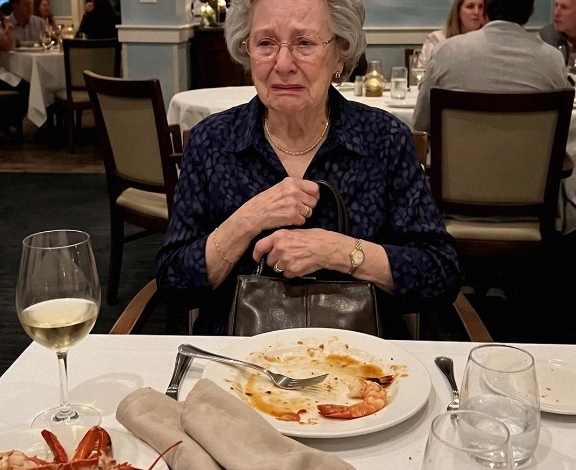
Sitting alone at the table. Small. Quiet. Clutching her purse like she’d done something wrong.
That’s what hit me the hardest.
Not just what they’d done—but that she felt like she had to apologize for it.
“Oh, honey, I’m so sorry,” she said the moment she saw me.
“You don’t have to apologize,” I told her, pulling a chair close. “Not for this.”
In that moment, something settled in me.
I wasn’t letting this go. Not quietly. Not this time.
I paid the bill without hesitation.
But before I left, I asked the waiter for something specific.
“Can you itemize everything?”
He looked confused, but nodded.
When the breakdown came back, it told the whole story.
Lobster. Steak. Wine. Dessert.
Alan and Daria had enjoyed themselves.
Grandma?
Tea. Soup. Bread.
I folded the receipt carefully and slipped it into my bag.
Not as proof.
As leverage.
I took Grandma home, made sure she was settled, made her tea. She kept offering to pay me back.
“No,” I told her gently. “You won’t.”
Then I left.
But I didn’t go home.
Some lessons lose their impact if you wait.
That night, I went to my office and printed the receipt—only bigger. Much bigger.
Big enough that it couldn’t be ignored.
Then I drove to Alan and Daria’s apartment.
They opened the door laughing.
That laugh disappeared the second they saw me.
“What are you doing here?” Daria asked.
“I thought we should talk,” I said calmly, stepping inside.
I laid the receipt on their table.
Alan barely looked at it. “We were going to come back.”
“She must’ve misunderstood,” Daria added.
I nodded slowly.
Then I tapped the paper.
“Interesting. Because this says someone ordered lobster. And unless Grandma’s developed a secret taste for that at 81… I’m guessing it wasn’t her.”
Silence.
Then Alan shrugged. “It’s just food.”
“It’s just money,” Daria added.
And there it was.
That one sentence told me everything I needed to know.
I didn’t argue. I didn’t raise my voice.
“I just wanted to understand,” I said lightly. “Now I do.”
And I left.
They thought that was the end of it.
It wasn’t even the beginning.
That night, I posted the receipt in the family group chat.
Not just immediate family—everyone.
“Just covered a $412 dinner after Alan and Daria left Grandma at the table to pay.”
The reaction was immediate.
Shock. Anger. Disbelief.
Then came the messages.
“That’s not what it looks like.”
“There was a misunderstanding.”
But something unexpected happened next.
Other people started speaking up.
Stories.
Patterns.
Money borrowed and never returned. Promises made and quietly forgotten.
It wasn’t just one dinner anymore.
It was a history.
So I added one more thing.
The recording.
Clear as day:
“It’s just money.”
And then I wrote:
“If it’s just money… why didn’t you pay?”
That ended the argument.
By morning, the group chat had turned into accountability.
Not chaos—accountability.
They called me.
“We’ll pay you back,” Alan said.
“That’s a start,” I replied.
Then I told them what actually needed to happen.
Not just repayment.
Acknowledgment.
Public apology.
And making things right with Grandma—not once, but consistently.
For the first time, they didn’t argue.
The messages came.
Apologies.
Detailed. Public.
Then payments.
Not just to me—to others too.
Grandma called me later that day.
“They apologized,” she said softly. “And they sent money… and said they’d keep helping.”
She sounded lighter.
Relieved.
“What did you do?” she asked.
I glanced at the oversized receipt sitting on my table.
“I just helped them understand.”
Things didn’t magically become perfect after that.
But they changed.
They showed up more. Called more. Helped—quietly, steadily.
Not out of obligation anymore.
Out of awareness.
And that receipt?
It’s still in my drawer.
Not as a threat.
As a reminder.
Because sometimes, people don’t change when you forgive them.
They change when they’re finally made to see themselves clearly—and realize they don’t like what they see.