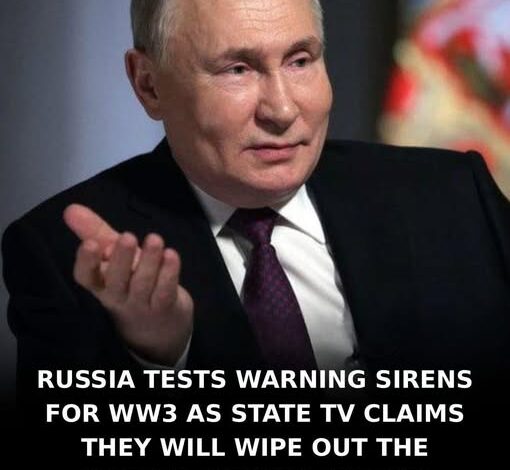
The eerie sound of air-raid sirens recently echoed across the Russian Federation, spanning all eleven of the country’s time zones—from the Baltic Sea to the Pacific coast. Officials described the event as a routine nationwide test of Russia’s public warning system, part of regular civil-defense drills meant to ensure that emergency communications remain functional. Even so, the timing of the exercise drew attention internationally. In today’s tense geopolitical environment, actions that might once have been considered ordinary are now closely watched for deeper meaning.
The siren test came amid increasingly sharp rhetoric from Moscow. Just days earlier, Dmitry Medvedev—former Russian president and now deputy chairman of the country’s Security Council—warned that ongoing tensions between Russia and the West could push the world toward a broader global conflict. Analysts note that Medvedev frequently uses dramatic language, but such statements can serve a strategic purpose. By combining routine government actions with stark warnings, Russia maintains a sense of uncertainty that keeps international observers attentive.
These developments are unfolding against a particularly complicated global backdrop. The war in Ukraine continues to dominate European security concerns, while instability in the Middle East—driven by tensions involving Iran, Israel, and the United States—has created another major geopolitical flashpoint. Russia has attempted to position itself carefully within that environment. While criticizing Western military actions in the region, Moscow has also promoted diplomacy and maintained close ties with Tehran, presenting itself as a counterbalance to American influence while still focused primarily on its campaign in Ukraine.
Inside Russia, state media has amplified nationalist messaging, often portraying Western governments and military alliances as weakened or ineffective. Analysts caution, however, that such rhetoric is frequently aimed at domestic audiences. Strengthening public morale and national unity can be just as important for governments as shaping foreign policy narratives.
For Ukraine, the growing number of global crises is a cause for concern. Leaders in Kyiv have warned that shifting international attention—especially toward conflicts in the Middle East—could eventually weaken Western support for Ukraine’s defense. From that perspective, Russia’s dramatic messaging and high-profile actions may also serve to keep Western governments divided across multiple priorities.
Despite the heightened rhetoric, most defense experts believe a direct Russian military intervention in the Middle East is unlikely in the near future. Russia’s war effort in Ukraine already places significant strain on its military resources and logistics. Opening another large-scale conflict would introduce risks that far outweigh the strategic advantages. Instead, Moscow’s involvement in the region is more likely to remain limited to diplomacy, weapons cooperation, and indirect influence rather than large conventional deployments.
Seen through this lens, the nationwide siren test functions less as a preparation for imminent conflict and more as a symbolic demonstration of readiness. It reinforces the message that the Russian state remains organized and capable despite the ongoing war and broader geopolitical pressures.
Today’s global landscape is defined by overlapping tensions and rapidly shifting crises. In such an environment, even routine actions—like testing a civil-defense system—can take on outsized significance. The sirens that sounded across Russia may not signal the start of a larger war, but they do reflect the heightened vigilance shaping international politics.
Ultimately, the moment illustrates how much the global order is in flux. Conflicts in Eastern Europe, instability in the Middle East, and competition among major powers are reshaping diplomatic and military dynamics in real time. While predictions of immediate global war are often exaggerated, the underlying pressures are very real.
In that sense, the sound of those sirens serves as a reminder: the current era is one of transition, where perception, messaging, and strategic signaling play nearly as large a role as military force itself.