The Entire Internet Tried to Figure It Out — But Almost No One Could, Until One Photo Revived a Forgotten Childhood Toy That Once Dominated Playgrounds, Drove Parents Crazy, Got Banned in Schools, and Became a Loud, Risky, Unforgettable Symbol of the 1970s

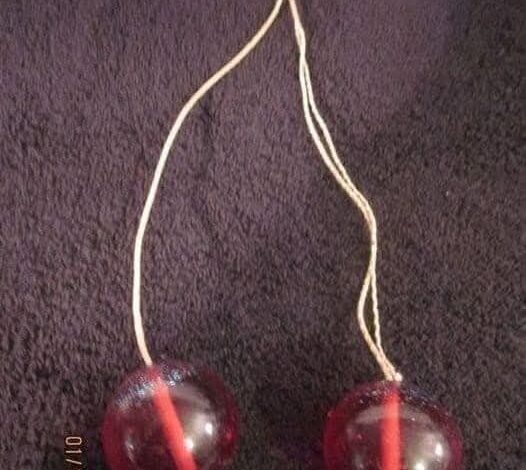
At first glance, the object looks strange—almost unsettling. Two glossy, dark red spheres hang from a string, with a small loop at the top. There’s no label, no instructions, nothing to explain what it does. When images of it started circulating online, confusion spread quickly. People speculated wildly, guessing everything from medical tools to fishing gear to something far less innocent.
But the answer wasn’t hidden. It was just forgotten.
For many adults—especially those who grew up in the late 1960s and early 1970s—the recognition was instant. Not curiosity, but memory. Before the name even came back, there was a sound:
Clack. Clack.
They were Clackers.
The reason so many people couldn’t identify them isn’t because they were obscure. It’s because they belonged to a very specific moment—a short-lived but intense craze that once dominated playgrounds before fading almost completely from everyday life.
Clackers weren’t quiet or subtle. They were loud, physical, and a little chaotic. And for a brief time, they were everywhere.
To understand the confusion, you have to understand the era they came from.
The late ’60s and early ’70s were a time when toys were simple, hands-on, and often a bit risky. There were no screens, no apps, no instant tutorials. Entertainment was physical. You learned by doing—and sometimes by getting it wrong.
Clackers fit perfectly into that world.
The design was incredibly basic: two hard plastic balls attached to either end of a string, with a small loop in the middle for your finger. That was it. No batteries, no setup. Just motion.
Using them, however, was another story.
You had to swing your hand up and down in just the right rhythm so the balls would collide above and below your hand in a continuous pattern. When you got it right, the result was a rapid, repeating clack-clack that could get louder and faster with practice.
It wasn’t easy to master. Beginners hit their knuckles, lost control, or tangled the string. But that difficulty was part of the appeal. Kids competed to see who could go the longest, the fastest, or pull off tricks. It wasn’t just play—it was coordination, timing, and persistence.
The toy first appeared around 1969, during a boom in novelty toys built around motion and simplicity. Companies like Wham-O—already known for hits like the Hula Hoop and Frisbee—helped popularize products like this. Clackers quickly became a sensation.
They were cheap, durable, and could be used almost anywhere. Playgrounds echoed with their sound. Living rooms weren’t much quieter. Parents tolerated them—barely.
But their simplicity came with a downside.
Early versions were made from acrylic plastic that couldn’t always handle the repeated high-speed impacts. Over time, cracks could form. In some cases, the balls shattered mid-swing, sending fragments outward. Injuries followed—cuts, bruises, complaints.
Schools began banning them. Some stores pulled them. Media coverage raised concerns. In response, manufacturers improved the design with stronger materials—but by then, the craze had already peaked.
Like many trends, Clackers burned bright and faded fast.
Part of the reason was overexposure. They became so common, so constant, that the novelty wore off. New toys replaced them. Attention shifted. And slowly, they disappeared from everyday life.
What remained was memory.
That’s why the internet struggled to identify them decades later. Younger generations never encountered them. Without context, they look incomplete—like something missing a purpose.
But for those who remember, there’s nothing unclear about them.
Clackers represent a time when play was loud, physical, and shared. When toys didn’t guide you step by step—you figured them out. When mastering something meant repetition, patience, and maybe a few bruised knuckles along the way.
The confusion online wasn’t really about the object. It was about time.
Clackers belong to a different kind of childhood—one that hasn’t entirely disappeared, but no longer defines how most people play.
And for those who once held that loop between their fingers, chasing the perfect rhythm, the image isn’t puzzling at all.
It’s a sound, a feeling, and a memory—still echoing, faint but unmistakable.