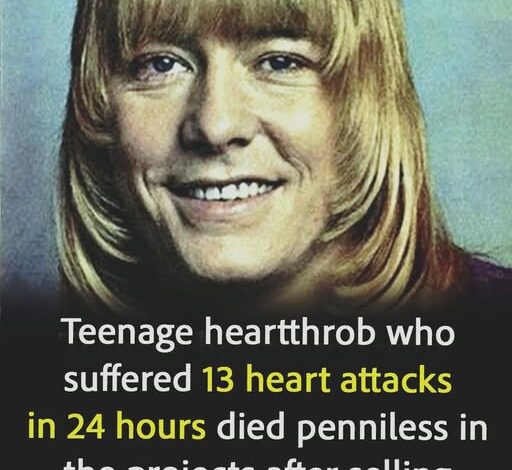
Brian Connolly’s life began far from the roar of fame. Long before audiences knew his name, he was a Scottish-born boy named Brian MacManus, with no obvious sign that his future would one day be filled with stadium lights, screaming fans, glittering costumes, and some of the most explosive songs of the glam rock era. Yet by the 1970s, as the unmistakable lead voice of The Sweet, Connolly had become one of rock’s most memorable frontmen — a performer who could turn noise into drama, rebellion into celebration, and heartbreak into something electric.
With hits like “Ballroom Blitz” and “Block Buster!”, The Sweet helped define a decade that wanted everything bigger, louder, brighter, and more theatrical. Their songs did not simply play; they charged forward. They were built for flashing lights, raised fists, teenage bedrooms, packed halls, and the kind of energy that made pop music feel dangerous.
But behind the blonde hair, stage swagger, makeup, and platform boots was a man carrying pain that fame could never fully erase. Connolly’s early life had been marked by uncertainty, adoption, and questions about identity that followed him into adulthood. Success gave him attention, but it did not give him peace. The applause was real, but so were the wounds beneath it.
As the years went on, the same world that had celebrated him began to witness his decline. Exhaustion, alcohol dependency, illness, financial problems, and the brutal demands of the music industry all took their toll. The bright glam rock image remained in memory, but the man behind it was fighting battles far more private and far more painful than most fans understood.
Still, Brian Connolly’s story is not powerful simply because it is sad. It remains powerful because he kept going.
Even when his health weakened and his voice no longer carried the same effortless force it once had, he continued to return to the stage. Performing was more than a career to him. It was connection. It was identity. It was one of the few places where he could still reach toward the person he had once been — and toward the audience that still remembered him.
Before the fame, Connolly’s life had already been shaped by instability. Born in Scotland in 1945 and later adopted, he grew up with complicated questions about where he came from and where he truly belonged. Later discoveries about his biological family only added more layers to that fractured sense of identity. For someone raised with uncertainty, performance can become more than ambition. It can become reinvention, escape, and survival.
Music gave Connolly a way to become someone larger than the pain he carried.
During the 1960s, Britain’s music scene was alive with possibility. Young bands moved through clubs, dance halls, and small venues, chasing dreams with cheap equipment, restless energy, and stubborn belief. Connolly performed with different groups before finding the lineup that would change his life. When The Sweet came together with Andy Scott, Mick Tucker, and Steve Priest, they stepped into a musical moment ready for spectacle.
And The Sweet knew how to deliver spectacle.
They were not just another pop-rock band. They brought drama, volume, attitude, and color. Their music mixed catchy melodies with harder rock edges, giving them a sound that could dominate radio while still thrilling teenagers who wanted something rebellious. Glam rock was full of contradictions — playful but aggressive, polished but wild, commercial yet defiant — and The Sweet embodied those contradictions perfectly.
Connolly stood at the center of it all.
His voice gave the band its emotional force. It could be sharp, playful, seductive, and explosive, sometimes all within the same song. Onstage, he had the kind of presence that made chaos feel controlled, as if the entire room could tip over at any moment but he knew exactly how to hold it together.
“Ballroom Blitz” remains one of the clearest examples of that power.
From its opening moments, the song feels like a riot about to become a party. It rushes forward with wild momentum, all tension and release, as if the performance is already spinning out of control. Connolly’s vocal cuts through the noise with theatrical confidence, capturing everything glam rock promised at its peak: escape, volume, danger, freedom, and pure performance.
The Sweet became one of the defining bands of the 1970s. They sold millions of records, appeared on television, toured widely, and built a global following. To fans, it looked glamorous. To the people living inside it, fame was far more complicated.
Behind the hits were endless pressures: constant travel, industry demands, creative disagreements, financial disputes, physical exhaustion, and the temptations that surrounded rock stardom. For Connolly, success did not remove his vulnerabilities. In many ways, it magnified them.
Alcohol slowly became a destructive force in his life. What may have begun as part of the social world of touring and performing became something heavier and harder to control. It affected his health, strained relationships, and contributed to the growing tension within the band.
By the late 1970s, The Sweet’s classic era was beginning to fracture. Music was changing, internal pressures were rising, and the years of intense fame had left marks on everyone involved. Connolly left the band in 1979, closing the chapter most fans still associate with The Sweet’s greatest success.
For a frontman, leaving the band that made him famous can be devastating. The public often freezes performers in one version of themselves — one sound, one look, one era, one image. Moving beyond that can be almost impossible, especially when the industry has already started looking elsewhere.
Connolly tried to build a solo career, but the same level of success never returned. That disappointment carried a deep emotional weight. For artists whose sense of self becomes tied to applause, shrinking audiences and fading attention can feel like a personal disappearance.
Financial troubles added to the strain. Legal and tax problems reportedly created serious hardship, and the stability that fame once seemed to promise slipped further away. At the same time, years of alcohol abuse and physical stress began to show in his body.
Through the 1980s and 1990s, Connolly’s health deteriorated. He suffered from serious heart issues, neurological problems, reduced stamina, and visible physical decline. For fans, watching him struggle was painful because music has a way of preserving people at their peak. Records keep voices young forever. Videos trap performers in the glow of their strongest years. Reality, however, is not so merciful.
But Connolly kept performing.
He could have withdrawn completely from public life, but he did not. He continued to tour in smaller venues and later performed with projects connected to The Sweet’s legacy, including Brian Connolly’s Sweet. These shows were not the roaring arena spectacles of the 1970s. They were more intimate, more fragile, and often more bittersweet.
The crowds were smaller. The voice was changed. The body onstage was visibly worn.
Yet fans still came.
They came for the songs, of course, but also for the man. They came to see someone who had once helped define their youth and who was still trying, despite everything, to stand beneath the lights and give what he had left. There was something deeply human in that effort. Even when the old power appeared only in flashes — a phrase, a smile, a sudden glimpse of charisma — those moments mattered.
A 1996 television documentary made his decline painfully visible. Viewers saw the contrast between the vibrant glam rock icon of the 1970s and the weakened man he had become. It was difficult to watch, but it was also honest. Connolly did not fully hide from the consequences of his lifestyle. He spoke with painful openness about alcohol, illness, and the damage that years of strain had caused.
There was courage in that honesty.
Around the same period, fatherhood brought renewed tenderness and meaning into his life. Connolly spoke about his son with affection, and family seemed to offer him an emotional anchor during a time when so much else was unstable. But even that love could not stop the physical decline that was already underway.
By late 1996, performing had become increasingly difficult. Those who saw him near the end often described a mixture of admiration and sadness. They were watching a man fight his own body simply to remain connected to the stage for a little longer.
In retrospect, his final performances feel almost symbolic.
A once-commanding frontman, weakened but still present.
Still stepping forward.
Still singing.
Still refusing to vanish completely.
Brian Connolly died on February 9, 1997, at the age of fifty-one. Kidney and liver failure, combined with long-term cardiovascular disease, ended a life that had burned brightly and painfully. Fifty-one was far too young, especially for someone whose music still sounded so alive.
Yet his influence did not die with him.
The Sweet helped shape the sound and style of glam rock, and their impact stretched beyond their own decade. Later rock, hard rock, and metal bands drew from their blend of massive hooks, aggressive guitars, theatrical presentation, and rebellious energy. They bridged worlds that did not always fit neatly together: pop and rock, glitter and grit, commercial success and emotional chaos.
At the heart of that identity was Connolly’s voice.
Even now, when “Ballroom Blitz” bursts through speakers, it does not feel dusty or distant. It still feels urgent. It still feels wild. The swagger remains. The excitement remains. New listeners continue to discover the band not as a museum piece, but as something alive, restless, and immediate.
That is what lasting music does.
It survives the era that created it.
Brian Connolly’s life was a story of brilliance and fragility, triumph and damage, applause and loneliness. Fame lifted him to extraordinary heights, but it also exposed him to pressures that helped accelerate his decline. He lived the dream many musicians chase, then spent years paying the cost of that dream in public.
But to remember him only as a tragic figure would be unfair.
Because even through addiction, illness, financial struggle, and fading strength, he kept reaching for music. He kept trying to connect. He kept returning to the one language that had given shape to his life.
That persistence is what makes his story linger.
Brian Connolly was not simply a fallen star. He was a wounded performer who kept searching for the spark that had once made audiences erupt. His voice was not powerful because it was perfect. It was powerful because it felt alive — bold, emotional, defiant, vulnerable, and unmistakably human.
The lights eventually dimmed.
The crowds changed.
The body failed.
But the sound remained.
And every time Brian Connolly’s voice rises again from an old record, something of him returns. For a few minutes, the glitter shines again, the guitars roar, the ballroom erupts, and the boy from Scotland who became the voice of The Sweet sounds, once more, untouchable.