The Mind Blowing Truth About The Eagle Tracked For Two Decades That Defied Every Law Of Nature

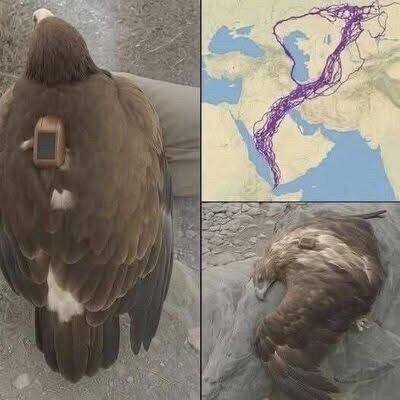
For twenty years, a single eagle traced a story across the sky that no one could immediately understand. What began as a routine tracking study—another data point in the long record of migratory behavior—slowly transformed into something far more profound. Scientists had expected predictability: a seasonal rhythm, a pattern repeated and reinforced over generations. Instead, they were handed a puzzle that refused to resolve, a map that looked less like instinct and more like intention.
At first glance, the bird’s journey seemed erratic, almost contradictory. It cut across expected routes, lingered in unlikely places, and veered away from the paths its species had followed for centuries. It crossed deserts where survival seemed improbable, soared over mountain ranges that challenged even the hardiest wildlife, and ventured into open expanses that offered little immediate reward. To the researchers watching the data unfold, it felt as though the eagle was defying the very rules that defined its kind.
Doubt crept in early. Instruments were checked and recalibrated. Data streams were scrutinized for errors. But the evidence held firm. The bird was exactly where it appeared to be—moving through a world in a way that didn’t match established models. What had once been considered “known” about migration began to feel incomplete, as if a larger system was at work just beyond the edges of human understanding.
The turning point came when scientists stopped trying to force the eagle’s path into familiar frameworks. Instead of asking why it wasn’t following the rules, they began asking what rules it might be following that they couldn’t yet see. They layered environmental data over its movements—wind currents, pressure systems, temperature shifts, ecological changes—and slowly, the chaos began to resolve into something else.
What emerged was not randomness, but responsiveness. The eagle wasn’t wandering; it was adapting. Its movements aligned with fleeting opportunities—bursts of prey activity, subtle atmospheric shifts, evolving weather patterns that hadn’t yet fully formed in predictive models. It moved not along a fixed route, but within a living system, adjusting in real time to conditions that were constantly changing. Where humans saw disorder, the eagle was reading signals with remarkable precision.
This realization reshaped more than just one study. It challenged the assumption that animal behavior is purely instinct-driven in a rigid, unchanging way. Instead, it suggested a kind of intelligence rooted in interaction—a continuous dialogue between organism and environment. The eagle’s journey became evidence of a deeper awareness, one that doesn’t rely on conscious planning as humans understand it, but on a finely tuned sensitivity to the world’s shifting patterns.
Over two decades, the bird endured changing climates, shifting ecosystems, and the unpredictable rhythms of a planet in motion. It survived not by following a script, but by constantly rewriting it. The path it left behind—once dismissed as tangled and incoherent—was revealed to be something far more elegant: a dynamic map of survival, shaped moment by moment.
When the signal finally disappeared, it marked the end of the data, but not the meaning. The eagle’s journey remained, etched into the records as both a scientific revelation and a philosophical one. It reminded researchers that understanding is often limited not by the absence of patterns, but by the limits of perception. What we call chaos may simply be a system too complex for us to recognize—at least, not yet.
In the end, the eagle didn’t just travel across continents; it shifted perspective. It invited those who followed its path to reconsider what it means to navigate, to adapt, and to belong within a world that is far more interconnected and responsive than it first appears. Its story lingers as a quiet challenge: to look closer, think deeper, and remain open to the possibility that nature still holds ways of knowing we are only beginning to glimpse.