The human mind is exceptionally good at building fear out of almost nothing. Give it one strange detail—just one—and it will construct an entire narrative around it, complete with danger, consequences, and worst-case scenarios. I learned that firsthand in the most unremarkable place imaginable: my girlfriend’s bathroom.
I had gone in for something simple—a glass of water. Instead, I froze.
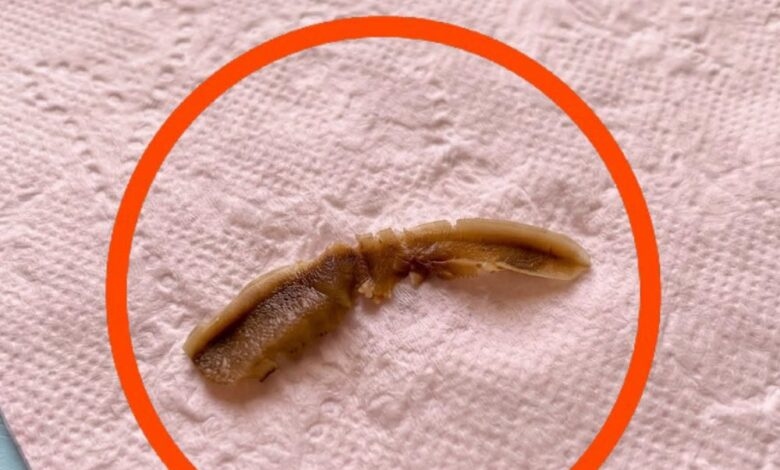
On a crumpled piece of tissue near the sink sat a small, brown, segmented object. It wasn’t large. It wasn’t moving. But it was wrong. I stood there staring at it, my brain spinning through possibilities with increasing urgency. For over an hour, I couldn’t look away. My thoughts escalated quickly—from insect, to parasite, to something far worse—something that didn’t belong in a normal, safe space like this.
That’s the strange thing about unfamiliar objects. When something appears out of place—especially something that looks vaguely alive—your brain stops treating it as an object and starts treating it as a threat. The limbic system takes over. Logic steps aside. Suddenly, you’re not analyzing—you’re reacting.
The object’s appearance didn’t help. It had a segmented look, like joints or a body part. The surface caught the light in a way that made it seem almost fresh, almost organic. It looked like something that had once belonged to a living thing. And once that idea takes hold, it’s hard to shake. Your brain fills in the blanks, turning ambiguity into certainty—usually the worst kind.
This is where perception betrays us. Humans are wired to recognize patterns, especially ones linked to danger. See something brown and segmented, and your brain doesn’t hesitate—it labels it insect before you’ve had time to question it. That instinct once kept us alive. Now, it just makes us stand frozen in bathrooms, staring at harmless debris like it’s evidence of something catastrophic.
Because the truth, as I eventually realized, is almost always far less dramatic.
Once I forced myself to step back—mentally, not physically—the possibilities became much more ordinary. The object could have been a fragment of food. Cooked organic matter, especially when dried, can look bizarre when removed from its context. A piece of shrimp, a strip of meat, even a caramelized vegetable can take on a glossy, segmented appearance. Oils reflect light like an exoskeleton. Fibers mimic joints. Something that once looked appetizing on a plate becomes unsettling when it appears in the wrong place.
There were other explanations too. It could have been part of an insect—but not in the way my imagination suggested. Bugs exist in every home, and sometimes they leave behind fragments. A leg, a shell, a piece of a body. Unpleasant, yes, but entirely normal. Not a sign of infestation. Not a signal of danger. Just evidence that the world is shared with smaller life forms.
Even plant material can be deceptive. Seed pods, dried roots, bits of peel—nature is full of shapes and textures that resemble living creatures. A fragment carried in on a shoe or sleeve can end up anywhere, including a bathroom sink, where it suddenly looks far more ominous than it really is.
And then there are non-organic culprits—degraded materials. Bits of rubber, glue, or packaging can warp under heat and humidity, taking on irregular, almost biological forms. What looks like something alive might just be something breaking down.
After all that time, I finally did the simplest thing: I picked it up with a tissue and threw it away.
No movement. No revelation. No horror.
Just… nothing.
That hour of staring wasn’t about the object at all. It was about the way the mind works. When something lacks context, we fill in the gaps—and we almost always fill them with fear. But most of the time, the explanation is ordinary. Boring, even.
The lesson was simple: not everything that looks threatening is meaningful. Not every mystery is a warning.
Sometimes, it’s just a piece of something small, seen from the wrong angle, in the wrong place, at the wrong time.
And once you realize that, the fear disappears just as quickly as it arrived—leaving behind nothing but a clean bathroom, and the quiet awareness of how powerful your own imagination can be.