The Truth About The Maxwell Email Melania Trump Breaks Her Silence On Jeffrey Epstein To Demand A Public Reckoning For The Real Culprits

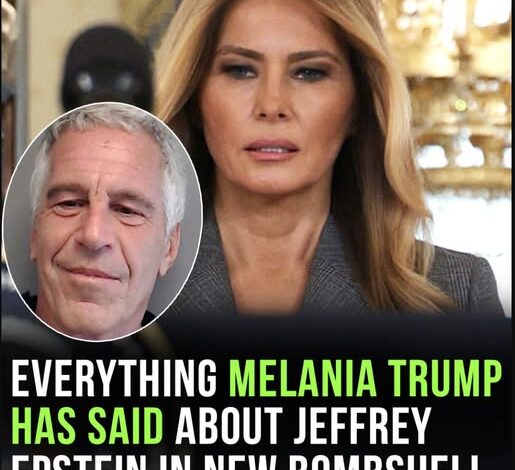
In the high-stakes world of global politics and elite social circles, reputation can hinge on the smallest fragment of evidence—a photograph, an email, a fleeting association. Melania Trump recently found herself pulled into a renewed wave of scrutiny, as online discussions attempted to link her to the long and troubling history surrounding Jeffrey Epstein. What might once have remained buried in the archives of past social connections has resurfaced in a digital era where context is often compressed and speculation spreads rapidly.
For years, Melania Trump has largely maintained a reserved and measured silence when faced with controversy. But this moment marked a departure. Faced with resurfaced claims tied to an old photograph and an email involving Ghislaine Maxwell, she chose not only to respond, but to do so directly and forcefully. What emerged was more than a denial—it was a deliberate effort to draw a clear boundary between casual social proximity and any suggestion of deeper involvement.
At the core of her response is a firm rejection of the narrative being constructed around her. She has stated unequivocally that she was never present for any illicit activity, never traveled on Epstein’s private jet, never visited his island, and has never been named in legal proceedings or victim testimony. In her framing, the connections being highlighted are artifacts of a particular time and place—an era when New York’s social circles were tightly interwoven, and appearances at the same events did not necessarily imply meaningful relationships.
This distinction—between association and implication—is central to her defense. In a media environment driven by speed and amplification, nuance often becomes the first casualty. A shared photograph can quickly evolve into a narrative of proximity, and proximity into suspicion. Melania’s response pushes back against that progression, arguing that such leaps are not only inaccurate but unfairly damaging.
What makes her statement particularly notable, however, is that it did not remain focused solely on personal vindication. In a strategic and somewhat unexpected shift, she redirected attention toward the broader issue at the heart of the Epstein case: the survivors and the unanswered questions surrounding those who enabled the abuse. By calling for transparent, public congressional hearings and a full accounting of the network that allowed such crimes to persist, she reframed her position from defensive to proactive.
This move carries both risk and significance. Calling for greater transparency invites deeper scrutiny—not only of others, but of the broader social and political networks of the time. It suggests a confidence that a fuller investigation would clarify distinctions between those peripherally connected and those directly involved. At the same time, it aligns her with a public desire for answers that has remained unresolved for years.
There is also a personal dimension to her response that stands out. Known for her composure and restraint, the level of detail and emotion in her statement signals the weight these accusations carry. She frames the situation as one of reputational harm—of being drawn into a narrative shaped by assumption rather than evidence. It reflects a broader reality faced by public figures in the digital age, where the line between scrutiny and speculation is often blurred.
As the broader Epstein narrative continues to evolve through legal developments and public inquiry, Melania Trump’s intervention marks a shift in how she engages with controversy. Rather than allowing the narrative to develop without her input, she has stepped into it, attempting to redefine both her role within it and the direction of the conversation itself.
Ultimately, this moment highlights the dual nature of modern visibility. The same digital platforms that can amplify suspicion can also be used to assert clarity—though neither outcome is ever fully within one person’s control. A single image can ignite questions, but it is the response that shapes how those questions endure.
In choosing to confront the issue directly while calling for broader accountability, Melania Trump has positioned herself not just as a subject of the narrative, but as an active participant in shaping it. Whether that effort leads to greater clarity or simply fuels further debate remains to be seen. But the message she has delivered is unmistakable: she rejects the implications being drawn, and she is willing to push for a wider reckoning to prove it.