TRUMP HEALTH SCARE RUMORS EXPLODE AS SUDDEN SCHEDULE CHANGES SEND SOCIAL MEDIA INTO A TOTAL FRENZY

In today’s hyperconnected world, it doesn’t take much to blur the line between fact and fiction. A single unexpected change—like a canceled appearance or a quiet gap in a public figure’s schedule—can quickly spiral into widespread speculation. That’s exactly what happened when recent adjustments to Donald Trump’s public calendar set off a wave of online rumors, showing just how quickly uncertainty can turn into assumed “truth” in the digital age.
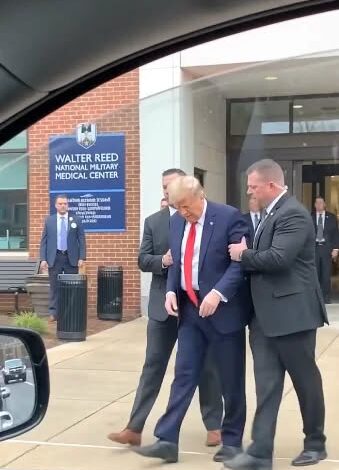
What began as a simple absence soon evolved into something far larger. Social media platforms lit up with claims that the former president had been rushed to Walter Reed Medical Center, despite no official confirmation. In a matter of hours, posts multiplied, each adding new layers of supposed detail. The lack of immediate information created a vacuum—and the internet rushed to fill it.
This pattern isn’t new. When high-profile individuals deviate from their usual routines, even slightly, it often sparks intense curiosity. In Trump’s case, his typically constant public visibility made the silence feel even more unusual to observers. That gap between expectation and reality became fertile ground for speculation, with some users presenting assumptions as established facts long before any credible source weighed in.
Social media algorithms played a major role in amplifying the situation. Platforms are designed to prioritize engagement, and emotionally charged or sensational content tends to spread the fastest. The idea of a sudden “medical emergency” involving a former president was exactly the kind of narrative that thrives in that environment. As more people shared the claims—whether out of concern, curiosity, or agenda—the story gained momentum regardless of its accuracy.
By the time officials stepped in, the rumors had already reached a peak. The clarification was direct: there had been no hospital visit, no emergency, and no hidden crisis. Trump had remained at his residence, continuing routine activities. But even with that confirmation, the episode highlighted a difficult truth—once misinformation spreads widely, correcting it becomes far more challenging than preventing it in the first place.
Part of the public sensitivity around such rumors stems from a long-standing interest in the health of political leaders. Over the years, discussions about Trump’s health—including mentions of conditions like chronic venous insufficiency—have created a backdrop that makes any sudden change feel significant. Even when those conditions are not serious, their presence in public discourse can fuel renewed speculation whenever uncertainty arises.
The reaction to this incident reflected a broader divide in how people consume information today. Some responded with genuine concern, others with skepticism, and some used the ambiguity to reinforce existing political views. Meanwhile, fact-checkers and established media outlets worked to verify details, emphasizing the importance of patience and reliable sourcing in an era where speed often outweighs accuracy.
At its core, this situation is less about one individual and more about the environment in which information now travels. The tools for sharing news have become incredibly powerful, but so have the risks. A single rumor can evolve into a global narrative before truth has a chance to catch up.
It serves as a reminder that in moments of uncertainty, restraint matters. Waiting for verified information may feel slow in a fast-moving digital world, but it’s often the only way to separate reality from assumption. In an age where visibility is constant and expectations are high, even a minor disruption can trigger major reactions—but not every headline reflects what’s actually happening.