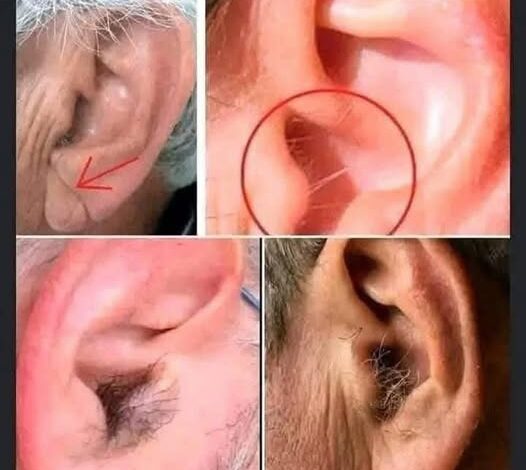
The human body carries the marks of its own biological timeline. Over the years, even small physical changes can reveal deeper shifts happening within our physiology. One such change is the appearance of hair on or around the ears. While many people consider this simply a cosmetic effect of aging, it actually reflects a more complex interaction between hormones, genetics, and the body’s natural protective systems. What may seem like a trivial detail can, in reality, offer insight into how the body adapts and evolves throughout life.
A key factor behind this change involves androgens—hormones such as testosterone that influence many male physical traits. These hormones are present throughout life, but the body’s response to them changes over time. Interestingly, the same hormonal activity that can lead to thinning hair on the scalp can stimulate growth in other areas like the ears, nose, and eyebrows. As men grow older, certain hair follicles become more sensitive to testosterone. This increased sensitivity can cause fine, barely visible hairs (known as vellus hairs) to become thicker, darker terminal hairs. Rather than being a malfunction, this process reflects the body adjusting its biological instructions as it ages.
Hair inside the ear canal also serves a functional purpose. These tiny hairs work together with earwax (cerumen) to help protect the ear from dust, debris, and microscopic particles. Acting as a filtration system, they prevent foreign material from reaching the sensitive eardrum and inner ear. In this sense, ear hair contributes to maintaining healthy hearing and preventing infections. However, when hair begins appearing on the outer parts of the ear—such as the tragus or the outer rim—it becomes less about protection and more about hormonal influence and inherited traits.
Genetics play a major role in determining how noticeable ear hair becomes with age. If male relatives such as fathers or grandfathers experienced prominent ear hair growth, the likelihood of inheriting the same trait is higher. This suggests that the responsiveness of ear follicles to hormones can be passed down through generations. For many men, this development is simply part of their family’s pattern of aging rather than an unexpected change.
In uncommon situations, unusually heavy hair growth on the ears may be linked to a condition called hypertrichosis. Unlike the typical age-related increase, hypertrichosis causes excessive hair growth in areas where it normally would not appear. This condition may be present from birth or develop later due to medications or underlying medical issues. If ear hair growth appears suddenly or becomes significantly more pronounced than expected, it may warrant medical attention to rule out other factors.
Medical researchers have occasionally explored whether visible features around the ears might provide clues about overall health. Since the 1970s, some studies have examined a possible association between heavy ear hair and a physical marker known as Frank’s Sign—a diagonal crease in the earlobe—and an increased risk of heart disease. While the evidence remains inconclusive and the connection is not considered a reliable diagnostic indicator, the research reflects the broader interest in identifying simple external markers that might hint at internal health conditions.
For most people, managing ear hair is simply part of personal grooming. Because the ear is sensitive and close to the eardrum, careful methods such as specialized trimmers or professional waxing are typically recommended. At the same time, cultural attitudes toward aging are gradually shifting. Rather than viewing these changes with embarrassment, many people now approach them with a more realistic and accepting perspective.
In a broader sense, small physical changes can be reminders that the body is constantly adjusting and responding to time. Just as scientists and observers analyze subtle signals to understand larger systems, changes in our appearance can also reflect the complex biological processes unfolding beneath the surface.
Ultimately, the presence of ear hair is simply one of many natural markers of aging. It illustrates how hormones, genetics, and protective biological systems continue to interact throughout life. By understanding the science behind these changes, we can move away from myths or embarrassment and instead appreciate them as part of the body’s ongoing story.
Even a minor detail like a single stray hair can represent something larger: the body’s continued activity, adaptation, and resilience over time. Recognizing this perspective encourages a greater appreciation for the remarkable complexity of human biology.