Viral Claims That Century-Old Sketches Prove Donald Trump and His Son Barron Are Time Travelers Spark Online Frenzy, But the Truth Behind the Images, Historical Context, and Human Pattern-Seeking Reveals a Fascinating Story About Perception, Coincidence, and How Easily the Internet Turns Mystery Into Myth

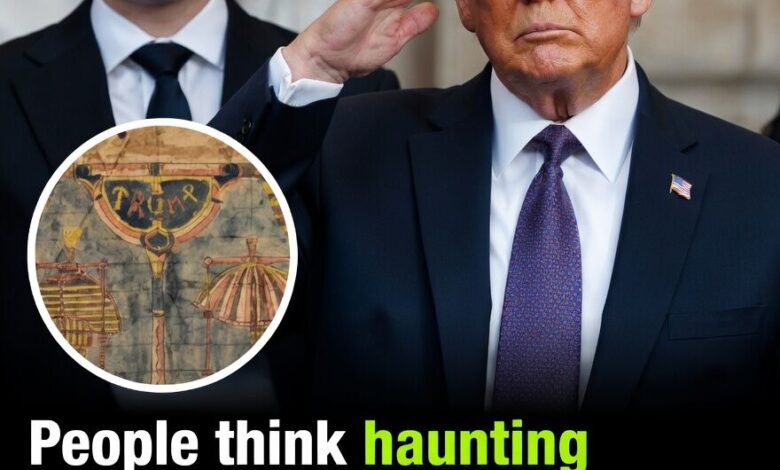
In the age of viral content, few things spread faster than a mystery that seems to blur the line between reality and imagination. Recently, a wave of online posts has sparked fascination by claiming that centuries-old sketches may depict modern figures like Donald Trump and his son Barron Trump. The suggestion behind these posts is as bold as it is unusual: that these similarities could be evidence of time travel.
While the idea is clearly extraordinary, it has gained traction across social media platforms where users eagerly compare historical artwork with modern photographs. Side-by-side images highlight perceived similarities in facial structure, hairstyle, and expression. At a glance, some of these comparisons can appear surprisingly convincing, creating a sense of intrigue that invites deeper speculation.
Why the Images Feel Convincing
At the heart of the theory lies a simple but powerful psychological tendency: humans are wired to recognize faces and patterns. Even small similarities can feel meaningful, especially when presented in a suggestive way.
When viewers are shown an old illustration alongside a modern figure, their brains instinctively search for connections. A similar jawline, hairstyle, or expression can quickly create the impression of a match. This phenomenon—often referred to as pattern recognition or pareidolia—plays a major role in why such claims gain popularity.
In reality, many of these perceived matches are coincidental. Historical artwork, particularly from earlier centuries, often features stylized or generalized facial characteristics rather than precise, individualized portraits. Artists frequently followed shared conventions, meaning many figures from the same era can look surprisingly alike.
The Problem of Missing Context
Another key issue is the lack of reliable sourcing behind many of the images being shared. Viral posts often present sketches or paintings without clear information about their origin, date, or subject. In some cases, images are cropped or edited in ways that emphasize resemblance while removing important contextual details.
Without proper documentation, it becomes impossible to verify what the artwork actually represents. This gap allows speculation to take over, turning uncertainty into what appears to be evidence. As the images circulate, the original context is often lost entirely, replaced by captions that guide viewers toward a specific—and often misleading—interpretation.
The Allure of Time Travel
The theory’s appeal is amplified by its connection to a much larger and deeply fascinating concept: time travel. As a theme, time travel has long captured the human imagination, appearing in countless books, films, and scientific discussions.
When that idea is combined with recognizable public figures like Donald and Barron Trump, it creates a narrative that feels both strange and oddly plausible. The presence of visual “evidence,” even if flawed, gives the story a sense of credibility that purely fictional ideas lack.
This blending of reality and imagination is what makes the theory so compelling. It invites people to entertain the possibility of something extraordinary, even if only for a moment.
The Role of Social Media
Social media platforms play a central role in amplifying these kinds of stories. Content that is unusual, surprising, or emotionally engaging is more likely to be shared, which means that even far-fetched ideas can spread rapidly if they capture attention.
As users comment, speculate, and add their own interpretations, the narrative evolves. Each share reinforces the illusion that the claim has credibility, creating a feedback loop where popularity is mistaken for truth.
What may begin as a simple observation—“this person looks similar to someone in an old painting”—can quickly grow into a complex theory involving hidden histories and unexplained phenomena.
What Science and History Say
From both a scientific and historical perspective, there is no evidence to support the idea that these images prove time travel. While modern physics explores concepts related to time—such as relativity and spacetime—these theories do not support the kind of human time travel suggested by viral claims.
Likewise, historical records provide no indication that modern individuals have appeared in past centuries. The absence of credible evidence in both fields makes it clear that these interpretations are not grounded in reality.
A Reflection of How We Think
Ultimately, the story of “centuries-old sketches resembling modern figures” says more about human perception than it does about history or science. It highlights our natural tendency to find patterns, draw connections, and create meaning—even when those connections are coincidental.
While the idea may be entertaining and even thought-provoking, it serves as a reminder of the importance of critical thinking. Not every striking similarity points to a hidden truth. Sometimes, it simply reflects the remarkable way our minds work—turning ordinary details into extraordinary stories.
In that sense, the real mystery isn’t time travel—it’s how easily imagination can reshape reality when given just a small spark.