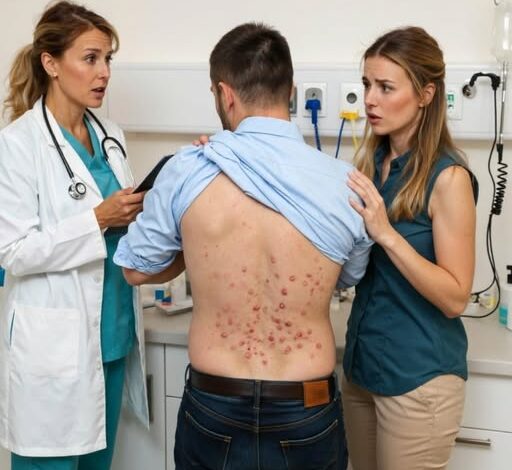
The morning started like any other. Soft sunlight slipped through the kitchen blinds while Oliver and I shared a quiet cup of coffee. He sat at the table, leaning over his laptop, already deep into the stress of another accounting audit. When he mentioned an annoying itch near his shoulder blade, I barely paid attention. I assumed it was something ordinary—dry skin or maybe a bug bite.
I lifted the back of his shirt to take a look.
What I saw made my breath catch in my throat.
Spread across his upper back were about thirty small red marks arranged in a pattern that looked almost deliberate. They were evenly spaced, forming a neat grid that didn’t resemble any rash or insect bites I had ever seen. Each spot was perfectly round, glowing faintly under the kitchen light. They looked almost glassy, like tiny red beads just beneath his skin. In the center of each one was a dark pinpoint that reflected light like metal.
“Oliver… don’t move,” I said quietly.
At first he laughed, thinking I was joking. But when he turned around and saw the fear on my face, his expression changed immediately.
Within half an hour we were rushing through the emergency entrance at St. Benedict Hospital. When the nurse saw the photos I had taken on my phone, her reaction was instant. She didn’t ask the usual intake questions. Instead, she quickly escorted us past the waiting room into a private examination area.
Soon a senior doctor arrived. He studied Oliver’s back from a short distance, his face unusually serious.
“Please don’t touch the area,” he told the nurse. Then he turned to me. “I’m going to contact hospital security and local authorities. For now, we need to treat this as a possible forensic situation.”
The words barely made sense. I tried suggesting allergies or rare infections, but the doctor didn’t respond. A few minutes later two police officers entered the room, followed by a detective named Elise Grant.
She began asking questions that seemed completely unrelated to medicine.
Had Oliver visited any industrial facilities recently?
Any laboratories?
Any restricted or government-controlled areas?
Oliver shook his head weakly. His life revolved around spreadsheets and office meetings. The most adventurous place he visited was the grocery store.
While the questioning continued, surgeons prepared to remove a few of the strange objects embedded in his skin. I watched from behind a glass partition as they carefully extracted the first one.
When it dropped into the metal tray, the sound was unmistakable.
It clinked.
The object didn’t resemble tissue or anything organic. Under the bright surgical lights, it gleamed.
Later that day the lab confirmed what no one expected.
The red “spots” were tiny electronic devices—microchips smaller than a grain of rice. Each one contained microscopic circuitry and a serial number etched onto its surface. They were designed to function as signal transmitters powered by body heat.
Detective Grant spoke quietly as she explained what investigators suspected.
“We don’t believe your husband was specifically chosen,” she said. “More likely he became an unintended subject in a larger test.”
Soon investigators searched our house thoroughly. Specialists examined everything—from our kitchen cabinets to our electronics. The breakthrough came late that night in the bathroom.
Behind a box of bandages, investigators found a package of heat therapy patches neither of us recognized. The packaging looked professional, decorated with a symbol resembling a DNA strand.
Oliver suddenly remembered.
A week earlier he had used one of those patches for a sore muscle, assuming it was something I had bought at the pharmacy. Investigators believed the patch had contained microscopic delivery mechanisms that inserted the devices beneath his skin once the heat activated them.
In the days that followed, federal investigators became involved. Gradually, a disturbing explanation began to surface. The devices appeared to be experimental tracking nodes created by a private defense contractor. The project was allegedly testing long-term biological integration with human nervous systems.
Oliver wasn’t alone. Authorities believed there were at least eleven other individuals who had unknowingly been exposed.
Removing the remaining chips required multiple procedures. Some had already begun integrating into the surrounding tissue, making the surgeries complicated.
Physical recovery took months.
But the psychological effects were even harder.
Oliver struggled to return to normal life. The constant presence of technology began to make him uneasy. He eventually left his job, unable to ignore the feeling that he was still somehow being monitored.
The legal case that followed never fully unfolded in public. Lawyers and government representatives handled it quietly behind closed doors. Official statements were brief and vague, and the story faded from the headlines.
For the rest of the world, it became another forgotten incident.
For us, everything had changed.
Nearly a year later, the scars on Oliver’s back have faded into thin silver lines. But sometimes he still complains about a faint itch where the devices once were.
One evening, while sorting through our mail, I noticed a brightly colored envelope labeled as a promotional sample. Inside was a new type of “smart relief” heat patch promising innovative technology for everyday pain.
I didn’t open it.
Instead, I picked up my phone and called Detective Grant.
Across the room, Oliver sat silently by the window, staring out at the quiet street.
Everything outside looked perfectly normal.
But after what we had experienced, I knew something most people didn’t.
Sometimes the world changes in ways that remain invisible—and the next experiment may already be waiting for someone else.