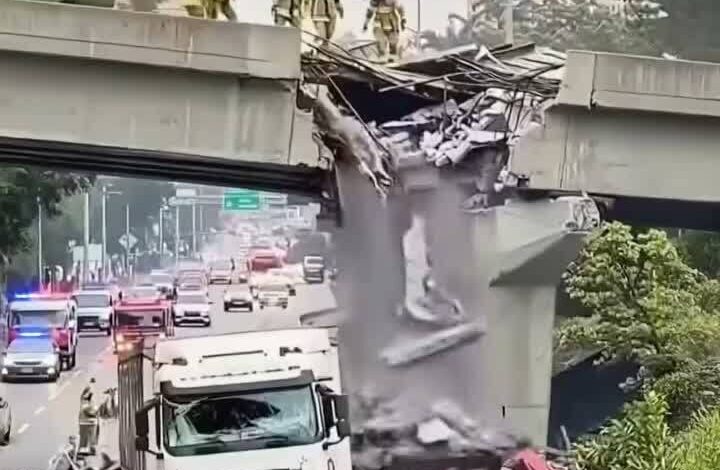
What began as an ordinary Friday morning in Richmond, British Columbia, quickly turned into a major transportation incident that disrupted traffic, raised urgent safety concerns, and renewed debate about commercial vehicle regulations across the province.
At approximately 7:15 a.m., a commercial truck traveling along Knight Street collided with the Cambie Road overpass after its dump trailer remained in a raised position while approaching the bridge. The elevated trailer struck the underside of the overpass with significant force, creating a dramatic and dangerous scene during the busy morning commute.
The impact was powerful enough to separate the truck’s cab from its trailer, leaving the damaged vehicle stopped beneath the bridge and forcing authorities to respond quickly. Witnesses described hearing a loud crash before seeing traffic come to a sudden halt as debris and damage became visible near the overpass.
Fortunately, no injuries were reported.
Even so, the collision immediately raised serious concerns about the structural condition of the overpass. Officials could not assume the bridge was safe simply because it remained standing. A strike of that magnitude can create hidden damage, including cracks, internal stress, weakened supports, or damage to expansion joints that may not be obvious from the roadway.
As a precaution, all southbound lanes in the area were closed while emergency crews, police, transportation officials, and engineers assessed the scene. The closure quickly caused traffic backups throughout Richmond and affected drivers traveling between Richmond, Vancouver, Delta, and other parts of the Lower Mainland.
The Immediate Emergency Response
Within minutes of the crash, police officers and transportation crews arrived to secure the area.
Their first priority was public safety.
Vehicles were redirected, access to the affected lanes was restricted, and officials worked to prevent additional hazards from developing around the damaged trailer and overpass. Because the incident occurred during the morning rush, traffic management became an immediate challenge. Drivers were urged to avoid the area and use alternate routes, but congestion spread quickly as commuters attempted to navigate around the closure.
Engineering teams were brought in to inspect the overpass and determine whether it had suffered structural damage. Although the roadway itself falls under provincial responsibility, Richmond municipal officials assisted with local coordination, safety measures, and traffic control.
The damaged trailer remained lodged near the bridge for several hours while crews worked carefully to stabilize the area and remove debris. Officials had to proceed cautiously, since moving the trailer without a full understanding of the damage could have created additional risks.
Investigating What Went Wrong
The Richmond Road Safety Unit, working with the Ministry of Transportation and Infrastructure, began investigating the circumstances surrounding the collision.
A central question quickly emerged:
Why was the dump trailer still raised while the truck was traveling on a major roadway?
Investigators are expected to examine several possible factors, including driver awareness, mechanical failure, pre-trip inspection procedures, hydraulic system performance, company safety practices, and whether any warning signs or clearance indicators were ignored or missed.
For commercial vehicles, even a small oversight can create major consequences. A raised dump trailer dramatically increases a vehicle’s height, making it incompatible with overpasses, bridges, power lines, and other overhead structures. Once a truck reaches an overpass at road speed, there may be little or no time to correct the mistake.
Structural engineers are also reviewing the bridge itself. Their work may include checking for cracks, inspecting concrete and steel components, examining support structures, reviewing expansion joints, and determining whether the bridge can safely reopen to traffic. Even if the visible damage appears limited, internal stress can compromise long-term durability.
That is why transportation authorities typically treat overpass strikes seriously. A bridge does not need to collapse for a collision to create risk. Damage can develop beneath the surface, and reopening too quickly without proper assessment could endanger future drivers.
A Problem Seen Across British Columbia
The Richmond collision is not an isolated concern.
British Columbia has experienced multiple overpass strikes in recent years, many involving commercial trucks, dump trailers, raised truck beds, construction equipment, or improperly measured loads. These incidents have caused costly repairs, major traffic delays, safety concerns, and renewed frustration among transportation officials.
In many cases, the cause appears preventable.
A dump box may not be fully lowered.
A trailer may remain elevated after unloading.
A driver may misjudge clearance.
A load may be improperly secured.
A route may not be checked carefully enough for height restrictions.
Sometimes drivers may not realize their vehicle exceeds the safe clearance until it is too late. In other cases, equipment problems or insufficient inspection procedures may contribute to the collision.
Whatever the cause, the outcome is often the same: a single vehicle strike can disrupt thousands of commuters, damage critical infrastructure, and create significant public expense.
The Infrastructure Question
Transportation experts note that overpass strikes are not only a driver-behavior problem. They also raise broader questions about infrastructure, freight growth, and road design.
Some bridges and overpasses were built decades ago, when commercial traffic patterns and vehicle configurations were different. As freight movement has increased across British Columbia, modern trucks and equipment are interacting with older infrastructure more frequently.
Clearance can also change over time. Road resurfacing, construction work, repairs, or changes in pavement elevation may gradually reduce the vertical space available beneath an overpass. If signage is outdated, unclear, or poorly placed, drivers may not receive enough warning before reaching a structure.
Industry advocates have argued that better signage, clearer route planning tools, and improved warning systems could help prevent incidents before they happen. Public safety experts agree that prevention is far less costly than emergency response, bridge repair, and traffic disruption after a crash.
Technology as a Safety Tool
One of the most discussed prevention methods involves over-height detection systems.
These systems use sensors, lasers, infrared beams, or other detection tools to identify vehicles that exceed safe clearance limits before they reach a bridge or overpass. If a vehicle is too tall, the system can activate warning lights, alarms, or electronic signs instructing the driver to stop or reroute.
In high-risk corridors, such systems can provide a crucial final warning.
Other proposed solutions include GPS systems designed specifically for commercial vehicles, with built-in bridge-clearance data and restricted-route information. Standard navigation apps may not always account for truck height, weight, or cargo restrictions, which can create risks if commercial drivers rely on tools designed primarily for passenger vehicles.
Safety experts have also recommended stronger driver training, mandatory height-verification procedures, better fleet monitoring, and more rigorous inspections of hydraulic trailer systems. In companies with large vehicle fleets, real-time monitoring could alert supervisors when equipment is not properly lowered or when drivers deviate from approved routes.
No single solution will eliminate every collision.
But a combination of technology, training, enforcement, and infrastructure upgrades could significantly reduce the frequency of overpass strikes.
Economic Consequences Beyond the Crash
While the visible damage attracts immediate attention, the economic effects of an overpass strike can be just as significant.
Knight Street is an important transportation corridor connecting Richmond with Vancouver, Delta, and the broader Fraser Valley. When a corridor like that is disrupted, the effects ripple outward quickly.
Commuters face longer travel times.
Delivery schedules are delayed.
Fuel consumption increases as vehicles idle or reroute.
Businesses wait longer for shipments.
Logistics companies must adjust schedules.
Emergency services may need to account for altered traffic patterns.
For commercial transportation providers, even a temporary closure can affect entire distribution networks. Freight schedules are often tightly planned, and delays in one corridor can create problems throughout the day. Perishable goods, construction materials, retail shipments, and industrial deliveries may all be affected by unexpected traffic disruptions.
The public cost can also be substantial. Bridge inspections, repairs, emergency response, cleanup, traffic management, and enforcement efforts all require public resources. If structural repairs are needed, costs can rise quickly.
That is why many transportation experts argue that prevention should be treated as an investment, not an optional expense.
Calls for Stronger Policy
Following the Richmond collision, calls for policy reform are likely to grow louder.
Some safety advocates want over-height detection systems installed on major trucking routes, especially in areas where previous strikes have occurred. Others support stronger penalties for companies or drivers involved in preventable overpass collisions.
Additional proposals include improved clearance signage, mandatory use of commercial vehicle navigation systems, updated infrastructure assessments, and more transparent public reporting after bridge strikes.
Public confidence is also an important issue. When an overpass is hit, residents want to know whether the structure is safe, how long inspections will take, and when traffic will return to normal. Clear communication from transportation authorities can help reduce confusion and prevent rumors from spreading during major disruptions.
As freight traffic continues to grow across British Columbia, the pressure to modernize safety systems will only increase. The province depends on efficient goods movement, but efficiency cannot come at the expense of public safety.
Lessons From the Richmond Collision
The Knight Street collision ended without reported injuries, but that does not make it minor.
The incident serves as a powerful reminder of how quickly a single oversight can affect an entire transportation network. A raised trailer, a bridge strike, and a blocked corridor can disrupt thousands of people within minutes.
The consequences extend beyond the driver and the damaged truck.
They affect commuters, businesses, emergency responders, engineers, transportation planners, taxpayers, and public confidence in infrastructure safety.
Preventing similar incidents will require cooperation across multiple groups. Drivers must remain vigilant. Trucking companies must enforce strong safety procedures. Regulators must ensure rules are meaningful and consistently applied. Engineers must assess infrastructure risks. Policymakers must invest in prevention tools before emergencies happen.
The Richmond incident may eventually be remembered as one crash on one morning, but its broader message is clear.
Modern transportation systems are interconnected and fragile. When commercial vehicles, aging infrastructure, busy commuter routes, and human error intersect, the results can be costly and dangerous.
For British Columbia, the Knight Street overpass collision is more than a traffic disruption.
It is a warning.
It shows the need for stronger prevention, better technology, clearer accountability, and continued investment in infrastructure safety. As investigators continue reviewing what happened, the incident stands as a reminder that safe transportation depends not only on roads and bridges, but on the decisions made by every person and organization responsible for using and maintaining them.