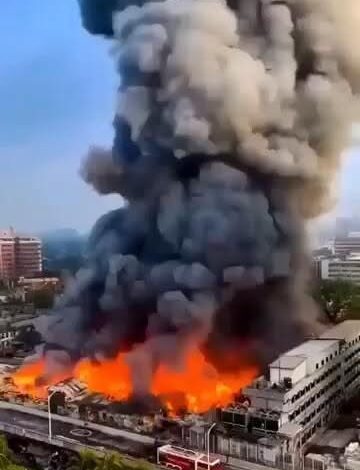
The ground began to shake without warning.
Within seconds, communities along the China–Myanmar border were thrown into panic as a powerful 7.7-magnitude earthquake tore through the region. Buildings trembled, roads split open, and homes that had sheltered families for generations collapsed into rubble. People rushed into the streets, searching for safety while calling out for relatives, neighbors, and friends amid the confusion.
In the moments after the quake, fear gave way to urgency.
Now, as the immediate shock begins to settle, the region faces a new and difficult reality: survival has turned into recovery. Rebuilding lives, restoring services, and helping displaced families will take time, resources, and extraordinary determination.
Across the affected areas, daily life has been replaced by scenes of destruction. Streets once filled with markets, schoolchildren, workers, and family gatherings now carry the marks of disaster. Emergency shelters have appeared where homes once stood, and rescue teams continue moving through damaged neighborhoods where unstable buildings and debris make every step dangerous.
For many families, uncertainty remains one of the hardest burdens.
Some are still searching for loved ones. Others are waiting to learn whether their homes can be saved or whether they must begin again from nothing. Each hour brings new reports, new assessments, and a clearer picture of the earthquake’s devastating impact.
Authorities in both China and Myanmar moved quickly after the disaster, launching large-scale emergency operations. Search-and-rescue crews were sent into damaged areas to look for survivors trapped beneath collapsed structures. Medical teams set up emergency treatment sites to care for the injured, while local officials worked to arrange evacuations and temporary housing for those forced from their homes.
The size of the response reflects the seriousness of the crisis.
Engineers have begun inspecting bridges, roads, hospitals, power stations, and communication systems to determine what remains safe and what must be repaired immediately. These evaluations are critical, especially in areas where aftershocks continue to create danger.
For rescue workers, the conditions are exhausting and unpredictable. Damaged buildings can shift without warning. Roads may be blocked or unstable. Communication gaps can slow coordination. Yet teams continue working through the risk, driven by the hope of finding survivors and bringing help to communities in need.
Humanitarian organizations are also mobilizing to support thousands of displaced residents. Food, clean drinking water, medical supplies, blankets, emergency equipment, and temporary shelters are being prepared and transported to impacted areas.
Reaching remote mountainous communities has become one of the greatest challenges. In some places, damaged roads and difficult terrain have slowed the delivery of aid. Restoring transportation routes is now a major priority, because every repaired road or bridge can mean faster access to food, medicine, and rescue support.
Communication networks are also being repaired as quickly as possible. For families separated during the earthquake, reconnecting phone lines and information systems can bring desperately needed answers. Reliable communication also helps officials deliver accurate updates and coordinate relief efforts more effectively.
Even amid the destruction, moments of hope have emerged.
Rescue teams have reported pulling survivors from damaged buildings, offering brief but powerful reminders that life can still be found beneath the wreckage. Families separated in the chaos have been reunited after hours of fear and uncertainty. Each reunion has become a symbol of endurance in the middle of tragedy.
Utility crews have started restoring electricity, water, and communication services in some affected areas. Progress may be slow, but each restored service matters. A working power line, a reopened road, or a functioning water supply can bring a sense of stability to people who have lost nearly everything.
Still, the road ahead will be long.
Thousands of families now face the painful task of rebuilding homes, businesses, schools, and community spaces. Many have lost belongings gathered over a lifetime. Others must wait for decisions about where and how rebuilding can safely begin.
The economic impact may continue long after the emergency phase ends. Local businesses have been disrupted. Public infrastructure has been damaged. Entire communities will need support not only for days or weeks, but potentially for months or years.
Recovering from an earthquake of this scale is never simple. It requires more than clearing debris and repairing buildings. It requires emotional healing, financial assistance, long-term planning, and safer construction for the future.
For that reason, officials and aid groups are already looking beyond immediate relief. The goal is not only to replace what was destroyed, but to help communities become stronger and more prepared for future disasters.
Collaboration has become essential.
Government agencies, emergency responders, volunteers, nonprofit organizations, medical workers, engineers, and local residents are working together to meet urgent needs while laying the foundation for recovery. Their efforts show that rebuilding after disaster depends not only on supplies and equipment, but also on unity, patience, and shared commitment.
As rescue operations continue and damage assessments expand, the priorities remain clear.
Protect lives.
Support survivors.
Restore critical services.
Reach isolated communities.
Help families begin again.
The earthquake has left deep scars across the China–Myanmar border region. It has shaken homes, disrupted communities, and changed countless lives. But it has also revealed the strength of the people affected and the determination of those working to help them recover.
Neighbors are helping neighbors.
Rescue workers are risking their own safety.
Aid teams are pushing supplies into hard-to-reach areas.
Families are holding on to hope even while facing tremendous loss.
The months ahead will bring difficult challenges. There will be setbacks, delays, and painful decisions. But there will also be rebuilding, healing, and renewal.
The damage caused by the earthquake may remain visible for years, but so will the courage shown in its aftermath.
As communities along the China–Myanmar border begin the long process of recovery, one truth is already clear: the force of the earthquake was powerful, but the resolve of the people determined to rebuild is stronger.