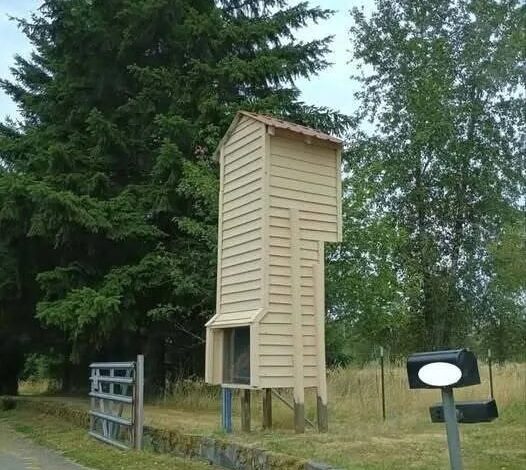
Strangers slam their brakes when they see it. A skinny beige tower, fifteen feet tall, stands at the edge of a quiet driveway, commanding attention with an almost imperceptible authority. Its wooden frame, streaked by decades of sun, rain, and snow, seems almost alive—weathered but unbowed, patient yet alert. There are no wires snaking down its sides, no blinking cameras, no glossy logos announcing a company, a product, or a purpose. Just wood, glass, and the quiet certainty of a mind that once looked at a dangerous curve and refused to wait for tragedy to strike. Drivers slow instinctively, not because the structure demands their respect, but because it radiates a clarity that cannot be ignored: something here exists to save lives.
At first glance, the tower could be dismissed as a roadside oddity—a hobbyist’s abandoned project, a sculptural quirk, a piece of folk art. But the closer you look, the more its purpose crystallizes. The driveway periscope, as locals have come to call it, does not ping satellites or collect data. It does not feed a corporate analytics dashboard. It does not promise the bells and whistles of modern safety technology. And yet, it performs a feat far more crucial than any sensor-laden system: it allows a driver to see around a blind corner, to anticipate danger before it becomes catastrophe. Two angled mirrors, a pane of polished glass, a wooden tower, and nothing more save for careful thought—this is the sum of what keeps lives from ending too soon on that quiet street.
The genius lies in its elegant simplicity. Anyone who has navigated a blind corner knows the tension: the fraction of a second when a collision could occur, the anxiety of pulling out only to meet an unseen vehicle barreling forward. Modern solutions often rely on software, sensors, or networked alerts—systems promising convenience while replacing human judgment with complexity, cost, and fragility. But here, someone asked a fundamentally different question: “How can I make it safe using what I have on hand?” The answer was beautiful in its minimalism: lift your eyes, reflect the light, give drivers a glimpse of the unseen. No screens, no alarms, no subscriptions. Just clarity.
Over the years, the tower has weathered more than storms. It has endured ice, high winds, and the sun’s relentless glare. Its paint peels at the edges, the mirrors fog in damp mornings, yet the structure persists. It is a lesson in durability that transcends engineering: effective solutions do not always require wealth, patents, or corporate oversight. They thrive on observation, empathy, and the simple human refusal to accept unnecessary risk. It asks nothing in return—no applause, no news story, no viral moment. Its reward is quiet: the preservation of life.
The human story behind it is equally remarkable. Picture a person standing at that treacherous driveway, weighing worst-case scenarios in their mind, and deciding that a solution is within reach. With a few boards, reflective glass, and an open mind willing to experiment, fear was transformed into action. There were no investors, no business plan, no demonstration for approval—just a problem and the ingenuity to solve it. In a culture that celebrates constant upgrades, cloud apps, and smart devices, the driveway periscope is a meditation on the enduring power of practical, understandable technology.
What makes it unforgettable is not its design, but its philosophy. It embodies an idea older than any modern gadget: clarity of thought, combined with human initiative, can be mightier than the flashiest machine. For the drivers who approach that curve, the tower is invisible until it matters. And yet, it is always there, patiently waiting, quietly vigilant, a testament to the enduring value of foresight and care.
It is more than a structure—it is a narrative of courage and thoughtfulness, a reminder that the simplest interventions often carry the greatest impact. And in that, it teaches an enduring lesson: sometimes the most profound solutions are the ones you can build with your own two hands, guided by attention, empathy, and the desire to protect what matters most.