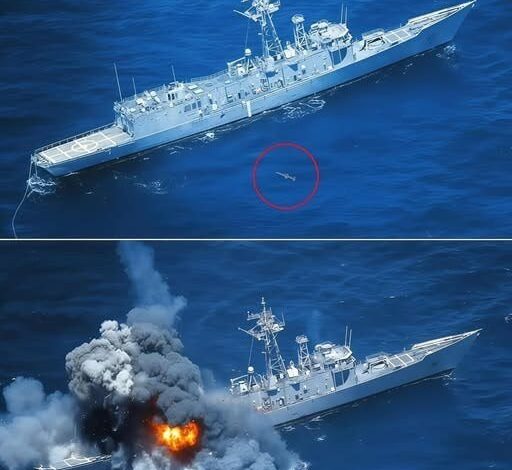
The life of the USS Rodney M. Davis (FFG-60) traces the familiar but powerful arc of many naval vessels: conceived in an era of global tension, forged for deterrence and defense, and ultimately retired in a manner that continued to serve the fleet. When the guided-missile frigate was deliberately sunk during a naval Sinking Exercise—known as a SINKEX—it was not the end of a war story, but the conclusion of a carefully planned final assignment. Struck by an AGM-84 Harpoon anti-ship missile—the very type of weapon the ship had once been equipped to fire—the event was a controlled operation designed to gather critical data on ship survivability and weapons performance.
To appreciate the symbolism of that moment, it helps to return to the ship’s beginnings. Commissioned in 1982, Rodney M. Davis was part of the Oliver Hazard Perry-class frigates, a backbone of U.S. naval operations during the latter half of the Cold War. These ships were engineered as versatile and cost-efficient escorts, capable of anti-submarine warfare, surface defense, and convoy protection. In an era defined by submarine threats and strategic maritime competition, Perry-class frigates were tasked with safeguarding carrier strike groups and ensuring open sea lanes.
The ship carried a name steeped in valor. Sergeant Rodney Maxwell Davis of the U.S. Marine Corps received the Medal of Honor posthumously for his actions in Vietnam in 1967, when he sacrificed his life by shielding fellow Marines from a grenade blast. The frigate bearing his name sailed with that legacy—one of courage and selflessness—embedded in its identity.
Over more than three decades of service, Rodney M. Davis operated across multiple theaters. She participated in maritime security missions, counter-narcotics patrols in the Eastern Pacific, multinational exercises in the Western Pacific, and sustained deployments in the Indian Ocean. Like many ships of her class, she became a familiar presence in global waters, a floating extension of U.S. diplomacy and deterrence.
By the mid-2010s, however, the Navy’s strategic priorities were evolving. Advances in naval warfare, including new sensor systems, modular ship designs, and updated combat platforms, gradually rendered the aging Perry-class less central to future fleet architecture. In early 2015, Rodney M. Davis was decommissioned at Naval Station Everett in Washington state. For some ships, retirement leads to storage or dismantling. In this case, the Navy chose a different path—one that would yield valuable operational insights.
Preparing a decommissioned vessel for a SINKEX involves extensive environmental and technical procedures. Before deployment to the test site, the ship underwent a comprehensive remediation process. Hazardous materials such as residual fuels, PCBs, asbestos, and heavy metals were removed in accordance with federal environmental regulations. Sensitive communications and weapons systems were extracted. What remained was a structurally intact hull, stripped of contaminants and classified equipment, ready to serve as a controlled test platform.
During the exercise, naval forces launched a Harpoon missile against the vessel under carefully monitored conditions. The purpose was not spectacle, but data. Engineers and analysts collected information through sensors, imaging systems, and structural monitoring tools to study how the hull responded to modern anti-ship munitions. Such testing informs future ship design—improving bulkhead reinforcement, damage control systems, and survivability features for current and next-generation surface combatants.
For sailors who once served aboard Rodney M. Davis, the sinking represented a complex farewell. A warship is more than steel and wiring; it is a workplace, a living space, and often a formative chapter in a sailor’s life. Crews share deployments, long watches, and milestones at sea. Watching the vessel disappear beneath the water can feel like closing a deeply personal chapter. Yet many veterans expressed pride that the ship’s final role continued to support naval readiness rather than ending quietly in dismantlement.
The vessel now rests in deep water, where its structure will gradually integrate into the marine environment. Over time, decommissioned ships sunk in approved zones often become artificial reefs, supporting marine ecosystems. While that ecological transformation is secondary to the exercise’s military purpose, it underscores the layered nature of a ship’s legacy.
The story of Rodney M. Davis reflects the Navy’s ongoing cycle of modernization. As new classes of ships enter service, older platforms yield lessons that shape future designs. Data gathered during live-fire exercises helps refine defensive systems and strengthen fleet resilience. In that sense, the frigate’s service extended beyond her active years.
Named for a Marine who embodied sacrifice, the ship concluded her career in a way consistent with that heritage—contributing to the safety and preparedness of those who will sail in the decades ahead. Though she now lies beneath the ocean’s surface, the operational knowledge gained from her final mission continues to influence naval engineering and strategy.