A slow, winding story about something small, familiar, and often misunderstood, told with patience, memory, and a few surprises along the way for anyone who has ever paused mid-bite and wondered what quiet forces might be at work

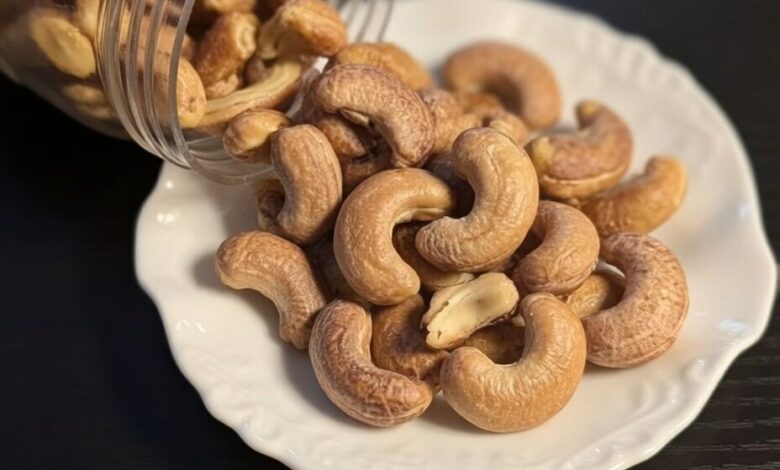
The sentence usually appears without warning on a phone screen, tucked between selfies, recipe links, and breaking news alerts:
“Doctors reveal that eating cashews causes…”
And then it stops. No conclusion. Just a dangling thought, a tease, an open invitation to worry.
It is a tiny thing—a fragment—but it lingers. It follows people through the day, hovering at the edge of attention while tea cools, while the evening news hums, while the mind wanders. It touches something familiar, especially for those who remember when food was discussed in kitchens, not headlines, when meals were shared without footnotes, and every ingredient did not come with a warning label.
Cashews are not strangers. They sit in bowls at family gatherings, tucked into holiday tins, folded into recipes that have been handed down for decades. They are ordinary, familiar, comforting. That is why the suggestion feels unsettling. Not because it is specific, but because it is vague. Something so familiar might secretly be dangerous? That small crack of doubt presses against a lifetime of experience.
So let’s slow down. Let’s finish the sentence carefully, honestly, without hype.
Cashews do not cause sudden illness. They do not poison silently. They are not a “hidden killer,” and no reputable doctor is issuing fear-driven warnings.
What cashews do cause—if anything—is subtle. Mostly positive. And occasionally, a few situations that deserve awareness rather than alarm.
Cashews are seeds, not true nuts, growing from a fruit that looks almost whimsical, as if nature allowed itself a moment of humor. Long before nutrition labels or viral headlines, they were valued simply for sustaining people—easy to store, easy to travel with, providing energy when other foods were scarce. In many cultures, they were considered strengthening food, eaten with gratitude, not suspicion.
Modern science still agrees on this: cashews are packed with healthy fats that support the heart, minerals like magnesium that soothe muscles and nerves, and copper and zinc that bolster immunity and connective tissue. These benefits work quietly, subtly, supporting the body over time. For older adults especially, these nutrients matter more than ever.
Here is where headlines twist the story. Cashews are calorie-dense. A handful carries more energy than it seems. Eating mindlessly, especially while distracted, can contribute to gradual weight gain. They also contain compounds that can cause mild digestive discomfort if overconsumed—bloating, heaviness, occasional gas. These are signals, not dangers.
For people with kidney conditions, potassium and oxalate content may require moderation. Allergies exist, and they can be serious—but they are visible and early, not secretive or delayed.
So what do cashews “cause”?
They cause satiety—the contented feeling of stepping away from the table.
They cause steady energy, avoiding sudden sugar crashes.
They cause flavor memories, moments connected to holidays, kitchens, loved ones.
What they do not cause is sudden harm in healthy people eating reasonable amounts.
The unfinished headline relies on a very old trick: letting fear complete the sentence. Without an ending, the mind fills in the worst possibilities. But the reality is far simpler: moderation, mindfulness, and context are enough. Doctors would say, “Cashews are healthy when eaten thoughtfully, like most foods.”
That statement travels poorly on social media. It does not provoke clicks or arguments. But it is the truth that lasts.
Food panics come and go. Butter, eggs, coffee—they all cycled between suspicion and forgiveness. The body is resilient, far more capable of balance than headlines suggest. Cashews are simply having their moment in the spotlight.
What matters more than a single ingredient is the rhythm of eating itself: meals savored slowly, portions tuned to hunger, foods enjoyed without fear. These habits shape health far more than any single handful.
When every food is framed as a threat, meals become anxious events. Pleasure becomes calculation. Cashews quietly remind us of a different way: nourishment, flavor, satisfaction, without obsession or alarm.
So the next time that fragment appears—unfinished, dangling, meant to provoke—remember this:
Food rarely betrays us suddenly. When it causes trouble, it does so gently, over time, with clear signals. Listen. Observe. Enjoy.
A small handful.
A moment of pleasure.
No fear required.
And perhaps that is the real ending to the sentence no one bothers to write.