It was never meant to be a weapon, but anyone who had used one knew it was never exactly harmless either.
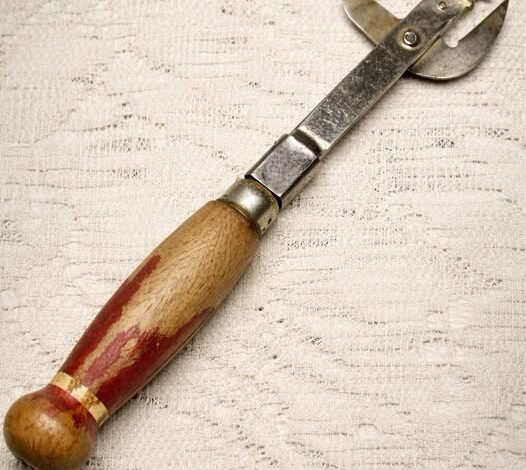
The strange metal object people jokingly call the “murder tool” from grandma’s drawer was, in reality, an old puncture-style can opener—a rough, stubborn kitchen relic from a time when even preparing dinner required a little courage. It did not glide smoothly around a lid the way modern openers do. It did not come with padded handles, safety wheels, clean edges, or gentle mechanics. It was built to stab, pierce, lever, and pry.
To use it, you had to force sharp steel into steel.
That was the whole design.
You pressed the pointed tip against the lid of a can, leaned your weight into it, and trusted your hand not to slip. Once the metal gave way, you worked the opener around the edge in short, jagged movements, tearing the lid open one bite at a time. The result was rarely neat. The lid curled back in sharp, dangerous ridges, and the can itself often looked as though it had survived a small battle.
For people who grew up seeing one in the kitchen drawer, the object carries a strange mix of nostalgia and dread. It reminds them of family kitchens, pantry shelves, soup cans, camping trips, and grandparents who seemed able to use dangerous tools with casual confidence. But it also recalls scraped knuckles, sliced fingers, and the tense moment when the tool suddenly slipped free.
That is why so many people react strongly when they see one again online. Recognition comes first, then laughter, then the uncomfortable memory of how unforgiving everyday tools used to be. The object feels almost absurd now, as if it belongs in both a kitchen drawer and a crime scene evidence bag. Yet for previous generations, it was ordinary.
That ordinariness is what makes it interesting.
The old puncture-style can opener is a reminder of an era when domestic life was filled with small, accepted dangers. Kitchens were not designed with the same obsession for safety and ease that many people expect today. Tools were practical, direct, and often unforgiving. They did the job, but they demanded attention, strength, and respect.
A dull knife was still used because it was the knife available. A mandoline might slice vegetables beautifully, even if it offered little protection for the fingers guiding them. Cast-iron pans burned hands. Gas flames flared. Pressure cookers rattled ominously on stovetops. Glass jars broke. Meat grinders clamped to counters. Heavy appliances had exposed parts, sharp edges, and cords that frayed with age.
Danger lived in plain sight, but because it was familiar, people stopped noticing it.
That was the quiet truth exposed by the sudden fascination with the old can opener. It was not just about one odd-looking kitchen tool. It was about the way past generations moved through risk as part of daily routine. They did not necessarily think of themselves as brave. They were simply doing what needed to be done with the tools they had.
Opening a can was not a dramatic act. It was dinner.
And yet, looking back, it is hard not to see how much trust those tools demanded. They trusted the user’s grip. They trusted balance, pressure, and timing. They trusted people to know where to place their fingers and when to pull back. A moment of distraction could mean blood on the counter before the meal had even begun.
Modern kitchen tools are often designed to remove that uncertainty. Handles are softer. Blades are guarded. Electric openers do the work with the push of a button. Smooth-edge can openers cut cleanly without leaving jagged metal behind. Packaging is engineered for convenience. Instructions are clearer. Safety warnings are everywhere.
That progress is easy to take for granted.
But objects like the old puncture opener remind us that convenience was built slowly, often through years of trial, injury, complaint, and redesign. The safer tools we use today did not appear out of nowhere. They were shaped by countless small accidents, frustrations, and practical improvements. In that sense, the rusted opener is not just a relic. It is evidence of how everyday life changes.
It also reveals something about how nostalgia works.
People often look back on older times with affection. They remember grandma’s kitchen, the smell of soup warming on the stove, the sound of drawers opening and closing, the sight of strong hands making difficult tasks look easy. Those memories are real and meaningful. But nostalgia can soften sharp edges, both literally and figuratively.
The past may have felt simpler in some ways, but it was not always gentler.
The old can opener captures that contradiction perfectly. It can make people laugh because it looks so aggressive compared to modern tools. It can make people sentimental because it belonged to kitchens filled with family history. And it can make people uneasy because it shows how much danger used to be accepted without much discussion.
There is also a kind of pride attached to it. Many people remember parents or grandparents using these tools with effortless skill. They could open cans, chop vegetables, knead dough, sharpen knives, fry food, preserve fruit, and repair half the things in the house without complaint. Their kitchens were places of labor, not just comfort. Food did not simply appear. It was worked into being.
The “murder tool” nickname is funny because it exaggerates the threat, but the joke works only because the threat is recognizable. Everyone understands that the object looks a little too sharp, a little too primitive, a little too eager to punish careless hands.
And yet, it served its purpose.
That is why it remains fascinating. It represents a practical world that cared less about user experience and more about whether something worked. It was not beautiful in the modern sense. It was not gentle. It did not ask for comfort. It asked for effort.
In many homes, tools like that lasted for decades. They were tossed into drawers, taken on camping trips, used during storms when electricity failed, and passed down without ceremony. They were not treasured heirlooms at the time. They were simply part of the machinery of daily life.
Only later, when replaced by safer and smoother designs, did they become symbolic.
Now, when someone finds one in an old drawer, it feels like discovering a small artifact from another way of living. It tells a story about toughness, necessity, and the hidden hazards of ordinary work. It reminds us that domestic labor has always required skill, even when that skill went unnoticed. It reminds us that kitchens were workplaces long before they became design showcases.
It also reminds us how casually previous generations accepted pain as part of getting things done.
A nicked finger was annoying, not surprising. A burn was part of cooking. A cut from a can lid was treated, wrapped, and moved past. The work continued because it had to. Meals still needed to be made. Families still needed to be fed. The tools were imperfect, but life did not pause for better ones.
There is something humbling in that.
The old opener may look alarming now, but it belonged to people who understood that daily life often required a certain amount of grit. Their tools were rough because their routines were demanding. Their kitchens were full of quiet risks because safety had not yet been engineered into every surface, handle, and blade.
Today, we can be grateful for better designs. We can appreciate smooth edges, ergonomic grips, safer mechanisms, and tools that protect us from the mistakes people once simply endured. But we can also look at that strange little opener and recognize the history it carries.
It is a reminder that progress often hides in the most ordinary places.
Not every invention changes the world loudly. Some changes happen in drawers, on countertops, and in the small adjustments that make daily tasks less dangerous. A safer can opener may not seem revolutionary, but to every hand spared from a jagged lid, it matters.
So the next time that old “murder tool” appears in a photo, a thrift store bin, or the back of a family kitchen drawer, it is worth seeing it for what it really is.
Not a weapon.
Not just a joke.
Not merely a piece of outdated metal.
It is a relic of a tougher domestic world, one where convenience was limited, safety was not guaranteed, and ordinary people learned to handle sharp things with steady hands. It carries the memory of meals made, fingers cut, families fed, and tools slowly improved through generations of use.
It may have opened cans.
But now, it opens something else too: a small window into how much everyday life has changed, and how much hidden labor and risk once lived behind even the simplest meal.