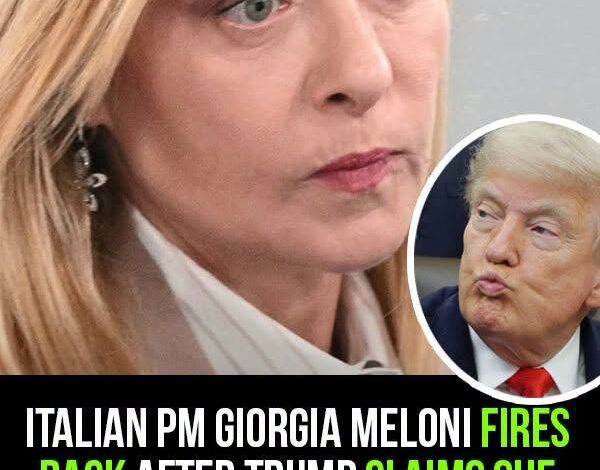
What first appeared to be a petty quarrel over a single G7 photograph has now revealed something far more serious: the relationship between Washington and Rome is no longer merely strained, but deeply poisoned. Giorgia Meloni’s angry denial — “Italy and I never beg” — was not simply a defensive response to an embarrassing public slight. It was a statement of national dignity, aimed at pushing back against the image of Italy as a subordinate partner pleading for approval from Washington.
For Meloni, the controversy seems to have touched a much deeper nerve. She has increasingly appeared frustrated by an ally who, in theory, should be among her closest ideological partners, yet has repeatedly treated her government with suspicion, impatience, and public contempt. Trump’s remarks did not land as an isolated insult. They were interpreted in Rome as part of a broader pattern: a president willing to flatter adversaries and strongmen abroad, while reserving some of his harshest language for democratic allies who refuse to fall fully in line.
That is why Italy’s reaction escalated so quickly. When the Italian foreign minister canceled his planned visit to the United States and described Trump’s comments as an insult to the entire country, the dispute moved beyond personality politics. It was no longer just a social-media argument or a passing diplomatic embarrassment. It became a visible rupture between two governments that were supposed to be on the same side of the Atlantic alliance.
Beneath the drama of the photograph lies months of accumulated resentment. Italy’s refusal to support Trump’s bombing campaign against Iran had already created tension, exposing major differences over military strategy and the limits of Western intervention. The dispute over a key air base in Sicily added another layer of mistrust, turning a strategic security issue into a test of sovereignty and respect. Even the strange argument over the Pope’s moral authority became part of the larger breakdown, showing how political, military, and symbolic disputes had begun to overlap.
Each of these episodes has chipped away at the foundation of trust between the two capitals. What might once have been handled quietly through diplomatic channels has instead spilled into public view, feeding nationalist anger on both sides. For Meloni, backing down would risk making her look weak at home. For Trump, admitting fault would undermine the dominant image he tries to project in foreign affairs. As a result, both leaders appear locked into a confrontation where compromise becomes harder with every public statement.
The photograph, then, is not really the cause of the crisis. It is the symbol of it. A single image has come to represent a much larger power struggle between two right-wing leaders who share some ideological instincts but differ sharply over loyalty, hierarchy, and national pride. What began as an argument over appearances has exposed a deeper question: whether the alliance between the United States and Italy can survive when personal humiliation, strategic disagreement, and political ego all collide at once.
In the end, this is about more than Trump and Meloni. It is about the fragility of alliances when trust disappears. The Washington-Rome relationship now appears caught between resentment and necessity, with both sides aware that they need each other but increasingly unwilling to treat each other as equals. Unless the two governments find a way to contain the damage, a dispute born from one photograph could become a lasting fracture inside the Western alliance.