I Did the Right Thing After Finding a Lost Wallet — and the Knock on My Door the Next Morning Changed Everything

I thought returning a lost wallet would be the end of the story.
I was wrong.
It was late on a cold Thursday night when I found it, long after the last customer had left my mechanic shop and the streetlights outside had started flickering over the cracked pavement. My shop was the kind of place people drove past unless they had no other choice. The sign was faded, the waiting room smelled faintly of oil and old coffee, and the heater worked only when it felt like it. But it was mine, and every day I fought to keep it open.
That night, I was exhausted.
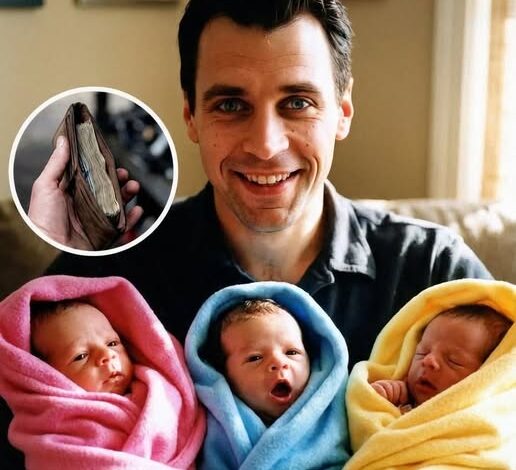
My hands were stained with grease, my back ached from bending under cars all day, and my mind was already counting bills I did not know how to pay. Rent was due. The electric company had sent another warning. The fridge at home was nearly empty. And my three six-year-olds needed winter coats I had been putting off buying because every dollar seemed to disappear before I could decide where it belonged.
Being a single dad to triplets had taught me how to stretch almost everything: groceries, gas, patience, sleep. But lately, even stretching was not enough.
Their mother had left two years earlier. No long explanation. No dramatic goodbye. Just a note, a suitcase, and a silence that followed us everywhere. Since then, it had been me, my elderly mother, and three little kids who still asked questions I could not always answer.
“Why can’t we get the cereal with marshmallows?”
“Why does Grandma have to sleep on the couch?”
“Why do you always look tired, Daddy?”
I always smiled and told them we were fine.
But that night, standing alone in the shop, I was not fine.
I was sweeping under one of the lifts when the broom hit something soft. At first, I thought it was an old rag or one of the gloves customers were always leaving behind. But when I bent down, I saw a brown leather wallet wedged near the base of the lift.
It was thick.
Too thick.
I picked it up and opened it, mostly to check for a driver’s license so I could call whoever had lost it. But the moment I saw the cash inside, my breath caught.
Hundreds.
Then more hundreds.
There was more money in that wallet than I had held in my hands in years.
For a few seconds, I just stood there staring at it.
I wish I could say I never thought about keeping it. I wish I could say the decision was instant, clean, and heroic. But the truth is, temptation hit me hard. That money could have paid the rent. It could have kept the lights on. It could have bought coats, groceries, medicine for my mother, new shoes for the kids, and maybe even a few small Christmas gifts so they would not have to pretend they were happy with dollar-store puzzles again.
No one was there.
No cameras pointed at that corner of the shop.
No one would know.
That was the thought that scared me most.
Because for one tired, desperate moment, I understood how easy it would be to convince myself that need made wrong things right.
Then I looked at the ID.
The wallet belonged to an older man named Harold Whitaker. Tucked behind his license was a small photo of him with a woman who looked like she might have been his wife. Behind that was a folded receipt from a pharmacy, a Medicare card, and a handwritten note listing amounts next to words like “heat,” “meds,” and “property tax.”
This was not extra money.
This was survival money.
Maybe rent. Maybe medicine. Maybe the savings of someone who had worked his whole life and now had to count every dollar the way I did.
My grip tightened around the wallet.
I closed my eyes and thought of my kids.
Not just their empty lunchboxes or worn-out coats, but their faces. Their trust. The way they watched me without realizing they were learning from everything I did. I thought about what kind of man I wanted them to believe their father was, even when life was unfair.
Especially when life was unfair.
So I locked up the shop, climbed into my old truck, and drove to the address on the license.
The house was small and dark except for one porch light. When I knocked, it took a long time for anyone to answer. Finally, the door opened a few inches, and Harold Whitaker peered out at me with tired, worried eyes.
“Mr. Whitaker?” I asked.
He nodded cautiously.
“I found something of yours at my shop.”
When I handed him the wallet, his face changed.
He opened it with trembling hands, counted just enough to know the money was still there, and then sank into the chair beside the door as if his legs had given out.
“Oh, thank God,” he whispered.
His voice broke on the last word.
He told me the money was part of his pension savings. He had withdrawn it to pay several overdue bills and help cover medication. He thought he had lost it for good. He had already spent the evening searching his house, his car, and every place he remembered going.
“You have no idea what this means,” he said.
I shrugged, uncomfortable with gratitude.
“I’m just glad I found it.”
He tried to give me a reward. I refused.
He insisted. I refused again.
Finally, he looked at me for a long moment and asked, “You have children?”
“Three,” I said. “Triplets.”
For the first time that night, he smiled.
“Then they have a good father.”
I did not know what to say to that, so I simply nodded, wished him well, and went home.
By the time I got back, the kids were asleep in a tangle of blankets in the room they shared. My mother was dozing in the chair with the television still on low. I stood in the doorway and watched my children breathe, one small body rising and falling beside another, and told myself I had done the right thing.
Even if nothing changed.
Even if the bills were still waiting.
Even if the fridge was still nearly empty.
I had done the right thing.
The next morning, a knock thundered through the house.
It was early. Too early for visitors. My mother looked up from the kitchen table, startled. The kids were still in pajamas, eating toast I had cut into triangles to make it seem like more than it was.
When I opened the door, a sheriff stood on my porch.
My stomach dropped.
Behind him were two patrol cars and several deputies.
My first thought was not about myself. It was about my children sitting behind me, their mouths sticky with jelly, their eyes wide with fear.
“Is something wrong?” I asked, stepping outside and pulling the door mostly closed behind me.
The sheriff looked at me, then removed his hat.
“Are you Daniel Miller?”
“Yes.”
“You returned a wallet last night to Harold Whitaker.”
My heart pounded.
“Yes,” I said slowly. “Did something happen?”
The sheriff’s expression softened.
“He’s my father.”
For a moment, I could not speak.
The sheriff glanced toward the house, where my kids were peeking through the curtain.
“My dad told me everything,” he said. “He told me you drove across town after closing your shop. He told me every dollar was still inside. He told me you refused a reward. And he told me you’re raising three children on your own.”
Heat rose to my face.
“I didn’t do it for attention,” I said.
“I know,” he replied. “That’s exactly why we’re here.”
He turned and nodded toward the deputies.
One by one, they began unloading boxes from the patrol cars.
At first, I did not understand what I was seeing.
Then I saw labels.
Winter coats.
Children’s boots.
School supplies.
Groceries.
Diapers and wipes, even though my kids were past that age. Cleaning supplies. Blankets. Gift cards. Cereal. Canned food. Fresh fruit. Laundry detergent. Backpacks. Art supplies. A few toys. Envelopes from local businesses. A prepaid card for utilities. A voucher from the pharmacy. Another from the grocery store.
I stood frozen as the boxes kept coming.
My mother opened the door fully, one hand pressed to her chest. The kids came running out onto the porch, staring as if Christmas had arrived in police cars.
“What is all this?” I whispered.
The sheriff looked me straight in the eye.
“My father made some calls. So did I. Word got around. People wanted to help.”
I shook my head, overwhelmed.
“I can’t accept all this.”
“Yes,” he said gently. “You can.”
I looked at the boxes filling my small living room, then at my children, who were touching the new coats as though they were afraid someone might take them away.
The sheriff stepped closer.
“You gave my father back his dignity last night,” he said. “You gave him back his peace. You reminded a lot of us what honesty looks like when it actually costs something. Let people return a little of that.”
That was when I broke.
Not loudly. Not dramatically. I just sat down on the edge of the couch, put my face in my hands, and cried for the first time in months.
I cried because I was tired.
I cried because I had been pretending I was not scared.
I cried because I had convinced myself that being a father meant never needing help.
And I cried because, for once, help had come before everything completely fell apart.
My three kids climbed onto the couch around me. One leaned against my shoulder. One wrapped both arms around my neck. The smallest, Lily, wiped my cheek with her sleeve and whispered, “Daddy, why are the police giving us cereal?”
Everyone laughed then, even me.
The sheriff stayed for a while. So did the deputies. They helped carry boxes into the kitchen, stacked supplies in the hallway, and made sure the kids each tried on a coat. My mother hugged the sheriff so tightly that he looked surprised at first, then hugged her back.
Before he left, he handed me one final envelope.
Inside was a note from Harold.
It said:
“Daniel, you returned what I thought I had lost. Not just my wallet, but my faith that good people are still out there. Please accept this help, not as charity, but as gratitude. Your children should know what their father did. They should know that honesty can still change lives.”
I read the note three times.
That evening, after the deputies were gone and the house was quiet, I sat with my kids on the floor surrounded by boxes. We sorted school supplies, folded coats, and made a dinner that included more than whatever I could stretch from the pantry. For the first time in a long time, I watched them eat without silently calculating how many meals were left.
Then I told them the story.
I told them about the wallet. About the money. About the temptation. About Mr. Whitaker and why the money mattered to him. I told them that doing the right thing is not always easy, especially when you need something badly. But needing something does not make it yours.
My son Noah asked, “But if nobody saw you, how would anybody know?”
I tapped his chest gently.
“You would know.”
He looked down, thinking.
“And I would know,” I said. “That matters.”
For a long moment, none of them said anything.
Then Lily asked, “So being good made the cereal come?”
I smiled.
“No, sweetheart. Being good does not always make things easy. Sometimes you do the right thing and nobody notices. Sometimes nothing comes back at all.”
She frowned.
“Then why do it?”
I looked at the three of them, sitting cross-legged in pajamas, surrounded by proof that kindness can travel farther than we expect.
“Because it tells you who you are,” I said. “And once you know that, no hard day can take it away from you.”
Years from now, my children may not remember every box that came through our door that morning. They may forget the sheriff’s name or the exact color of the coats they received. They may not remember how empty the cupboards had been the night before.
But I hope they remember the lesson.
I hope they remember that their father found a wallet full of money when he desperately needed money and chose to return it anyway. I hope they remember that integrity is not about what you do when life is comfortable. It is about what you do when life has backed you into a corner and no one is watching.
I thought returning that wallet would be the end of the story.
But it became the beginning of something else.
It became the day my children saw that honesty still matters. It became the day I learned that accepting help does not make you weak. It became the day a stranger’s gratitude reminded me that even in a hard world, goodness still has a way of finding its way back.
Not always.
Not predictably.
Not because we are owed anything.
But sometimes, when we need it most, kindness circles back through unexpected hands.
And when it does, it can change everything.